# Qingming Festival: Honoring Ancestors with Peace Talismans in Taoist Tradition
Qingming Festival — often translated as *Pure Brightness* or *Tomb-Sweeping Day* — is one of the most solemn and spiritually resonant observances in the Chinese cultural calendar. Falling on the 15th day after the Spring Equinox (typically April 4–6), Qingming marks a time when families gather to tend ancestral graves, offer incense and food, and reaffirm bonds across generations. Rooted in over 2,500 years of agrarian and philosophical tradition, Qingming is not merely a ritual of remembrance — it is an embodied practice of harmony, filial piety (*xiao*, 孝), and cosmic balance. Within the Zhengyi Daoist tradition — particularly as preserved at Mt. Longhu (龙虎山), the sacred seat of the Celestial Masters — Qingming carries deep liturgical significance. Here, the quiet reverence of tomb-sweeping converges with consecrated practices such as the use of *peace talismans*, which serve as tangible expressions of intention, respect, and spiritual continuity. This article offers a respectful, historically grounded guide to Qingming Festival through the lens of authentic Taoist culture — exploring its origins, evolving customs, symbolic meanings, and how traditional items like consecrated talismans support meaningful participation in this sacred season.
—
## What Is Qingming Festival? A Historical and Cultural Overview
Qingming traces its origins to the Zhou Dynasty (c. 1046–256 BCE), emerging from the ancient Cold Food Festival (*Hanshi Jie*, 寒食节), which commemorated the loyal retainer Jie Zitui. According to legend, after Jie refused rewards from Duke Wen of Jin and withdrew into seclusion, the duke ordered a mountain forest burned to force him out — only to find Jie and his mother perished in the flames. In remorse, the duke declared a day of fire prohibition and cold food — later absorbed into Qingming’s broader observance.
By the Tang Dynasty (618–907 CE), Qingming had evolved into an official state festival, codified in the *Tang Liuchao* (Six Codes of the Tang). It was formally recognized as one of the Twenty-Four Solar Terms — marking the moment when yang energy ascends, skies clear, and nature reawakens. The term *Qingming* itself reflects this dual clarity: *qing* (清) meaning “pure” or “clear,” and *ming* (明) meaning “bright” — signifying both atmospheric brightness and moral lucidity.
Unlike festivals centered on celebration or deities, Qingming is fundamentally *relational*. Its core practice — grave-tending — is an act of *qi* (vital energy) cultivation: clearing physical overgrowth mirrors clearing emotional stagnation; offering fresh tea and seasonal foods nourishes both memory and metaphysical connection. As scholar Patricia B. Ebrey notes in *Chinese Civilization: A Sourcebook*, “Ancestor veneration in China is less about worship than about sustaining relationship — a reciprocal flow of care that spans lifetimes.”
In Taoist cosmology, this reciprocity aligns with the principle of *gan-ying* (感應): resonance between human conduct and cosmic response. When performed with sincerity and ritual precision, Qingming rites help stabilize familial *qi*, harmonize earthly and ancestral realms, and reinforce the Confucian-Taoist ideal of *he* (harmony).
—
## Qingming and the Zhengyi Daoist Tradition: Why Mt. Longhu Matters
While Qingming is widely observed across East Asia — from Korea’s *Hansik* to Vietnam’s *Tết Thanh Minh* — its integration with formal Taoist liturgy is most deeply preserved within the Zhengyi Daoist lineage (*Zhengyi Dao*, 正一道), headquartered at Mt. Longhu in Jiangxi Province. Designated a UNESCO World Heritage Site in 2010 for its “outstanding universal value” in religious and ecological heritage, Mt. Longhu has served as the hereditary seat of the Celestial Masters (*Tianshi*, 天师) since the 2nd century CE.
The Celestial Masters’ authority derives not from monastic seclusion but from *ritual efficacy*: the ability to mediate between heaven, earth, and humanity through scripture, talismanic writing (*fu*), and communal rites. During Qingming, Zhengyi priests at Mt. Longhu conduct *Jiao* (Offering) ceremonies — multi-day rituals involving altar construction, spirit summoning, merit dedication, and the burning of *jinzhou* (golden paper offerings). These rites are not intended to “control” spirits but to restore equilibrium — ensuring ancestors rest peacefully and descendants live with clarity and moral grounding.
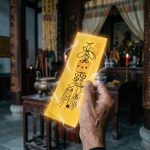
What distinguishes Zhengyi practice is its emphasis on *consecration* (*guan*, 灌) — a process wherein paper, silk, or wood is ritually infused with celestial script, breath, and focused intention. Unlike decorative or folk-art talismans, Zhengyi *fu* are written only by ordained priests who have undergone decades of training in calligraphy, cosmology, and ritual discipline. Each stroke corresponds to stellar alignments; each seal bears the authority of the Celestial Master’s lineage. For Qingming, specific talismans — especially those invoking peace, purification, and gentle transition — are prepared in advance and distributed to families preparing for tomb visits.
This authenticity matters. In an era where mass-produced “lucky charms” circulate globally, genuine Qingming-related talismans reflect continuity — not commodification. They are cultural artifacts rooted in living practice, not nostalgic souvenirs.
—
## The Role of Peace Talismans in Qingming Observance
Among the many ritual objects used during Qingming, *peace talismans* hold quiet prominence. Known in classical texts as *an shen fu* (安神符, “spirit-calming talismans”) or *ning xin fu* (宁心符, “heart-stilling talismans”), these are not tools of coercion or protection-by-force. Rather, they embody *wu wei* — effortless action — through symbolic stillness, balanced composition, and references to tranquil natural imagery: flowing water, still mountains, unbroken circles.
Historically, such talismans were placed at grave sites after cleaning, tucked inside ancestral tablets, or carried by mourners during procession. Their purpose is twofold: first, to express the descendant’s sincere wish for the ancestor’s peaceful repose; second, to gently remind the living to release grief without suppression — honoring sorrow while returning to daily life with composure.
A typical Qingming peace talisman includes:
– **The character *an* (安)**, centrally inscribed — symbolizing safety, stability, and inner quiet;
– **Stellar diagrams** referencing the Northern Dipper (*Beidou*), believed to govern life span and spiritual direction;
– **Seals of the Celestial Master**, affirming ritual legitimacy;
– **Ink-infused rice paper or mulberry silk**, materials chosen for their absorbency and biodegradability — reflecting Taoist reverence for natural cycles.
Importantly, these talismans are never “activated” by the user. Their power resides not in incantation or personal belief, but in the integrity of their creation: the priest’s cultivation, the timing of writing (aligned with solar terms and lunar phases), and the purity of intention behind the rite. As recorded in the *Zhengyi Fajiao Yijian* (Manual of Zhengyi Ritual Practice), “When the brush moves in alignment with Heaven’s rhythm, the talisman becomes a vessel — not of force, but of fidelity.”
For modern practitioners, incorporating a peace talisman into Qingming observance can deepen intentionality. One might place it beside offerings at the grave, keep it folded in a journal during reflection, or display it quietly at home as a reminder of intergenerational continuity.
For those seeking authentic peace talismans prepared according to Zhengyi standards, DeHuiTang offers consecrated *Ning Xin Fu* — hand-written on archival-grade rice paper by ordained priests from Mt. Longhu, timed specifically for the Qingming solar term. These are not generic “calm” charms, but culturally grounded artifacts rooted in centuries of unbroken practice.
—
## How to Observe Qingming Respectfully: A Practical Guide
Qingming need not require elaborate resources or doctrinal expertise. At its heart, it is an invitation to presence — to pause, remember, and realign. Below is a gentle, step-by-step guide grounded in Taoist-informed practice:
### 1. Prepare Your Intention Before Action
Before visiting a grave or setting up a home altar, take five minutes in stillness. Breathe slowly. Reflect on one ancestor — not as a distant figure, but as a source of inherited traits, values, or even quiet habits. In Zhengyi tradition, intention (*yi*, 意) precedes all ritual. No incense or paper is needed at this stage — only awareness.
### 2. Clean With Care, Not Compulsion
Grave-tending (*saomu*, 扫墓) is central. Remove weeds, wipe stone surfaces, and clear debris — but do so mindfully, not hurriedly. Taoist ecology teaches that growth and decay are complementary phases of *Dao*. Avoid harsh chemicals; use water and soft cloths. If visiting a distant grave is impossible, tend a potted plant or clean a family photograph frame instead — the gesture holds equal resonance when rooted in sincerity.
### 3. Offer Simply and Seasonally
Traditional offerings include fresh tea, fruit (pears and pomelos are common), steamed buns, and *qingtuan* (green glutinous rice balls made with mugwort). These are chosen for freshness, natural color (green symbolizes renewal), and ease of decomposition. Avoid plastic-wrapped or processed items — they contradict the festival’s ethos of return and regeneration. Light one stick of sandalwood or aloeswood incense, not for “summoning,” but as a fragrant bridge between senses and memory.
### 4. Speak Aloud — Then Listen
It is customary to speak to ancestors — sharing news, expressing gratitude, or simply saying their name. After speaking, sit quietly for two minutes. In Taoist practice, silence (*jing*, 静) is not emptiness — it is receptive space. This pause allows emotional resonance to settle, honoring both joy and sorrow without judgment.
### 5. Close With Gratitude and Release
Conclude by bowing — not in subservience, but in acknowledgment. Some burn joss paper with care (using a fire-safe container), visualizing warmth and light carried upward. Others choose eco-conscious alternatives: planting a tree, donating to environmental causes, or writing a letter to be sealed and stored. The key is conscious closure — turning attention back to the present with gentleness.
If you wish to extend this practice beyond the day, consider placing a consecrated *Qu Xie Fu* (Negative Energy Dispelling Talisman) near your home entrance in the weeks following Qingming. Not as a shield, but as a subtle marker of boundary and renewal — helping to maintain the clarity and calm cultivated during the festival.
—
## Beyond Superstition: Understanding Talismans as Cultural Artifacts
In Western discourse, talismans are often mischaracterized as “magic charms” or “good luck tokens.” Such framing overlooks their profound cultural grammar. In Taoist thought, a talisman (*fu*) is best understood as *written ritual* — a condensed form of liturgy made visible. Its efficacy is relational, not mechanical: it gains meaning through context (Qingming), creator (ordained priest), material (natural fibers), and recipient (a participant in shared tradition).
Scholars such as Vincent Goossaert and David A. Palmer, in *The Religious Question in Modern China*, emphasize that *fu* function as “social technologies of harmony” — stabilizing relationships between people, places, and time. A *Ning Xin Fu* used during Qingming does not “eliminate grief,” but provides a culturally sanctioned vessel for holding it — much as a haiku gives shape to fleeting emotion.
This perspective invites humility. It asks us not to seek control over fate, but to participate meaningfully in cycles we inherit — honoring what came before, tending what is present, and leaving space for what follows.
DeHuiTang honors this depth by offering only talismans consecrated through verified Zhengyi lineages — never mass-printed or algorithm-generated. Each item arrives with documentation of its ritual timing and priestly origin, affirming transparency and continuity.
—
## Conclusion: Carrying Qingming Forward
Qingming Festival is more than a date on the calendar — it is a living thread connecting breath to bone, memory to motion, silence to song. In a world of accelerating change and fragmented attention, its enduring power lies in its simplicity: to sweep, to offer, to speak, to sit, to remember.
Whether you observe Qingming through family graveside visits, quiet reflection at home, or participation in temple ceremonies, the heart of the practice remains unchanged: cultivating *de* (virtue) through remembrance, and *he* (harmony) through balance. Peace talismans — when approached with cultural understanding — serve not as shortcuts, but as companions along this path: quiet anchors of intention, crafted with reverence, and rooted in the living soil of Mt. Longhu.
If you feel drawn to deepen your Qingming practice with authentic, consecrated items prepared in accordance with Zhengyi Daoist tradition, we invite you to explore the carefully curated collection at DeHuiTang. Each piece reflects decades of priestly training, seasonal alignment, and unwavering respect for the ancestors — both those who walked before us, and those who safeguarded this wisdom across centuries.
—
## Frequently Asked Questions (FAQ)
**Q: Can non-Chinese or non-Taoist individuals respectfully observe Qingming?**
A: Yes — with sincerity and study. Qingming is fundamentally about human relationship and seasonal awareness, not exclusive doctrine. Learning its history, observing basic customs (like cleaning a memorial space or lighting incense in remembrance), and approaching it with humility are meaningful ways to participate across cultural lines.
**Q: Are talismans necessary for Qingming?**
A: No. Talismans are optional supports — not requirements. The essence of Qingming lies in intention and action: remembering, caring, and returning to balance. For some, a talisman deepens focus; for others, quiet reflection suffices. Authentic practice honors individual capacity and conscience.
**Q: How should I dispose of a talisman after Qingming?**
A: Traditionally, paper talismans are respectfully burned in a clean, safe container — ideally outdoors or in a ceremonial brazier — while holding gentle intention. Ashes may be buried in garden soil or scattered in flowing water. This honors the cyclical nature of *Dao*: form returns to formless, intention returns to stillness.
—
These items are sold as cultural artifacts. Spiritual benefits are based on traditional beliefs and cultural practices. DeHuiTang does not guarantee specific outcomes.
Related Taoist Instruments
About DeHuiTang — This article is part of our Taoist cultural education series. Explore more authentic Taoist knowledge, Feng Shui wisdom, and destiny philosophy at our main site.