# Taoist Spiritual Protection: Authentic Practices Beyond Halloween Costumes
As October approaches and storefronts fill with plastic skulls, flickering LED jack-o’-lanterns, and novelty ‘spell kits’, many spiritually curious adults pause—wondering whether the ancient traditions behind symbols of protection hold deeper meaning than seasonal spectacle. For those drawn to Taoist culture—not as costume or caricature, but as a living lineage of reverence, balance, and mindful practice—the concept of *spiritual protection* invites thoughtful reflection. Unlike commercialized notions of warding off ‘ghosts’ through theatrics, **Taoist spiritual protection** is rooted in cosmology, ritual discipline, and centuries of ethical cultivation centered on harmony between Heaven, Earth, and Humanity.
This article explores what authentic Taoist spiritual protection truly means: its historical foundations in Zhengyi Daoism (正一道), its expression through consecrated talismans and ritual objects, and how modern practitioners can engage respectfully—with clarity, not confusion—with these time-honored traditions. We’ll clarify common misconceptions, honor the sacred context of Mt. Longhu (龙虎山), and offer practical guidance for approaching protection not as fear-based defense, but as conscious alignment with the Tao. By the end, you’ll understand why a Wu Lei Fu or Qu Xie Fu is not a ‘magic charm’—but a cultural artifact embodying disciplined intention, priestly lineage, and enduring philosophical wisdom.
—
## What Does ‘Spiritual Protection’ Mean in Taoist Tradition?
In English, the phrase *spiritual protection* often carries vague or sensational connotations—evoking images of invisible shields, exorcisms, or supernatural intervention. In classical Taoist thought, however, protection is neither reactive nor combative. It emerges from *cultivation* (*xiu* 修) and *alignment* (*he* 和).
The *Dao De Jing* teaches: *“He who knows others is wise; he who knows himself is enlightened.”* (Chapter 33). True protection begins inwardly—through self-awareness, ethical conduct (*de*, 德), and quietude (*jing*, 静). When one’s *qi* flows smoothly, one’s *shen* (spirit) remains settled, and one’s actions accord with natural principle (*li*, 理), external disturbances naturally recede—not because they are banished, but because resonance shifts.
Historically, this understanding evolved into structured practices within the Zhengyi Daoist tradition, especially after the formal establishment of the Celestial Master (*Tianshi*, 天师) lineage at Mt. Longhu during the Eastern Han dynasty (c. 2nd century CE). There, ordained priests developed codified methods—rituals (*jiao*, 醮), meditation, dietary observance, and the crafting of talismans (*fu*, 符)—not to dominate spirits, but to restore balance where imbalance had arisen.
Importantly, Taoist cosmology does not divide reality into ‘good spirits’ and ‘evil ghosts’ in a moralistic sense. Rather, it recognizes *yin-yang fluctuations*, *qi disturbances*, and *temporal afflictions*—such as the annual influence of the Tai Sui (太岁), or celestial energies that may challenge personal stability. Protection, then, is often about *harmonizing with cycles*, not conquering them.
This perspective stands in quiet contrast to Halloween’s playful inversion of sacred boundaries—where fear is commodified and the numinous reduced to décor. Authentic Taoist spiritual protection is neither performative nor temporary. It is sustained, reverent, and inseparable from daily virtue.
—
## The Role of Talismans (*Fu*) in Zhengyi Daoist Practice
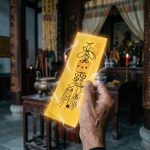
Among the most visible expressions of Taoist spiritual protection are *fu*—consecrated talismans traditionally inscribed on yellow paper or silk using cinnabar ink and precise calligraphic strokes. Though sometimes mistaken for decorative amulets, *fu* are deeply ritual objects, inseparable from the priestly lineage, timing, and intention behind their creation.
### Origins and Integrity
The earliest surviving *fu* texts date to the Six Dynasties period (3rd–6th centuries CE), but their systematic use flourished under the Zhengyi tradition at Mt. Longhu—the sacred seat of the Zhang family Celestial Masters for over 1,800 years. Each *fu* is composed according to strict canonical rules: specific deities invoked, stellar alignments observed, breath control (*xingqi*, 行气) practiced during writing, and consecration performed through fire (*huo fu*, 火符) or water (*shui fu*, 水符) rituals.
Crucially, a *fu* is not effective by virtue of its image alone. As the *Zhengyi Fazhuan* (正一法箓, “Zhengyi Ritual Registers”) states: *“Without true transmission (*chuan*), no talisman holds power; without sincere heart (*cheng xin*), no ritual bears fruit.”*
This underscores why authenticity matters—not as mystique, but as continuity. A *fu* from Mt. Longhu is not merely ‘made in China’; it is the product of ordained priests trained in a living tradition, consecrated during auspicious dates, and aligned with the ritual calendar (*tongzhen li*, 通真历).
### Common Types and Their Cultural Context
While Western audiences may associate talismans with singular wishes—‘protection,’ ‘wealth,’ ‘love’—Taoist *fu* reflect holistic cosmological functions:
– **Wu Lei Fu (Five Thunder Talisman)**: Associated with the Five Thunder Department (*Wu Lei Bu*, 五雷部), this *fu* invokes celestial authority to stabilize *qi* fields and resolve energetic turbulence. Historically used before major ceremonies or during seasonal transitions (e.g., the autumn equinox), it symbolizes heavenly order reasserting harmony—not punishment or force.
– **Qu Xie Fu (Negative Energy Dispelling Talisman)**: Often misunderstood as ‘ghost repellent,’ this *fu* addresses *xie qi*—a classical term for stagnant, discordant, or imbalanced energy arising from environmental clutter, emotional strain, or prolonged neglect of ritual hygiene (*qingjing*, 清静). Its purpose is restorative clarity, not confrontation.
– **Tai Sui Fu (Annual Affliction Resolution Talisman)**: Commissioned each year to harmonize with the ruling Tai Sui deity, this *fu* supports resilience amid cyclical change—a practice grounded in astronomical observation and ethical preparation, not superstition.
For those seeking authentic talismans rooted in this tradition, DeHuiTang offers carefully consecrated examples—including the Wu Lei Fu and Qu Xie Fu—crafted by Zhengyi priests at Mt. Longhu and distributed with full contextual guidance.
—
## Ritual Objects: More Than Symbolic Props
Beyond talismans, Taoist spiritual protection involves physical ritual instruments—each selected for material, form, and function in accordance with classical texts like the *Yunji Qiqian* (《云笈七签》, “Seven Bamboo Tablets of the Cloudy Satchel”). These are not theatrical props, but calibrated tools supporting focused intention and energetic boundary-setting.
### Peach Wood Swords (*Tao Jian*, 桃剑)
Peach wood has been revered in Chinese cosmology since antiquity—for its association with immortality (the Peach of Immortality grows in the Queen Mother of the West’s garden) and its natural resistance to decay and pests. A peach wood sword is never wielded violently; rather, it is placed upright near doorways or altars to *anchor* *yang* energy and gently redirect *yin*-heavy stagnation. Its efficacy lies not in myth, but in consistent symbolic reinforcement—much like lighting incense to mark sacred time or ringing a bell to clear mental distraction.
### Incense Burners and Ritual Bells
The steady rise of sandalwood or aloeswood smoke serves both sensory and metaphysical roles: it purifies the air physically, calms the nervous system, and visually represents the ascent of prayer (*bao bai*, 报拜). Similarly, the bronze ritual bell (*ling zhong*, 令钟) is struck precisely three, six, or nine times—not for sound alone, but to synchronize breath, heartbeat, and cosmic rhythm (*tian ren he yi*, 天人合一).
These objects gain significance through regular, reverent use—not passive display. A ritual bell left silent on a shelf holds no more inherent ‘power’ than an unused musical instrument holds melody. Their value unfolds through practice: learning when to ring, how to bow, how to pause before lighting incense. That is where spiritual protection becomes embodied—not abstract, not magical, but *lived*.
—
## Honoring Seasonal Transitions—Without Appropriation
Halloween’s roots lie in Celtic Samhain—a liminal time when the veil between worlds was believed thinnest. While Taoist tradition has no direct equivalent festival, it *does* recognize seasonal thresholds as moments requiring heightened awareness and ritual care.
The autumn season (*qiu*, 秋) corresponds to the Metal element (*jin*, 金), the organ system of Lung and Large Intestine, and the emotion of grief (*bei*, 悲). In classical medicine and cosmology, this is a time of harvesting, releasing, and preparing for inward stillness. Rather than dramatizing ‘ghosts,’ Taoist observance emphasizes *letting go*: clearing clutter (physical and emotional), honoring ancestors through quiet remembrance (*zhui si*, 追思), and strengthening *wei qi* (defensive energy) through qigong and nourishing herbs.
Mt. Longhu temples observe the *Zhongyuan Festival* (中元节), also known as the Ghost Festival, on the 15th day of the seventh lunar month—approximately August/September in the Gregorian calendar. Unlike Halloween’s emphasis on fright, Zhongyuan centers on compassion: offerings of food and paper goods are made not to appease ‘hungry ghosts,’ but to express gratitude and release attachment, guided by the *Yu Huang Ben Hang Ji* (《玉皇本行集》, “Jade Emperor’s Original Conduct Scripture”).
This distinction matters. When Western audiences adopt Taoist symbols—like talismans or peach wood swords—without understanding their ethical and ritual scaffolding, they risk flattening profound traditions into aesthetic accessories. Authentic engagement asks: *What does this object invite me to cultivate? How does it connect me to lineage, season, and self?*
That kind of reflection transforms seasonal curiosity into meaningful spiritual practice.
—
## How to Approach Taoist Spiritual Protection Respectfully
If you feel drawn to Taoist practices—not as exotic escape, but as grounded support—here are four principles to guide your approach:
### 1. Prioritize Learning Over Acquisition
Begin with study, not shopping. Read translations of core texts (*Dao De Jing*, *Zhuangzi*, *Tai Shang Ganying Pian*), explore reputable academic resources (like the [China Heritage Quarterly]( or attend public lectures hosted by Taoist temples abroad. Understanding *why* a *fu* is written a certain way deepens appreciation far more than owning one ever could.
### 2. Recognize Lineage and Authorization
Not all talismans are equal—not because of ‘power,’ but because of transmission. Authentic Zhengyi *fu* require ordination, decades of training, and authorization from the Celestial Master’s office at Mt. Longhu. Ask respectful questions: Who consecrated this? Under which temple’s auspices? Is the priest ordained in the Zhengyi lineage? Transparency reflects integrity.
### 3. Integrate, Don’t Isolate
A talisman or peach wood sword gains resonance when placed within daily practice—even modest ones: five minutes of seated stillness each morning, keeping a small altar clean and uncluttered, journaling reflections on *de* (virtue) and *ren* (benevolence). Spiritual protection grows from consistency, not crisis-response.
### 4. Embrace Cultural Humility
Taoism is not a toolkit to be ‘mixed and matched’ with other systems. While cross-cultural dialogue is valuable, reducing *fu* to ‘energy stickers’ or invoking deities outside their cosmological framework risks disrespect. Honor the tradition by learning its grammar before speaking its language.
These principles ensure that your interest in Taoist spiritual protection remains rooted in reverence—not reduction.
—
## Frequently Asked Questions
**Q: Are Taoist talismans safe to keep at home?**
A: Yes—when treated with respect and understanding. Traditionally, talismans are placed in clean, elevated spaces (e.g., above eye level on an altar or wall), away from clutter or foot traffic. They are not toys or décor, and should not be handled casually or displayed alongside unrelated spiritual items without contextual awareness.
**Q: Can I use a Taoist talisman alongside my own religious practice?**
A: Many people do so respectfully—viewing the *fu* as a cultural artifact expressing universal values like harmony, balance, and ethical intention. However, Taoist rituals involve specific deity invocations and cosmological frameworks. If your tradition prohibits veneration of other deities or ritual forms, consult your spiritual advisor first.
**Q: Do I need to be ‘Taoist’ to benefit from these practices?**
A: No. Taoist spiritual protection is accessible to anyone drawn to its philosophy of balance, self-cultivation, and reverence for natural law. You need not adopt a new religion—only approach with sincerity, patience, and openness to learning.
—
## Closing Thoughts: Protection as Presence
Halloween reminds us that humans have always marked thresholds—moments when the familiar feels thin, and the unseen seems near. But while costumes fade and candy wrappers litter sidewalks, Taoist spiritual protection offers something quieter, sturdier: the practice of showing up fully—to our breath, our ethics, our environment, and our place within a vast, rhythmic cosmos.
It asks not *what can I ward off?*, but *what can I nurture?*
Not *how do I avoid disturbance?*, but *how do I deepen my center?*
That shift—from avoidance to alignment—is where real protection begins.
If you’re ready to explore authentic, consecrated items crafted with integrity and care—such as the Wu Lei Fu for energetic stabilization or the Qu Xie Fu for restoring clarity—we invite you to browse DeHuiTang’s collection. Each item arrives with background notes, usage suggestions, and the assurance of Zhengyi Daoist lineage from Mt. Longhu.
These items are sold as cultural artifacts. Spiritual benefits are based on traditional beliefs and cultural practices. DeHuiTang does not guarantee specific outcomes.
—
*DeHuiTang Editorial | August 2026*
Related Taoist Instruments
About DeHuiTang — This article is part of our Taoist cultural education series. Explore more authentic Taoist knowledge, Feng Shui wisdom, and destiny philosophy at our main site.