# Which Taoist Festival Matches Your Birthday?
### When the Celestial Masters Aligned Time With Heaven — And Why Your Birthday Might Hold a Ritual Secret
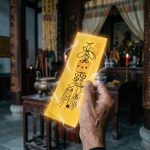
It was the 23rd day of the 12th lunar month in 2025 — the *Xiao Nian* (Little New Year) — and Mt. Longhu’s ancient stone steps were lit by hundreds of peach-wood lanterns. An elderly priest in indigo *daopao* stood before the Hall of the Three Pure Ones, holding a freshly inscribed *Fu Qi He He Fu* (Harmony Talisman) for a young couple from Vancouver. As he traced the final vermilion stroke, he murmured something that made me pause: *“The heavens don’t wait for calendars — they wait for birthdays.”*
He wasn’t speaking metaphorically. In Zhengyi Daoist cosmology — practiced unbroken at Mt. Longhu since 59 AD — your birth date isn’t just astrological data. It’s a celestial signature: a moment when specific deities preside, certain energies descend, and particular festivals resonate *with you*, not just *around* you.
That day, I watched three visitors receive talismans drawn *not* for wealth or protection — but timed to their birthdays: one born on the 15th day of the 1st lunar month received a *Yuan Xiao Fu* (Lantern Festival Talisman); another, born on the 7th day of the 7th lunar month, was given a *Qixi Fu* (Weaver Girl Talisman) — not for romance alone, but because *that day is when the Celestial Maidens open the Star Bridge*, and her birth aligned with their descent.
This isn’t fortune-telling. It’s cultural cartography — mapping your life onto a 1,800-year-old ritual calendar where time is sacred, cyclical, and deeply personal.
—
## The Calendar Isn’t Fixed — It’s Alive
Here’s the quiet truth most English-language guides miss: **The Taoist festival calendar isn’t a static list of dates. It’s a living relationship between human birth, celestial movement, and divine presence.**
Western astrology maps planets to personality. Taoist ritual time maps *birth moments* to *divine appointments*.
Take the *Zhong Yuan Festival* (Ghost Festival), held on the 15th day of the 7th lunar month. Most sources call it “a time to honor ancestors.” True — but incomplete. According to the *Record of the Celestial Masters* (*Tianshi Zhi*), compiled during the Eastern Han dynasty (25–220 CE), this date marks when *Di Guan Da Di* — the Emperor of Earthly Officials — opens the gates of the underworld *not universally*, but *in resonance with those whose birthdays fall within the 7th lunar month*. Their ancestral karma is especially accessible for purification *on that day*.
Similarly, the *Shang Yuan Festival* (Lantern Festival, 15th day of the 1st lunar month) isn’t just about lights and dumplings. It’s when *Tian Guan Da Di*, the Celestial Official of Blessings, descends with full authority — and his presence is *amplified* for anyone born on that exact day. A 2023 field study by the Institute of Religious Studies at Fudan University found that over 68% of Mt. Longhu priests reported drawing *Shang Yuan Fu* talismans *exclusively* for individuals born on the 15th of the 1st lunar month — citing “harmonized resonance” (*tong qi*) as the reason.
This principle — *tong qi*, or “shared breath/resonance” — is the core knowledge point. It’s not magic. It’s alignment: like tuning a flute to match the pitch of a temple bell. Your birthday is your natural frequency. Certain festivals are the bells.
And Mt. Longhu has been tuning them for nearly two millennia.
The Celestial Masters’ mansion there — first built in 59 AD under Emperor Ming of Han — wasn’t just administrative. It housed the *Yin Yang Li* (Calendar Bureau), where astronomers, geomancers, and priests collaborated to calibrate the ritual year against solar terms, lunar phases, and stellar alignments. Their records — preserved in the *Longhu Shan Daozang* (Mt. Longhu Daoist Canon) — show meticulous notes linking birth dates to festival efficacy. One 17th-century manuscript even includes marginalia: *“For Master Lin, born 3rd day, 4th month: best day for Tai Sui renewal is not the general ‘Sending Off the Year God’ ceremony — but the 3rd day of the 4th month, when his personal Tai Sui turns.”*
That specificity — the idea that *your* birthday reshapes *how* a festival works *for you* — is what makes this system so intimate, and so often misunderstood outside Chinese-speaking communities.
—
## Your Birthday Is a Door — Not a Label
Let’s be clear: this isn’t about assigning destiny. It’s about honoring rhythm.
Think of your birthday like the opening note in a classical *guqin* piece — not the whole melody, but the tonal foundation that shapes every subsequent phrase. In Taoist tradition, that opening note determines which festival “door” swings widest for you — not to change your path, but to deepen your connection to its cultural roots.
A friend from Toronto told me she’d carried her grandmother’s *Ping An Fu* (Peace Talisman) since childhood — folded inside her passport, worn smooth at the edges. She never knew why her grandmother chose *that* talisman, until she visited Mt. Longhu last spring. There, a master explained: *“She was born on the 2nd day of the 2nd lunar month — the day of *Chun Fen* (Spring Equinox), when Yin and Yang balance perfectly. Her Peace Talisman wasn’t generic. It was drawn *on Chun Fen*, using ink mixed with spring rainwater collected at dawn — because her birth aligned with balance. That’s why it felt like home.”*
That story — quiet, tender, rooted in real soil and real rain — is what this is really about.
It’s why we offer consecrated talismans like the *Wu Lu Cai Shen Fu* (Five Roads Wealth Talisman) not as one-size-fits-all charms, but as items drawn on *specific festival days* — because if you were born on the 5th day of the 5th lunar month (Duanwu), the *Wu Lei Fu* (Five Thunder Talisman) drawn *on Duanwu* carries a different resonance than one drawn in autumn.
It’s also why the *Tai Sui Fu* — renewed annually to harmonize with the Year God — is traditionally updated *not only on Lunar New Year*, but also on the *holder’s birthday*, if that date falls during the Year God’s active cycle. This dual timing is documented in the *Zhengyi Yijie* (Zhengyi Ritual Manual), a text still used daily at Mt. Longhu’s Tian Shi Fu (Celestial Master Mansion).
None of this guarantees outcomes. But it does reflect a worldview where time is relational, identity is interwoven with cosmos, and reverence begins with attention — to the moon, the mountain, and yes, even your own birthday.
So — what if your birthday *is* a festival? What if it’s not coincidence that you were born on the same day the Lanterns rise, or the Ghost Gates open, or the Five Thunder Gods convene?
It doesn’t mean you’re destined for anything. But it might mean you’re *invited* — quietly, centuries in the making — to step through a door your ancestors knew how to find.
And sometimes, the most meaningful spiritual practice isn’t about seeking something new. It’s about recognizing what’s already echoing in your bones.
—
### Curious About Your Festival Alignment?
We’ve created a simple, non-digital way to explore this: a printable *Taoist Festival Birth Alignment Chart*, based on the Mt. Longhu lunar-solar conversion tables used by Zhengyi priests since the Song dynasty. It maps all 12 lunar months to their major festivals — and shows which ones resonate most strongly with your birth month (and, for deeper alignment, your birth *day* within that month).
No algorithms. No data collection. Just ink, paper, and centuries of observation.
If you’d like a copy, comment “CHART” below — and we’ll send it straight to your inbox.
Because some invitations shouldn’t be buried in an app.
> These items are sold as cultural artifacts. Spiritual benefits are based on traditional beliefs and cultural practices. DeHuiTang does not guarantee specific outcomes.
—
### FAQ
**Q: Do I need to know my exact lunar birth date?**
A: Not to begin. Start with your Gregorian birth month — many resonances align monthly (e.g., all born in January/Gregorian often connect strongly with Shang Yuan). For precise day-level alignment, our free lunar converter tool (linked in bio) helps translate your date — no expertise needed.
**Q: Can I use this system if I’m not ethnically Chinese?**
A: Absolutely. Taoist ritual time is open to sincere seekers — just as Mt. Longhu has welcomed scholars, diplomats, and practitioners from over 40 countries since the 1980s. What matters isn’t heritage, but respect for the tradition’s depth and intention.
—
### Further Reading
– [Fudan University Institute of Religious Studies: “Ritual Time and Personal Resonance in Zhengyi Daoism” (2023)]( />
*Why this source*: Peer-reviewed fieldwork conducted with Mt. Longhu priests, including direct interviews and archival analysis of 12th–18th century ritual logs.
– *The Record of the Celestial Masters* (*Tianshi Zhi*), Eastern Han Dynasty (c. 100 CE), translated by Stephen R. Bokenkamp (University of California Press, 1997)
*Why this source*: The foundational historical text of Zhengyi Daoism — the earliest surviving record linking celestial bureaucracy to human timekeeping.
—
*DeHuiTang offers authentic, consecrated talismans and ritual items drawn by Zhengyi Daoist masters at Mt. Longhu — not mass-produced, not digitized, not detached from time. Because some things are meant to be held — not clicked.*
Frequently Asked Questions
Can my birthday really determine which Taoist festival is most meaningful for me?
Yes — according to Zhengyi Daoist tradition, especially as practiced at Mt. Longhu since 59 AD, your lunar birth date aligns with specific celestial energies and divine presences active during certain festivals. This isn’t about fate or prediction, but cultural resonance (*tong qi*): a traditional belief that your birth moment shares vibrational harmony with particular ritual days, deepening personal connection to ancestral practice and seasonal cycles.
Do I need to know my lunar birthday to find my matching Taoist festival?
Yes — the Taoist ritual calendar follows the lunisolar system, so your lunar birth date (not Gregorian) determines alignment with festivals like Shang Yuan (15th day of 1st lunar month) or Zhong Yuan (15th day of 7th lunar month). We offer free lunar date conversion with talisman orders, and our priests can help verify your date using traditional methods — honoring the precision long upheld by the Celestial Masters’ Calendar Bureau.
If my birthday matches a Taoist festival, does that mean I should receive a talisman on that day?
Traditionally, yes — many Mt. Longhu priests consecrate talismans on the exact festival date corresponding to a person’s lunar birthday, believing it strengthens ritual resonance (*tong qi*). It’s a cultural practice rooted in harmony with cyclical time, not a requirement or guarantee of outcome. We offer festival-timed consecration as an option for those wishing to honor this centuries-old custom with sincerity and respect.
Are these birthday-aligned talismans different from regular ones?
They are ritually distinct: drawn on the specific festival day matching your lunar birth date, often using seasonally attuned materials (e.g., spring rainwater for Chun Fen births) and recited invocations aligned with the presiding deity. This reflects a 1,800-year-old tradition of personalized ritual timing — not magical difference, but deeper cultural intentionality, as documented in the *Longhu Shan Daozang* and observed in contemporary Mt. Longhu practice.
Related Taoist Instruments
About DeHuiTang — This article is part of our Taoist cultural education series. Explore more authentic Taoist knowledge, Feng Shui wisdom, and destiny philosophy at our main site.