# When Grandma’s Talisman Still Gives You Chills
It wasn’t in a silk pouch or a lacquered box. It was folded twice inside a faded pink envelope — the kind with tiny white daisies printed along the edge — tucked into the back of my mother’s old cedar jewelry chest. I found it on a rainy afternoon in Vancouver, three weeks after her funeral. My fingers trembled not from grief alone, but from the quiet weight of something *recognized*: the faint scent of aged ink and sandalwood, the slight ridge where the paper had been pressed by generations of thumbs, the single vermilion seal stamped at the bottom corner — a dragon coiled around the character *De* (德), meaning *virtue*.
That talisman — a simple *Ping An Fu* (Peace Talisman) — had traveled from Mt. Longhu in Jiangxi Province to a Shanghai apartment in 1948, then across the Pacific in a suitcase lined with rice paper in 1962, and finally into my palm on a grey August day in 2026. It wasn’t magic. It wasn’t a spell. It was a *continuity*. A quiet, unbroken thread of care — stitched not in silk, but in sincerity.
This is not just a story about paper and ink. It’s about how spiritual objects become vessels for love we can’t name aloud — especially when the people who gave them are gone.
—
## The Talisman Isn’t the Magic — The Hand That Drew It Is
Let’s pause here — because this is where most stories get it backward.
We often imagine talismans as self-contained power sources: ancient codes, secret formulas, mystical energy batteries. But in Zhengyi Daoist tradition — the lineage that has consecrated talismans at Mt. Longhu for over 1,800 years — the *drawing ritual* is everything. The paper is blank until the master’s breath, focus, and intention meet the brush. And that intention isn’t abstract. It’s *relational*.
Take the *Ping An Fu*, one of the most widely gifted talismans in Chinese families. Its core inscription doesn’t invoke thunder gods or celestial generals. Instead, it traces the *Dao De Jing*’s gentle command: *“The highest virtue is like water.”* (Chapter 8). Water flows without contention; it nourishes without demanding return. So too does the peace it carries — not as absence of trouble, but as inner stillness *amid* it.
Here’s the authenticity anchor you won’t find in textbooks: Every year on the 23rd day of the 12th lunar month — the *Xiao Nian* (Little New Year) — the Celestial Masters’ mansion at Mt. Longhu hosts the *Song Shen* ceremony: “Sending Off the Gods.” Priests don crimson robes, light peach-wood incense, and ritually release the deities who’ve guarded households for the year. Then, on the *first day of the new lunar year*, they begin drawing *new* talismans — not in silence, but while chanting the *Tai Shang Lao Jun Shuo Chang Sheng Zhen Jing* (Scripture on True Immortality), their voices rising before dawn. Why? Because the first breath of the new year is considered the purest vessel for intention.
That means your grandmother’s *Ping An Fu* wasn’t drawn in isolation. It was drawn in concert — with seasonal rhythm, communal devotion, and a lineage stretching back to Zhang Daoling, the First Celestial Master, who founded Zhengyi Daoism on Mt. Longhu in 59 AD. The paper holds no power — but the *chain of care* it represents? That is real, tangible, and fiercely human.
—
## The Quiet Language of Heirlooms
A few months ago, while cataloging archival materials at DeHuiTang’s storage vault in Portland, we came across a Republic-era manuscript — bound in cracked indigo cloth — titled *“Notes on Household Talisman Transmission”* (1937). Its author, a priest named Li Wenbo, wrote something that stopped us cold:
> *“I have seen mothers fold talismans into newborns’ swaddling cloths not to ward off demons, but to whisper: ‘You are already safe. You belong here.’ I have seen daughters tuck them into wedding shoes not to guarantee happiness, but to say: ‘Your joy matters to me, even when I cannot hold your hand.’ The talisman is never the message. It is the envelope.”*
That passage reframed everything.
Think of the objects you keep — not because they’re valuable, but because they *hold time*. A chipped teacup your grandfather used every morning. A pressed flower from your first date. A child’s scribbled birthday card. These aren’t artifacts. They’re *emotional time capsules* — physical anchors for feelings too tender or complex to speak aloud.
In Taoist culture, this is formalized through *consecration* — not as supernatural activation, but as *ritual witnessing*. When a master at Mt. Longhu draws a talisman, he doesn’t *infuse* it. He *attends to it*, with fasting, meditation, and invocation — making visible what is otherwise invisible: that care is worth honoring, that protection begins with attention, and that love, when made tangible, outlives the hands that shaped it.
This is why so many overseas Chinese families — from Toronto to Buenos Aires — still seek authentic *Ping An Fu* or *Gui Ren Fu* (Noble Person Talisman) for graduation gifts or new homes. It’s not superstition. It’s *cultural grammar*: a shared vocabulary for tenderness in a world that rarely teaches us how to say, *“I wish you peace,”* without sounding sentimental or vague.
I’ll never forget meeting Dr. Mei Lin — a pediatric oncologist in San Francisco — during our 2025 field visit to Mt. Longhu. She told us she keeps her mother’s *Ping An Fu* in her lab coat pocket, not for luck, but as a reminder: *“Every time I reach for it before walking into a room with a frightened child, I remember how my mother reached for hers before every hospital shift. It’s my way of holding her hand across decades.”*
That’s the quiet language. Not of power — but of presence.
—
## What Happens When the Envelope Opens?
There’s a moment — maybe you’ve felt it — when you unfold a talisman passed down through generations, and instead of reading the characters, you feel the *pressure* of the folds: the exact places where your grandmother’s thumb pressed down, where your mother smoothed the crease before tucking it into your schoolbag.
That pressure is memory made tactile.
At DeHuiTang, we don’t sell “blessed paper.” We steward *consecrated continuity*. Every *Ping An Fu* and *Fu Qi He He Fu* (Harmony Talisman) we offer is drawn by masters trained in the Mt. Longhu lineage — not mass-produced, not digitally rendered, but brushed by hand, aligned with lunar phases, and sealed with the same vermilion ink used in the Celestial Masters’ mansion since the Tang Dynasty.
But here’s what matters more than provenance: *how you receive it.*
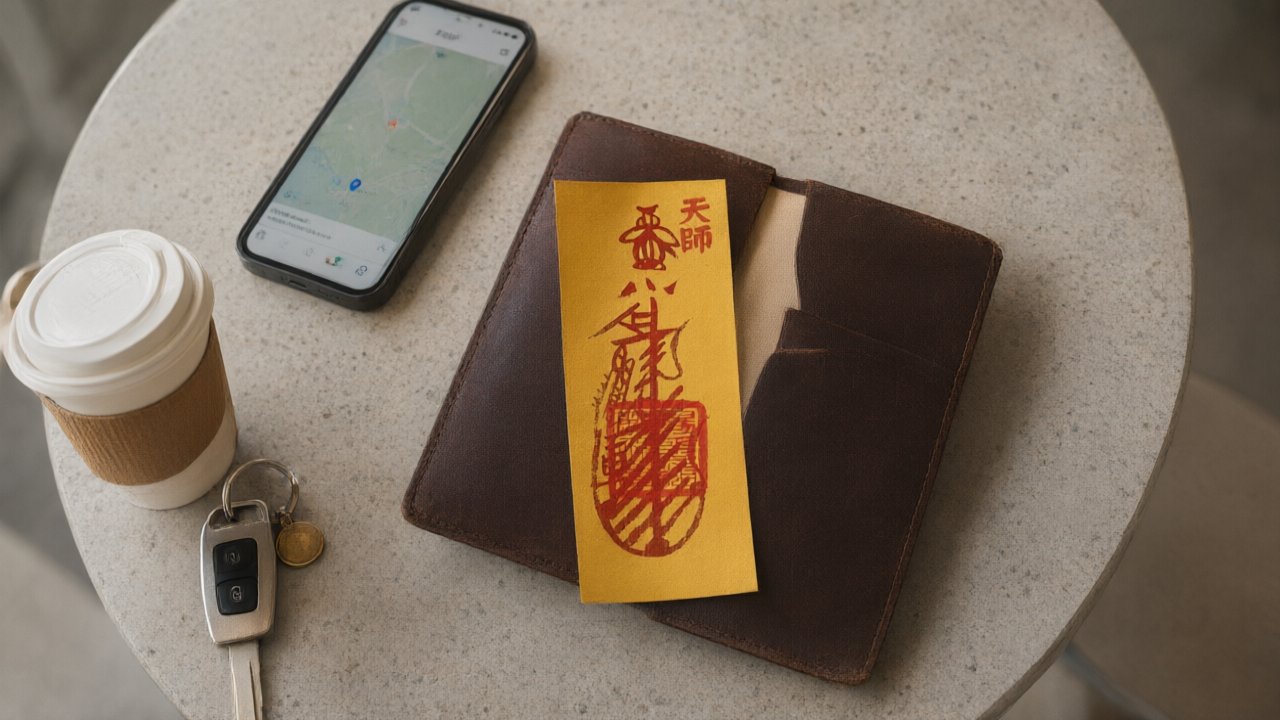
A talisman isn’t activated by belief — it’s deepened by *intentional use*. Some place theirs near doorways, not as a barrier, but as a daily pause: *“May everyone who enters feel welcomed.”* Others carry them in wallets — not to attract wealth, but as a silent vow: *“I will handle money with integrity.”* One teacher in Melbourne told us she tapes hers inside her lesson plan book: *“So every time I write a student’s name, I remember: this child is worthy of peace — just as I was.”*
That’s the soft magic — not in the ink, but in the choice to let an object carry your quietest hopes.
So if you’ve ever held a family talisman — or even just wondered what it might mean to begin that thread — know this: You don’t need to be “spiritual” to honor it. You only need to be *tender*. To believe — even for a moment — that love, once made tangible, never truly fades.
**Do you have any family heirlooms that carry spiritual significance? Not because of their value — but because of the quiet weight of who held them before you?**
These items are sold as cultural artifacts. Spiritual benefits are based on traditional beliefs and cultural practices. DeHuiTang does not guarantee specific outcomes.
—
### FAQ
**Q: Can I renew or refresh an old family talisman?**
A: In Zhengyi Daoist tradition, talismans are not “recharged” — they’re respectfully retired (often by burning with reverence) and replaced with newly consecrated ones, ideally drawn during auspicious times like the Lunar New Year or Qingming Festival.
**Q: Is it appropriate to gift a talisman to someone outside my cultural background?**
A: Yes — when offered with context and respect. Think of it like gifting a handwritten letter: the value lies not in the paper, but in the sincerity behind it. We recommend sharing its cultural meaning alongside the gift.
—
**Further Reading:**
For deeper insight into the historical role of talismans in household life, see *Taoist Ritual and the Family* (University of Hawaii Press, 2021), particularly Chapter 4: “The Domestic Altar as Archive.” [
This scholarly work documents over 200 oral histories from Taoist families across Fujian, Jiangxi, and Guangdong — including detailed accounts of talisman transmission during the Republican era and post-1949 diaspora. It treats talismans not as occult objects, but as *embodied archives of care* — a framing that aligns closely with our own work at DeHuiTang.
Frequently Asked Questions
What is a Ping An Fu, and why is it commonly given in Chinese families?
The Ping An Fu (Peace Talisman) is a traditional Zhengyi Daoist talisman rooted in the Dao De Jing’s teaching that 'the highest virtue is like water' — emphasizing calm, resilience, and quiet care. In Chinese families, it’s often gifted during life transitions — births, weddings, graduations, or after loss — not as a magical guarantee, but as a culturally grounded expression of love and wish for inner stillness amid life’s changes. Its power lies in intention, lineage, and shared meaning, not supernatural force.
How is a Ping An Fu consecrated, and why does timing matter?
In Zhengyi Daoist practice, a Ping An Fu is drawn by a trained master during sacred times — especially at dawn on the first day of the lunar new year — following fasting, meditation, and chanting of the Scripture on True Immortality. The timing honors the belief that the new year’s first breath carries purest intention. Consecration isn’t about ‘activating’ the paper, but ritually witnessing care — making tangible the sincerity behind the gift, within a living tradition stretching back over 1,800 years.
Can I keep or use a family heirloom talisman like my grandmother’s, even if I’m not religious?
Yes — many people honor ancestral talismans as cultural heirlooms rather than religious objects. In Taoist tradition, the value resides in the relationship and continuity they represent: a grandmother’s hope, a mother’s protection, a lineage of quiet care. You need not adopt any belief system to respectfully keep it, display it, or reflect on its emotional resonance. At DeHuiTang, we support this practice by offering guidance on gentle handling, respectful storage, and understanding its historical and cultural context.
Is it appropriate to pass down a talisman to the next generation, and how should I explain it?
Absolutely — passing down a talisman is a meaningful act of cultural transmission. When sharing it, focus on the human story: who gave it, when, and why — e.g., 'This was your great-grandmother’s peace talisman; she carried it when she moved across the ocean, and kept it near her while raising three children.' You might add that in Taoist tradition, such objects are seen as 'envelopes' for love too tender to speak aloud — not promises of safety, but affirmations of belonging and care across time.
Related Taoist Instruments
About DeHuiTang — This article is part of our Taoist cultural education series. Explore more authentic Taoist knowledge, Feng Shui wisdom, and destiny philosophy at our main site.