# Which Taoist Talisman Matches Your Personality?
### When Grandma’s Ink-Stained Paper Felt Like a Superpower — And Why That Still Makes Sense in 2026
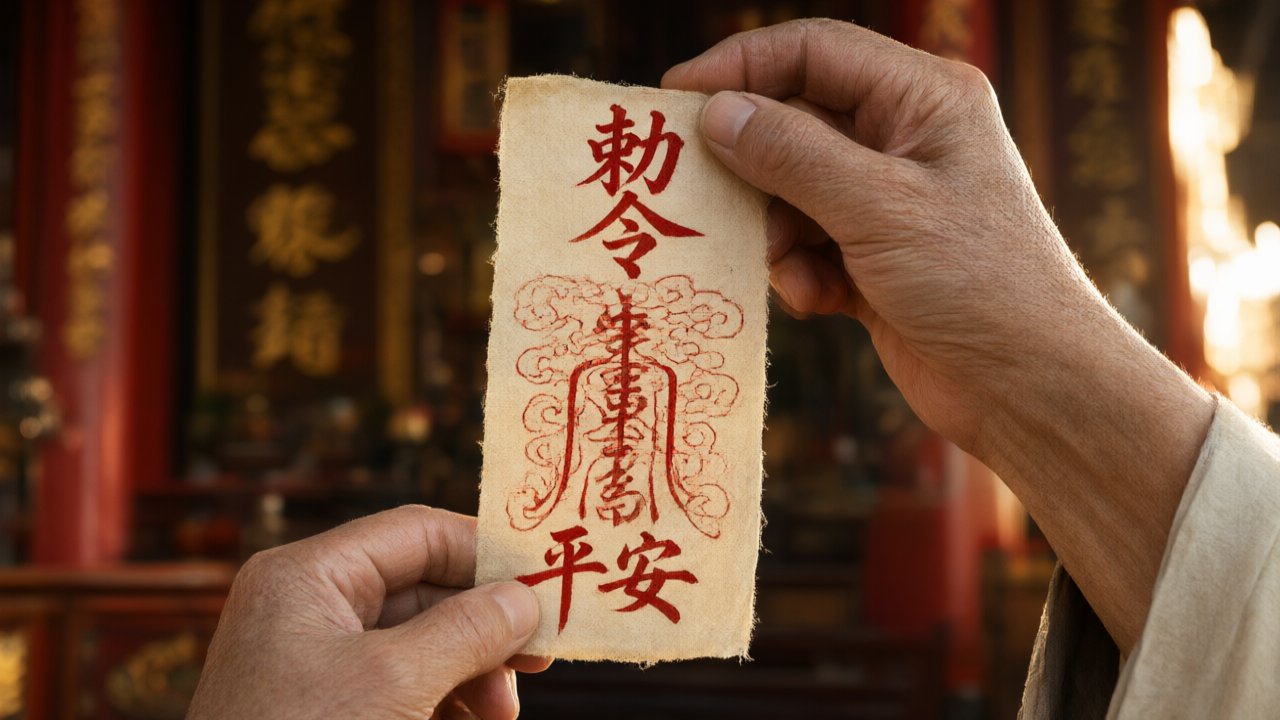
The other day, while helping a friend unpack her late grandmother’s cedar chest in Vancouver, we found it: a folded square of yellow paper, brittle at the edges, sealed with a vermilion stamp that still bled faint crimson when touched. No name. No date. Just three bold strokes — *Ping An* — and a looping, almost musical script beneath it.
She held it like something sacred — not because she believed it *worked*, exactly, but because it *meant*. It meant her grandmother had carried quiet courage through war, migration, and widowhood. It meant protection wasn’t about force — it was about presence. About intention folded into ink.
That talisman didn’t come with instructions. No QR code. No app update. Just a quiet, unspoken pact between generations — one that’s quietly surging again among English-speaking adults from Berlin to Brisbane, not as superstition, but as *cultural resonance*.
This isn’t about choosing a lucky charm. It’s about recognizing which ancient archetype — drawn by Zhengyi Daoist masters on Mt. Longhu for over 1,800 years — mirrors your inner rhythm. Your temperament. Your quietest strength.
Let’s play a gentle game — no incense required.
—
## The Real Reason Talismans Were Never Meant to Be “One-Size-Fits-All”
Here’s what most modern guides get wrong: they treat talismans like apps — download *Wu Lu Cai Shen Fu* for wealth, *Tai Sui Fu* for crisis, *Fu Qi He He Fu* for relationships — and call it done.
But that’s like reading only the title of a novel and assuming you know the plot.
In authentic Zhengyi Daoist practice — the lineage rooted at Mt. Longhu since the Han Dynasty (officially codified under Zhang Daoling in 142 CE) — talismans weren’t mass-produced spells. They were *ritual correspondences*.
Think of them like musical keys: *Wu Lei Fu* (Five Thunder Talisman) resonates with *yang*-intensity — decisive action, clear boundaries, lightning-fast clarity. It’s the talisman a fire chief might carry before entering a burning building, or a teacher who holds space for chaotic classrooms. Its ink is drawn after three days of fasting, meditation, and breathwork — not to “summon power,” but to align the priest’s *qi*, intention, and ceremonial timing with the cosmic rhythm of thunder energy.
Meanwhile, *Ping An Fu* (Peace Talisman) operates in *yin*-harmony — soft resilience, grounded calm, enduring presence. Its strokes are slower, its ink mixed with powdered pearl and lotus root — symbols of purity and quiet continuity. A Chinese-American doctor in San Francisco told us she keeps hers taped inside her stethoscope case. “Not because I think it stops viruses,” she said, “but because it reminds me *why* I chose this work.”
This distinction — between *resonance* and *result* — is the cultural heartbeat behind the matching game.
And it goes back to the very first Celestial Master. According to the *Record of the Celestial Masters* (*Zhengyi Fawei Lu*, compiled 5th century CE), Zhang Daoling didn’t hand out talismans like coupons. He observed how disciples walked, spoke, and breathed — then matched them with talismans whose energetic signature *mirrored* their innate disposition. A naturally cautious scholar received *Gui Ren Fu* (Noble Person Talisman) not to “attract luck,” but to strengthen his quiet discernment. A restless young priest received *Wu Lei Fu* not to “control storms,” but to channel his intensity into disciplined ritual focus.
So this isn’t fortune-telling. It’s *cultural pattern-matching* — using 1,800 years of observational wisdom as a mirror.
—
## Your Guardian Talisman Isn’t Chosen — It Recognizes You
Let’s pause here and do something rare online: *not scroll.*
Take three slow breaths. Not to “activate energy” — just to land.
Now ask yourself: When life gets loud, where does your strength live?
– Is it in **clarity** — cutting through confusion like a blade? → *Wu Lei Fu* may resonate.
– Is it in **steadiness** — holding ground like mountain mist? → *Ping An Fu* may be your anchor.
– Is it in **connection** — weaving harmony between people, even in tension? → *Fu Qi He He Fu* may hum alongside you.
– Is it in **resourcefulness** — finding abundance in unexpected places, like water seeping through stone? → *Wu Lu Cai Shen Fu* may feel like home.
– Is it in **protection** — not as armor, but as deep, unwavering presence? → *Tai Sui Fu* (Yearly Guardian Talisman) may align with your seasonal awareness.
Notice: none of these say *“this will make you rich”* or *“this guarantees love.”* They say: *“This reflects how you already meet the world.”*
That’s why, every year on the 23rd day of the 12th lunar month — the grand *Sending-Off Gods* ceremony at Mt. Longhu — thousands gather not to beg for blessings, but to *renew alignment*. To place their old talismans in the sacred furnace and receive new ones — not because last year’s “expired,” but because *they* have changed. Their priorities shifted. Their challenges evolved. Their inner rhythm deepened.
A talisman isn’t a static object. It’s a dialogue.
And the most beautiful part? You don’t need to travel to Jiangxi Province to begin it.
When we visited the old street near the Celestial Masters’ mansion last spring — built in 59 AD and continuously inhabited since — we watched an elderly master sit cross-legged, drawing talismans not for sale, but for neighborhood children. One boy, maybe eight, fidgeted. The master smiled, dipped his brush, and drew *Wu Lei Fu* — not for power, but to help the boy *name* his big feelings. “Thunder isn’t just noise,” he told him. “It’s the sound of something breaking open so light can enter.”
That’s the heart of it.
—
## The Quiet Magic of Recognition — And Where to Begin
There’s something deeply comforting about being *seen* — not by algorithms, but by tradition. By patterns older than nations, yet tender enough to hold a child’s nervous energy or a grandmother’s quiet grief.
That’s why so many people today — from yoga teachers in Portland to software engineers in Singapore — aren’t seeking miracles. They’re seeking *continuity*. A thread connecting their modern values — integrity, presence, compassion — to something older, quieter, and beautifully human.
If you’ve ever felt a pang seeing a talisman in a museum case, or paused at the red seal on an old family document, or wondered why your grandmother kept that folded paper in her drawer… that’s not nostalgia. That’s recognition.
You don’t need to “believe” in talismans to honor what they represent: the ancient human instinct to mark intention, to consecrate care, to say, *“I am here — and I choose how I meet this world.”*
For those beginning that dialogue, DeHuiTang offers authentic, consecrated talismans drawn by Zhengyi Daoist masters on Mt. Longhu — each one aligned with centuries of ritual precision and cultural reverence. Whether you resonate with the grounding presence of *Ping An Fu*, the harmonizing grace of *Fu Qi He He Fu*, or the clarifying strength of *Wu Lei Fu*, these are artifacts of continuity — not commodities.
And if you’d like a simple, printable guide to the five core talismans — with their historical roots, symbolic elements, and real-life resonance stories — just comment “GUIDE” below. We’ll send it straight to your inbox.
> These items are sold as cultural artifacts. Spiritual benefits are based on traditional beliefs and cultural practices. DeHuiTang does not guarantee specific outcomes.
—
### FAQ
**Q: Do I need to be Taoist to use a talisman?**
A: No. Talismans are cultural artifacts rooted in Zhengyi Daoist practice, but they’re used globally by people of all backgrounds — as reminders of intention, symbols of heritage, or focal points for reflection.
**Q: How are DeHuiTang talismans consecrated?**
A: Each is drawn by ordained Zhengyi Daoist masters on Mt. Longhu during auspicious times — following fasting, meditation, and ritual purification — then sealed with the official vermilion stamp of the Celestial Masters’ lineage.
—
### Cultural Anchor Footnotes
– The Celestial Masters’ mansion at Mt. Longhu was first established in 59 AD under Emperor Ming of Han, making it the oldest continuous Daoist administrative center in the world ([China Heritage Quarterly]( />
– The *Record of the Celestial Masters* (*Zhengyi Fawei Lu*) — a foundational Zhengyi text — documents early talisman-matching practices dating to the Northern and Southern Dynasties (420–589 CE), emphasizing resonance over prescription.
– Every year on the 23rd day of the 12th lunar month, Mt. Longhu hosts the *Sending-Off Gods* ceremony — a 1,800-year-old ritual where old talismans are respectfully burned and new ones consecrated, symbolizing renewal of intention and alignment.
Frequently Asked Questions
Do Taoist talismans actually work for things like wealth or protection?
In traditional Zhengyi Daoist practice, talismans are not magical tools that guarantee outcomes like wealth, health, or romantic success. Instead, they serve as ritual correspondences — visual and symbolic anchors that reflect and support a person’s innate temperament and intention. Their power lies in cultural resonance, mindful alignment, and intergenerational continuity, not causal efficacy. As the article emphasizes, it’s about recognition, not control: a talisman ‘matches’ how you already meet the world.
How is a talisman chosen in authentic Taoist tradition?
Authentic Zhengyi Daoist talisman selection is rooted in observation and resonance, not wishful thinking. Historical sources like the *Zhengyi Fawei Lu* describe Celestial Masters assessing a person’s bearing, speech, breath, and disposition before offering a talisman whose energetic signature — whether yang-intense (e.g., Wu Lei Fu) or yin-harmonious (e.g., Ping An Fu) — mirrors their natural rhythm. It’s a reflective, relational practice, not a transactional one, grounded in over 1,800 years of lived tradition at Mt. Longhu.
Can I choose my own talisman, or does it need to be given by a master?
While historically talismans were inscribed by ordained Zhengyi Daoist masters after ritual preparation — including fasting, meditation, and precise timing — the article affirms that respectful engagement begins with self-reflection. You can thoughtfully consider which archetype resonates with your inner rhythm (e.g., steadiness, clarity, connection). That awareness itself honors the tradition. A consecrated talisman from a qualified master deepens the practice, but the first step — recognition — is always accessible and meaningful.
Why do some talismans use special ingredients like pearl powder or lotus root in the ink?
In traditional Zhengyi Daoist craftsmanship, materials carry symbolic and ritual significance — not pharmacological effect. Pearl powder represents purity and quiet resilience; lotus root, continuity and emergence through adversity. These substances are carefully selected to harmonize with the talisman’s intended resonance (e.g., Ping An Fu’s yin-harmony). Their inclusion reflects a holistic worldview where intention, substance, and symbolism cohere — part of a disciplined, embodied practice passed down through generations on Mt. Longhu.
Related Taoist Instruments
About DeHuiTang — This article is part of our Taoist cultural education series. Explore more authentic Taoist knowledge, Feng Shui wisdom, and destiny philosophy at our main site.