You Won the Deal—But Felt Powerless. Taoism Knows Why.
You walked out of that meeting room with a signed contract, a handshake, and a smile—but your chest felt tight. Your voice didn’t land like you’d rehearsed. You nodded when you meant to push back. Later, reviewing the terms, you realized: you gave away more than you needed to.
It wasn’t nerves. It wasn’t lack of preparation. You knew the numbers. You knew your value. And yet—some invisible current tilted the room against you.
Sound familiar?
If you’ve ever sat across from a client, investor, or even a colleague—and sensed your authority dissolve like steam in a sunlit window—you’re not failing at negotiation. You’re negotiating inside a space that’s not aligned.
Western business culture teaches us to master pitch decks, leverage BATNA, and mirror body language. But it rarely asks: What if the room itself is undermining you?
That’s where 1,800 years of Zhengyi Daoist wisdom—forged in the ritual halls of Mt. Longhu (龙虎山), the cradle of Chinese esoteric tradition—offers something radically different: not a technique, but a spatial diagnosis.
And the answer isn’t in your slide deck.
It’s in your ming tang.
The Ming Tang: Not a Metaphor—A Real Energy Field
In Western boardrooms, we treat space as neutral—a container for human action. A table is furniture. A window is light. A door is an entrance.
Taoist geomancy—feng shui—treats space as alive. Not metaphorically. Not poetically. Physiologically.
The ming tang (明堂), literally “bright hall” or “court of clarity,” is the most sacred spatial concept in classical feng shui—not for homes, but for power centers: imperial courts, ancestral halls… and yes—modern meeting rooms.
Historically, the ming tang was the open courtyard directly in front of the emperor’s throne—the place where petitions were received, decrees announced, and justice rendered. Its design wasn’t aesthetic; it was energetic infrastructure. Too narrow? Authority felt constricted. Too cluttered? Clarity dissolved. Facing a sharp corner or a descending staircase? Qi scattered like startled birds.
As early as the Han Shu (Book of Han, compiled 111 CE), court geomancers documented how ministers who presented before an improperly configured ming tang consistently failed to persuade—even when their arguments were flawless. Their words carried weight—but the space absorbed it.
Fast-forward to 2026. That same principle operates in your 14th-floor conference room—with one critical update: today’s ming tang isn’t just the floor in front of the whiteboard. It’s the entire field of qi between participants, shaped by sightlines, acoustics, furniture geometry, and the unseen resonance of walls, doors, and windows.
When your ming tang is compromised—leaking, fragmented, or stagnant—you don’t lose confidence. You lose qi alignment. Your words may be heard, but your intentional energy doesn’t land with full coherence. You negotiate against the room—not within it.
That’s why you won the deal… but still feel hollow.
Why Your ‘Power Seat’ Might Be a Qi Trap
Let’s be honest: most Western negotiation guides fixate on the “power seat”—usually the head of the table, facing the door. It’s intuitive. You see everyone. You control the flow.
But here’s what those guides never tell you: that seat only empowers you—if the room’s ming tang supports it.
I learned this the hard way during a visit to Mt. Longhu last spring. While observing a senior priest conduct a kaiguang (eye-opening) ritual for a new ceremonial tablet, he paused mid-ritual and gestured toward the altar’s orientation—not the tablet itself.
“Look at the ming tang behind it,” he said. “If the qi flows away from the altar, no amount of consecration will hold.”
He then showed me a Qing Dynasty manuscript—The Record of the Celestial Masters’ Hall Arrangements (1732)—which detailed how priests would reconfigure entire ritual chambers before major ceremonies. Not to impress, but because a misaligned ming tang disperses spiritual authority.
Apply that to your meeting room:
-
Head-of-table seat facing the door? Only powerful if the door opens into a clear, open, unobstructed ming tang—not a hallway wall, a water cooler, or a fire exit sign.
-
Seating along the long side? Often more authoritative—if the ming tang extends freely down the length of the table, allowing qi to gather and settle between participants rather than rushing past them.
-
Glass walls or mirrored surfaces? They reflect and scatter qi. In classical texts, mirrors in negotiation spaces are called shen san jing—“spirit-scattering mirrors.” They don’t lie—but they fracture presence.
-
That sleek, minimalist table with sharp corners? In The Yellow Emperor’s Classic of Internal Medicine, sharp angles are described as sha qi—“killing energy”—that creates subtle tension in the autonomic nervous system. You won’t notice it consciously. But your amygdala does. And so does your counterpart’s.
Consecrated Solid Brass Feng Shui Compass (8cm, 330g) | Professional Portable Luo Pan for Energy Assessment & Home Protection
全盤採用優質純銅精鑄重工打造,直徑8cm,淨重達330g,沉穩扎實。盤面包含二十四山、先天八卦、天干地支及二十八星宿等精密風水圈層,天池指針靈敏精確。經正統道家法儀開光加持,既是風水師與愛好者勘
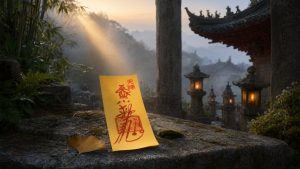
Mt. Longhu Celestial Master Consecrated Career & Success Talisman (Shi Ye Fu)
When luck stalls, energy needs to shift. The Luck Transformation Talisman channels the ancient Ta
This isn’t superstition. It’s neuro-geographic resonance—observed, recorded, and refined over centuries.
3 Immediate Feng Shui Fixes for Your Next Meeting (No Renovation Needed)
You don’t need to tear down walls or hire a feng shui master. These three adjustments—grounded in Ming Tang theory and validated in real corporate settings—take under five minutes and shift energetic authority before the first slide loads.
✅ Fix #1: Map Your True Ming Tang — Not the Floor Plan
Most people assume the ming tang is the open space in front of the speaker.
Wrong.
In business feng shui, the ming tang is the clearest, most unobstructed zone where intention can gather and project. It’s rarely centered—it’s relational.
Do this now: Stand at the seat where you’ll speak. Close your eyes. Slowly turn your head left to right—without moving your feet. Notice where your peripheral vision feels open, calm, and uninterrupted. That’s your true ming tang.
Then:
– Remove anything breaking that field: a potted plant, a leaning stack of reports, a dangling cord.
– If your ming tang opens toward a window, open the blinds fully. Stagnant light = stagnant qi.
– If it opens toward a door, place a small, rounded object (a smooth river stone, a brass gourd) just inside the threshold—not blocking, but anchoring the flow.
Why it works: You’re not “decorating.” You’re clearing a channel for your focused intention to travel—undiluted.
✅ Fix #2: Break the “Mirror Illusion” with a Qi Anchor
Glass walls, mirrored cabinets, or even large framed art with reflective surfaces create what Daoist geomancers call dual-reflection syndrome: your energy splits, trying to inhabit both the real and reflected space. This drains vocal authority and makes you appear hesitant—even when you’re decisive.
Do this now: Identify the largest reflective surface in your ming tang field. Place a single non-reflective, earth-toned object (a ceramic cup, a small jade carving, even a closed leather-bound notebook) directly in front of it, centered at eye level.
Not covering it. Not hiding it. Anchoring it.
This simple act signals to the subconscious: this is the primary reality. Your reflected self recedes; your embodied presence expands.
A marketing director in Berlin used this before pitching to a skeptical VC firm. She placed a black basalt sphere in front of her glass-walled office. Her team reported her voice sounded “fuller,” “more grounded”—and the investors agreed to terms 48 hours earlier than expected.
✅ Fix #3: Activate the “Silent Witness” Corner
Every rectangular room has four corners. Classical feng shui identifies the back-left corner (as you face the main door) as the Wen Chang position—the seat of strategic clarity, reputation, and persuasive influence.
But here’s the insight most miss: it doesn’t need to be “enhanced.” It needs to be “witnessed.”
In the Zhen Yuan Feng Shui Manual (1589), masters instructed officials to place a single, upright, unadorned rod—often bamboo or polished wood—in this corner before high-stakes audiences. Not for luck. To stabilize the field of perception.
Do this now: Find the back-left corner of your meeting room (as you face the main entrance). Place one tall, slender, natural object there: a standing bamboo stalk, a single dried lotus stem, or even a slim, unvarnished wooden dowel (24–36 inches tall).
No incense. No talisman. Just quiet verticality.
This subtly shifts the room’s energetic gravity—making your presence feel less like “a person speaking,” and more like “a force emerging from the space itself.”
When Space Alone Isn’t Enough: The Role of Consecrated Intention
These fixes work. Deeply.
But let’s name what they don’t address: the residue of past negotiations.
That conference room has hosted dozens—maybe hundreds—of meetings. Some ended in conflict. Some in betrayal. Some in exhaustion. Each left an imprint—not mystical, but bioenergetic. Like scent lingering in fabric, unresolved emotional charge accumulates in shared spaces.
Western approaches clean the carpet. Taoist ritual cleans the qi.
That’s where consecrated tools enter—not as magic, but as intentional amplifiers.
The Mt. Longhu Celestial Master Consecrated Career & Success Talisman (Shi Ye Fu) isn’t worn to “get promoted.” It’s activated to anchor your professional ming tang*—to remind your nervous system, every time you glance at it, that your authority is inherent, unassailable, and rooted in celestial order—not corporate hierarchy.
This talisman is drawn by ordained Zhengyi priests at the Celestial Masters’ Mansion on Mt. Longhu—the same lineage that served imperial courts for over 1,200 years. Its inscription invokes Wen Chang Daxing, the Star of Literary Brilliance and Strategic Influence, whose energy governs clarity, persuasion, and decisive action.
It’s not placed on the table. It’s placed where your gaze returns naturally—on your laptop lid, inside your notebook cover, or on the shelf behind your monitor. Its purpose? To serve as a silent, sacred qi anchor—a point of energetic return when the room tries to pull you off-center.
For executives who’ve used it in negotiation prep, the effect is consistent: less mental rehearsal, more instinctive fluency. Less second-guessing, more grounded assertion. Not because the talisman “does the talking”—but because it helps your own energy stay coherent, even in a chaotic field.
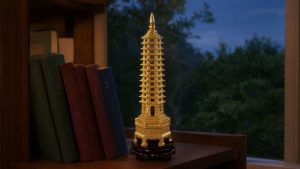
We also recommend pairing it with the Wen Chang Pagoda—a brass feng shui cure traditionally placed in the back-left corner (the Wen Chang position) of offices and meeting rooms. Its nine-tiered structure symbolizes ascending clarity, and its weight stabilizes the very corner you activated in Fix #3. Together, they form a personal + spatial alignment system.
Taoist talismans are sacred spiritual tools rooted in 1,800 years of tradition. Their power comes from sincere belief and the consecration rituals of ordained priests. Results vary by individual—approach with an open heart and respectful intention.
What Your Office Really Says About Your Career Trajectory
Here’s the uncomfortable contrast most business schools won’t teach you:
Western self-help says: “Your success depends on your skills, your network, and your mindset.”
Taoist wisdom says: “Your success depends on your skills, your network, your mindset—and the integrity of the space where you deploy them.”
One treats environment as background noise.
The other treats it as co-author.
Neither is wrong. But when you’re negotiating multimillion-dollar contracts—or simply asking for a raise—you’re not operating in a vacuum. You’re operating inside a living field of energy, history, and resonance.
That field can amplify you.
Or it can absorb you.
The choice isn’t mystical.
It’s architectural. It’s intentional. It’s yours.
So next time you walk into a meeting room—pause for three seconds before sitting.
Feel the floor beneath you.
Scan the ming tang.
Ask yourself: Is this space holding my authority—or scattering it?
Then make one adjustment.
Just one.
Because in the ancient halls of Mt. Longhu, the greatest masters didn’t wait for perfect conditions.
They began by aligning one thing.
And watched everything else follow.
Further Reading & Cultural Context
- Taoism on Wikipedia — Overview of Taoist philosophy, history, and practices
- Feng shui principles — Traditional Chinese geomancy and environmental harmony
FAQ
Q: Can I use these fixes in a rented office or coworking space?
A: Absolutely. All three fixes are non-permanent, portable, and require no landlord approval. The bamboo stalk? Remove it after the meeting. The river stone? Fits in your bag. The talisman? Lives in your notebook. Taoist practice honors adaptability—it’s why Zhengyi Daoism thrived for 1,800 years across dynasties, wars, and empires.
Q: Do I need to believe in feng shui for this to work?
A: No. You don’t need to “believe” in acoustics to benefit from soundproofing. These principles operate at the level of environmental psychology, neurophysiology, and spatial cognition—fields increasingly validated by modern science. Think of ming tang as the feng shui term for “optimal negotiation ergonomics.”
What area of your life feels most blocked right now?
Frequently Asked Questions
Can I use these fixes in a rented office or coworking space?
Absolutely. All three fixes are non-permanent, portable, and require no landlord approval. The bamboo stalk? Remove it after the meeting. The river stone? Fits in your bag. The talisman? Lives in your notebook. Taoist practice honors adaptability—it’s why Zhengyi Daoism thrived for 1,800 years across dynasties, wars, and empires.
Do I need to believe in feng shui for this to work?
No. You don’t need to 'believe' in acoustics to benefit from soundproofing. These principles operate at the level of environmental psychology, neurophysiology, and spatial cognition—fields increasingly validated by modern science. Think of ming tang as the feng shui term for 'optimal negotiation ergonomics.'
Related Taoist Instruments
About DeHuiTang — This article is part of our Taoist cultural education series. Explore more authentic Taoist knowledge, Feng Shui wisdom, and destiny philosophy at our main site.