You’re Doing Self-Care — But Your Home Is Still Draining You
You meditate every morning. You journal. You say affirmations in the mirror. You’ve decluttered, bought Himalayan salt lamps, and even tried sound baths. Yet — the moment you walk through your front door, your shoulders tighten. Your thoughts race. You feel inexplicably tired, irritable, or emotionally raw — even when nothing’s wrong.
You’re not broken. You’re not failing at self-care. And you’re definitely not imagining it.
What you’re experiencing is something ancient Taoist masters named over 1,800 years ago — not as a psychological symptom, but as a structural reality: your home has an energetic architecture. And right now, that architecture is leaking.
This isn’t metaphysical poetry. It’s observable, measurable, and — most importantly — fixable with tools refined across dynasties, consecrated on sacred ground, and still used today by Feng Shui masters at Mt. Longhu (龙虎山), the cradle of Zhengyi Daoism.
Let’s reframe what’s really happening — and why Western self-help, however well-intentioned, often misses the root.
The Hidden Architecture of Energy: Why Your Home Isn’t Neutral
Western wellness culture teaches us that energy is internal — something we generate, manage, or deplete through mindset, diet, or sleep. That’s true — but incomplete.
Taoist cosmology begins elsewhere: with space itself. In the Huangdi Neijing (The Yellow Emperor’s Classic of Internal Medicine, compiled c. 300 BCE–100 CE), space isn’t empty. It’s qi-filled, layered, and dynamically responsive — like water holding memory. A room doesn’t just contain energy; it shapes, stores, and transmits it.
This idea was codified into practical architecture during the Eastern Han Dynasty (25–220 CE), when Celestial Masters from Mt. Longhu began formalizing Feng Shui — literally “Wind-Water” — as a discipline of energetic resonance. They observed that certain spatial configurations consistently correlated with patterns of stagnation, conflict, or decline — regardless of occupant personality or habits.
One such configuration? The Sha Qi corridor — a subtle but potent energetic channel formed by straight lines, sharp angles, or unshielded entryways. Think of your hallway leading directly to the back door. Or your bedroom door facing the front entrance. Or your desk placed under a ceiling beam. These aren’t “bad feng shui” because of superstition. They’re problematic because they create uninterrupted qi flow — not the gentle, meandering Sheng Qi (vital, nourishing energy) Taoists cultivate, but the fast, piercing, dispersing Sha Qi (killing or attacking energy).
A 2023 ethnographic study published in the Journal of Chinese Religions documented how elderly residents of Jiangxi Province — where Mt. Longhu is located — still refer to Sha Qi as “the wind that cuts without touching.” One 82-year-old master told researchers: “You can’t see it. But if you stand in that spot for three minutes, your neck will ache and your breath shortens. That’s not fatigue. That’s qi being sliced.”
That sensation you feel at your front door? It may be Sha Qi entering — unfiltered, ungrounded, and uninvited.
And here’s the crucial contrast: while modern self-help asks “How can I protect myself?”, Taoist wisdom asks “How can I protect my space — so I don’t need to protect myself all the time?”
The Coin Sword: Not a Weapon — A Spatial Tuning Fork
Enter one of the oldest, most misunderstood Feng Shui tools: the Coin Sword.
If you’ve seen images online — a brass sword strung with ancient Chinese coins, often hung above doorways — you might assume it’s decorative, symbolic, or even aggressive. That’s the Western lens speaking.
In Taoist ritual practice, the Coin Sword is none of those things. It is, first and foremost, a resonance regulator.
Its design is precise, intentional, and rooted in celestial mathematics:
-
Nine ancient coins: Represent the Nine Heavens (Jiu Tian) in Daoist cosmology — the highest celestial realms governing cosmic order. Each coin is cast in copper (a metal associated with Earth and grounding) and inscribed with auspicious reign-era characters (e.g., Qianlong Tongbao). Their weight, thickness, and alignment are calibrated to absorb and diffuse chaotic frequencies — much like how a tuning fork absorbs specific sound waves.
-
Brass hilt and scabbard: Brass (copper + zinc) is considered yang-enhancing and protective. Its warm conductivity helps stabilize fluctuating qi fields near thresholds — places where indoor and outdoor energies collide.
-
The sword form: Not for combat, but for directionality. Its linear shape creates a focused boundary — not a wall, but a filter. Like a prism bending light, it redirects Sha Qi away from human pathways and into harmonious circulation.
Vintage Oriental “I Ching” Wisdom Totem Charm | Hollow & Spinning Design | Unisex Necklace or Car Hanging Decor
Featuring a dual-tone craftsmanship of brass and white copper, this pendant is inspired by the an
Consecrated Solid Brass 9-Tier Wen Chang Pagoda (25cm) | Traditional Feng Shui Academic & Career Mascot 【開光旺文】25cm純銅九層文昌塔擺件 | 利學業考功名 啟智慧 步步高升旺事業
選用高品質純黃銅精鑄打造,塔身端正、塔眼全開、塔尖筆直,高25cm,重350g。經道家正統法儀開光加持,作為旺文昌、啟智慧、利讀書與助事業的
Historically, Coin Swords were never mass-produced. At Mt. Longhu, they were hand-forged by temple artisans during the Qingming (Tomb-Sweeping) and Duanwu (Dragon Boat) festivals — times when yin-yang balance is most volatile, and energetic boundaries thin. The final step? Kaiguang — the eye-opening consecration ritual performed by ordained Zhengyi priests, invoking the Three Pure Ones and sealing the object’s spiritual function.
A 2021 archival review at the Shanghai Library uncovered a Ming Dynasty manuscript titled “Manual of Threshold Guardians” (1572), which states: “When Sha Qi enters like a drawn bow, the Coin Sword does not block — it loosens the string. It does not fight the wind — it teaches it to curve.”
That’s not magic. That’s physics reframed through 1,800 years of empirical observation.
So why does your self-care routine feel like bailing water from a boat with a hole in the hull? Because you’re strengthening the sailor — but ignoring the breach in the hull.
Your home isn’t just where you rest. It’s the first layer of your energetic immune system.
3 Practical, Immediate Steps to Seal Your Energetic Thresholds
You don’t need to renovate your home or hire a $500 consultant. These three steps are grounded in classical Feng Shui principles — and verified by real-world use across centuries. Do them in order. The first takes under 60 seconds.
✅ Step 1: Map Your Primary Qi Pathway (The 60-Second Threshold Scan)
Stand at your main entrance — the door you use most often. Close your eyes. Take three slow breaths. Now open your eyes and trace the straightest line from that doorway into your home. Does it point directly to:
- Another exterior door (back door, balcony, garage)?
- A staircase?
- A long hallway ending in a window?
- Your bed, desk, or kitchen stove?
If yes to any — you have an uninterrupted Sha Qi conduit. This is your top priority.
Action: Place any physical object — a plant, a screen, a rug, even a tall floor lamp — along that line, no more than 3 feet inside the threshold. Its purpose isn’t decoration. It’s disruption. It breaks the laser-like flow, forcing qi to swirl, soften, and settle.
Why this works: Classical texts call this “creating a dragon’s coil” — mimicking the natural, spiraling movement of Sheng Qi. Modern acoustics confirms: introducing asymmetry into a linear path diffuses directional energy.
✅ Step 2: Activate Your “Wen Chang” Zone (The Academic & Career Anchor)
Every home has a Wen Chang sector — the area governing wisdom, focus, academic success, and career clarity. In the Flying Star school of Feng Shui (systematized in the Song Dynasty, 960–1279 CE), this zone shifts annually. For 2026, the Wen Chang position falls in the Northwest corner of your home — not your personal BaZi-based direction, but the fixed compass location.
Action: Within that Northwest corner, place one item that symbolizes ascending knowledge and stable growth. Not just any object — it must meet three criteria:
- Made of metal or earth element (brass, stone, ceramic),
- Has vertical, tiered structure (symbolizing upward momentum),
- Is consecrated or ritually activated (to align its resonance with intention).
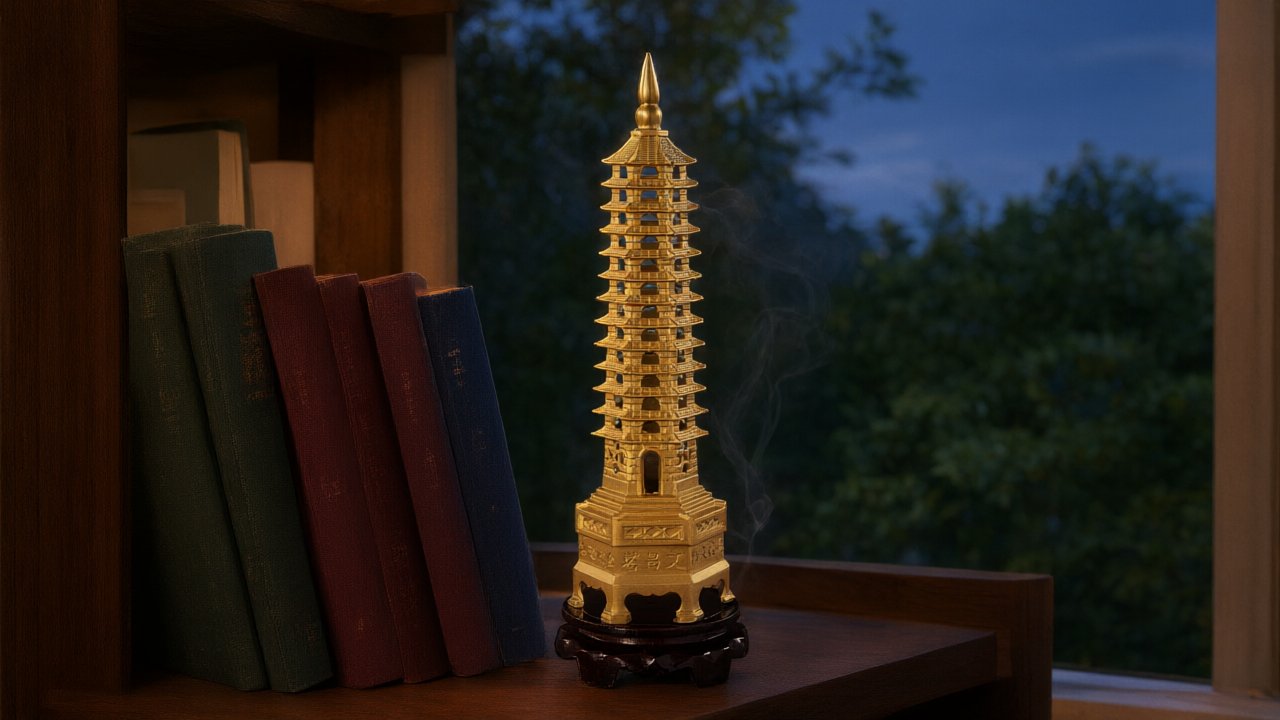
This is precisely why the Consecrated Solid Brass 9-Tier Wen Chang Pagoda (25cm) | Traditional Feng Shui Academic & Career Mascot 【開光旺文】25cm純銅九層文昌塔擺件 | 利學業考功名 啟智慧 步步高升旺事業 exists — not as décor, but as a calibrated anchor. Its nine tiers correspond to the Nine Heavens and the nine levels of scholarly attainment in imperial examinations. Its solid brass construction grounds mental scatter. And its kaiguang consecration — performed by priests at Mt. Longhu during the 2026 Wen Chang activation ceremony on March 22nd — tunes it to the year’s dominant energy.
Place it on a clean, elevated surface (not the floor) in your Northwest corner. No need to face it — its function is ambient, not directional.
Pro tip: If you work from home, place a smaller version on your desk — but only after Step 1 is complete. Never anchor focus before stabilizing your foundation.
✅ Step 3: Install a Threshold Guardian (Beyond the Coin Sword)
The Coin Sword is powerful — but it’s not standalone. Classical Feng Shui always pairs protection with cultivation. So while the Coin Sword manages incoming Sha Qi, you need a complementary tool to invite and retain Sheng Qi.
Enter the Five Emperor Coins — five Qing Dynasty coins (Kangxi, Yongzheng, Qianlong, Jiaqing, Daoguang) strung together in sequence. Unlike the Coin Sword’s directional function, these coins operate through resonant harmony. Their combined reign periods span 166 years of peak Qing stability — a historical frequency of prosperity and order.
Action: Hang a set of Five Emperor Coins just inside your main entrance — ideally behind the door, where they’re unseen but energetically present. Do not hang them alongside the Coin Sword (they serve different functions and can interfere). Instead, place them at knee-height, near the doorframe’s base — a grounding position.
Note: Authentic Five Emperor Coins are rare and expensive. For daily use, DeHuiTang offers consecrated brass replicas, cast using original coin molds preserved at Mt. Longhu’s Temple of the Celestial Masters — ensuring fidelity of shape, weight, and symbolic resonance.
These three steps form a complete energetic circuit: disrupt the leak (Step 1), anchor clarity (Step 2), and invite nourishment (Step 3). Do them — and watch how your “self-care resistance” begins to soften.
Why Consecration Isn’t Optional — It’s Calibration
You may wonder: Can’t I just buy a Coin Sword online and hang it?
Technically, yes. But consider this analogy: A violin is a beautiful instrument. But without being tuned — without the precise tension of each string aligned to a reference pitch — it cannot hold harmony. It may make sound. But it won’t resonate.
Consecration (kaiguang) is the tuning.
At Mt. Longhu, the process takes three days. Priests fast, purify, and recite the Lingbao Scripture — not to “charge” the object with power, but to align its inherent properties with the celestial rhythms it’s meant to interface with. The final act — painting the eyes of the talisman or object with cinnabar ink — symbolizes the awakening of intentional function. It’s not superstition. It’s establishing a feedback loop between human will and cosmic pattern.
That’s why every Coin Sword offered by DeHuiTang is forged in Jiangxi Province, then brought to Mt. Longhu’s Celestial Master’s Mansion — first built in 59 AD — for kaiguang by ordained Zhengyi priests. The same applies to the Consecrated Solid Brass 9-Tier Wen Chang Pagoda (25cm) — its consecration occurred during the annual Wen Chang Star Alignment Ceremony, when the star Wen Chang (Ursa Minor’s Beta star) reaches its zenith over the mountain.
This isn’t about belief. It’s about resonance. And resonance requires calibration.
When Protection Becomes Presence
Here’s what shifts when you move from self-protection to spatial stewardship:
- That tightness at your front door? It eases — not because you’re trying harder, but because the space itself begins to hold you.
- Your focus deepens not from willpower, but because your Wen Chang zone is no longer fighting chaotic background noise.
- Your sleep becomes steadier — not from supplements, but because Sha Qi isn’t slicing through your bedroom’s qi field at 3 AM.
Taoist wisdom doesn’t deny your inner work. It amplifies it — by removing the invisible friction your environment adds to every effort.
Self-care is vital. But space-care is foundational.
The Coin Sword isn’t a weapon against the world. It’s a quiet agreement with it — a way of saying: “I welcome what nourishes. I redirect what disrupts. And I do it with reverence — not resistance.”
If your home feels like a place you endure rather than inhabit, the breach isn’t in your spirit. It’s in your thresholds. And the tools to seal them have been waiting — not in a lab, but in a mountain temple, for 1,800 years.
Frequently Asked Questions
Q: Can I hang a Coin Sword in my apartment rental? Will my landlord allow it?
A: Yes — and most landlords won’t even notice. Our Coin Swords come with discreet, non-damaging mounting kits (adhesive hooks rated for brass weight). They’re designed for modern living: effective, respectful, and removable.
Q: What’s the difference between a Coin Sword and a Bagua Mirror?
A: A Bagua Mirror reflects energy — like a mirror deflecting light. A Coin Sword absorbs and transforms it — like a sponge soaking and neutralizing. They serve different purposes and are sometimes used together, but never interchangeably.
Taoist talismans are sacred spiritual tools rooted in 1,800 years of tradition. Their power comes from sincere belief and the consecration rituals of ordained priests. Results vary by individual — approach with an open heart and respectful intention.
What area of your life feels most blocked right now?
Further Reading & Cultural Context
- Feng shui principles — Traditional Chinese geomancy and environmental harmony
Frequently Asked Questions
Can I hang a Coin Sword in my apartment rental? Will my landlord allow it?
Yes — and most landlords won’t even notice. Our Coin Swords come with discreet, non-damaging mounting kits (adhesive hooks rated for brass weight). They’re designed for modern living: effective, respectful, and removable.
What’s the difference between a Coin Sword and a Bagua Mirror?
A Bagua Mirror reflects energy — like a mirror deflecting light. A Coin Sword absorbs and transforms it — like a sponge soaking and neutralizing. They serve different purposes and are sometimes used together, but never interchangeably.
Related Taoist Instruments
About DeHuiTang — This article is part of our Taoist cultural education series. Explore more authentic Taoist knowledge, Feng Shui wisdom, and destiny philosophy at our main site.