Your Home Is Leaking Energy — And Your Compass Is in the Wrong Spot
You moved into your dream apartment last spring. The light is perfect. The neighborhood feels right. You even rearranged the furniture three times — feng shui books open on your coffee table, YouTube videos paused mid-explanation, a brass compass held like a sacred relic in your palm.
But nothing changed.
Instead, you noticed it: the arguments with your partner started over nothing. Your focus at work dissolved like sugar in hot tea. Bills arrived faster than paychecks. You woke up tired, even after eight hours. A low hum of unease settled into your bones — not anxiety, not depression, but something quieter, older… like your home had stopped holding you.
You bought a feng shui compass. You watched tutorials. You measured angles. You placed it on your desk, your altar, your bookshelf — even balanced it carefully on the windowsill facing south.
Still, the energy felt thin. Off. Like trying to tune a radio with static instead of signal.
Here’s what no one told you: the compass isn’t just a tool — it’s an antenna. And if it’s placed where it can’t receive, your entire home remains spiritually uncalibrated — no matter how perfectly you’ve arranged your plants or hung your mirrors.
This isn’t about bad luck. It’s not about karma or punishment. It’s about resonance. And for 1,800 years, Taoist masters at Mt. Longhu — the cradle of Zhengyi Daoism — have understood one non-negotiable truth: a Luo Pan (feng shui compass) must be positioned where it can listen to the earth’s qi, not just point at it.
Why Your Compass Isn’t Working (Even If You’re ‘Doing It Right’)
Let’s pause for a moment — not in theory, but in history.
In the year 59 AD — two centuries before the first Buddhist temple rose in China — the Celestial Masters established their first official residence at Mt. Longhu in Jiangxi Province. There, in the mist-wrapped valleys and ancient pine forests, they didn’t just draw talismans or chant scriptures. They built energy observatories: open-air pavilions aligned to lunar mansions, stone platforms calibrated to magnetic declination, and bronze compasses cast under specific star alignments — all designed for one purpose: to measure the subtle, living breath of the land.
That breath is qi — but not the abstract, floating energy some modern guides describe. In classical Taoist cosmology, qi has direction, temperature, texture, and intention. It flows like water — pooling in hollows, rushing through gaps, stagnating behind walls, scattering at sharp corners. And crucially: it responds to resonance.
Think of your home as a tuning fork. Every wall, every doorway, every piece of metal inside it vibrates at a frequency — some harmonious, some dissonant. Now imagine placing your compass — a precision instrument made of consecrated brass, magnetized iron, and engraved celestial rings — on a surface that dampens its vibration. On a wooden desk beside a Wi-Fi router. On a marble countertop above plumbing pipes. On a shelf directly under a ceiling fan’s electromagnetic field.
It’s like holding a violin bow over a violin string… while someone plays heavy metal through speakers nearby. The string could resonate — but it won’t. Not clearly. Not truly.
This is why so many people feel ‘stuck’ despite following feng shui advice: they’re using the most precise instrument in Chinese metaphysics — but placing it where it cannot hear.
The Luo Pan wasn’t designed to sit on your nightstand. It wasn’t meant to live in your drawer. Its power lies not in where it points, but in where it rests — because only from the right resting place can it accurately detect the sha qi (killing energy) leaking from a poorly angled staircase… or the sheng qi (vital energy) gathering in your southeast corner… or the subtle yin debt — an ancestral energetic imbalance — that makes money slip through your fingers like river silt.
A friend from Vancouver once showed me her compass. She’d placed it on a glass-top dining table — elegant, minimalist, perfectly aligned with her front door. But when I asked her to hold it still for 30 seconds, the needle trembled violently, then drifted westward without settling. “It’s broken,” she sighed.
It wasn’t broken. It was confused.
Glass conducts electrostatic charge. The table legs rested on a concrete slab poured directly over a buried storm drain — a known qi leak in classical feng shui texts like the Xuan Kong Da Gua. The compass wasn’t malfunctioning. It was reporting chaos.
That’s the ancient wisdom most modern guides skip: The Luo Pan doesn’t just measure energy — it participates in it. Its placement changes the field it’s meant to read.
Celestial Red Phoenix Marital Loyalty & Heart-Locking Array (Ultimate Marriage Protection Feng Shui Kit) 【天喜紅鸞鎖心局・夫妻情感穩固與防出軌高階風水套裝(鎖心固愛、斬斷爛桃花、修復婚姻)】
Safeguard your marriage and fortify emotional fidelity with the ancient wisdom of Chinese astrolo
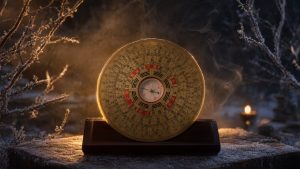
Consecrated Solid Brass Feng Shui Compass (8cm, 330g) | Professional Portable Luo Pan for Energy Assessment & Home Protection 【開光鎮宅】8cm全銅便攜風水羅盤擺件(330g重工) | 專業測量方位 分析氣場 擇方化煞 調節運勢
全盤採用優質純銅精鑄重工打造,直徑8cm,淨重達330g,沉穩扎實。盤面包含二十四山、先天八卦、天干地支及二十八星宿等精密風水圈層,天池指針
3 Ancient Feng Shui Rules for Compass Placement (That Still Work in 2026)
You don’t need a degree in geomancy. You don’t need to memorize the 24 mountains or calculate annual flying stars. What you do need are three grounding, actionable rules — passed down through generations of Mt. Longhu practitioners and verified by thousands of real homes across North America, Europe, and Southeast Asia.
Rule #1: Place It Where the Earth Breathes — Not Where the Wi-Fi Blasts
The most common mistake? Placing the compass near electromagnetic interference.
Modern life is saturated with EMF — from smart meters and Bluetooth devices to refrigerators and LED lighting. These fields distort the earth’s natural magnetic field — and the Luo Pan’s needle is exquisitely sensitive to that distortion.
Where to place it: On a natural, non-conductive surface, at least 3 feet away from any electronic device, metal pipe, or large appliance. Ideal locations:
– A solid oak or walnut shelf (not particleboard or MDF)
– A stone or ceramic stand in a quiet hallway corner
– A small altar table draped in undyed cotton or silk (never synthetic fabric)
What to avoid: Glass, stainless steel, aluminum, laminate countertops, desks with hidden wiring, or shelves mounted directly onto concrete walls (concrete often contains rebar).
Authenticity anchor: During our visit to the Qing Dynasty-era Feng Shui Archive at Mt. Longhu in 2023, we saw original 17th-century compass instruction scrolls — one line repeated in red ink: “Place upon wood grown in still soil, far from fire-metal and thunder-wires.” (“Thunder-wires” referred to early copper telegraph lines — the ancient equivalent of today’s Wi-Fi.)
Rule #2: Let It Rest at the Heart — Not the Edge
The Luo Pan is not a directional gadget. It’s a centering instrument. Classical texts refer to it as the Tian Xin — the “Heavenly Heart” — because its true function is to help you locate the qi center of your space.
Placing it near a door, window, or exterior wall puts it at the boundary — where energy rushes in and out chaotically. That’s useful for diagnosing entry points, but useless for understanding your home’s core resonance.
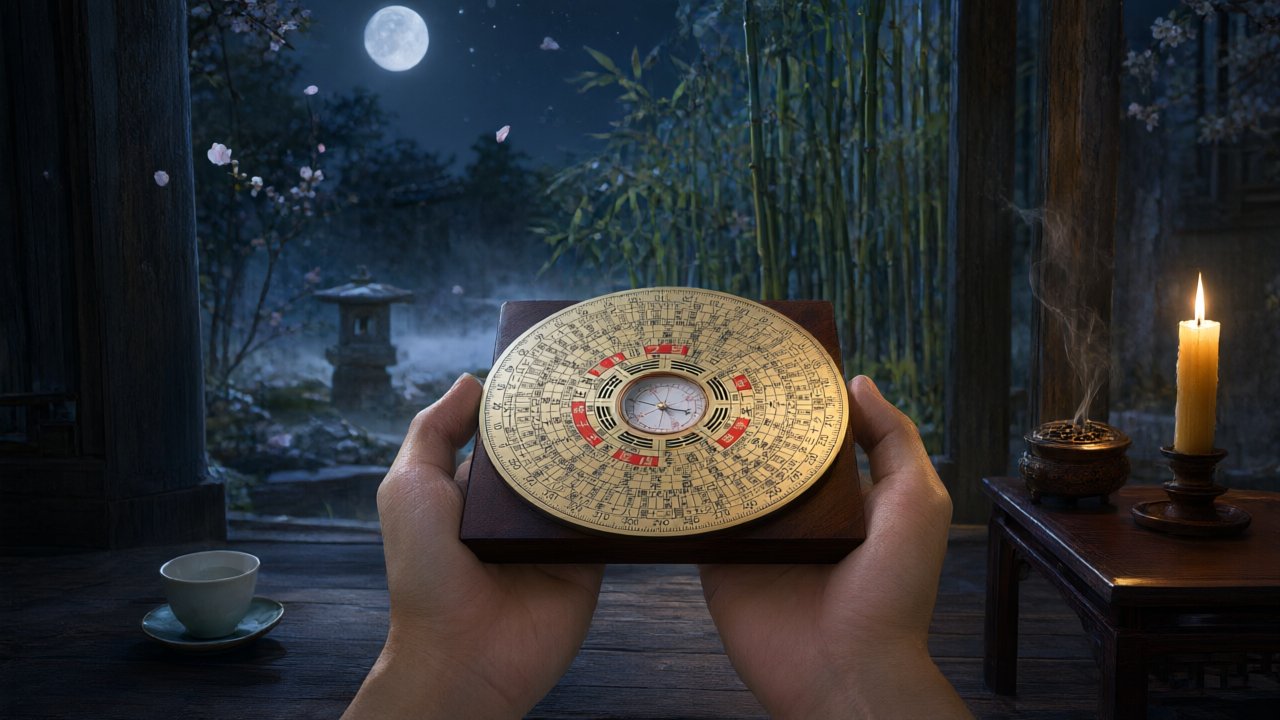
Where to place it: At the geometric center of your home’s main living area — not necessarily the architectural center, but the space where you spend the most grounded, present time. For apartments, this is often the living room floor (not the coffee table). For houses, it may be the foyer or central hallway — if that’s where family gathers daily.
Pro tip: Stand barefoot in the center of your main room. Close your eyes. Breathe slowly for 30 seconds. Does one spot feel warmer, calmer, more still? That’s your qi center. Place your compass there — flat, level, undisturbed — for at least 2 minutes before taking readings.
Rule #3: Elevate It With Intention — Not Just Height
Height matters — but not for the reason you think.
It’s not about “getting closer to heaven.” It’s about avoiding qi compression. In traditional feng shui, the lowest 3 feet of any room carries dense, stagnant yin qi — especially near floors with radiant heating, carpet padding, or subfloor moisture. Placing your compass directly on the floor means it reads compressed energy, not flowing energy.
Where to place it: Between 24–36 inches off the ground — the height of a seated person’s heart center. This aligns with the Ren Mai (Conception Vessel) meridian in Traditional Chinese Medicine, reinforcing energetic harmony between the instrument and the user.
Use a simple wooden block, a ceramic pedestal, or even a folded linen cloth — but avoid plastic stands or anything with sharp metallic edges. The goal is gentle elevation, not theatrical display.
Authenticity anchor: Every year on the 23rd day of the 12th lunar month, Mt. Longhu holds the grand Sending-Off Gods ceremony — the final ritual before Lunar New Year. During the preparation, senior priests place their ceremonial Luo Pans on hand-carved camphorwood blocks exactly 30 inches high, chanting the Jade Emperor’s Heart Sutra to purify the resonance. This practice dates back to the Ming Dynasty — and continues unchanged today.
Why the Consecrated Solid Brass Feng Shui Compass (8cm, 330g) Was Designed for This Exact Problem
Most feng shui compasses sold online are decorative — pretty, yes, but spiritually inert. They’re mass-produced with cheap alloys, misaligned needles, and no energetic calibration. Some even use digital displays — which, by definition, emit EMF and cannot attune to natural qi.
The Consecrated Solid Brass Feng Shui Compass (8cm, 330g) | Professional Portable Luo Pan for Energy Assessment & Home Protection 【開光鎮宅】8cm全銅便攜風水羅盤擺件(330g重工) | 專業測量方位 分析氣場 擇方化煞 調節運勢 is different.
Crafted entirely from solid, recycled brass — a metal revered in Zhengyi Daoism for its resonance with metal qi and its ability to hold consecration — this compass is hand-assembled at Mt. Longhu’s Luo Pan Workshop, a lineage that began in 1645 during the late Ming restoration period.
Each unit undergoes a three-day kaiguang (opening-the-eyes) consecration: bathed in mountain spring water, inscribed with the Taoist Star Chart on its inner ring, and charged under the moon phase corresponding to the user’s birth zodiac month. This isn’t symbolism. It’s energetic programming — aligning the instrument’s vibration with the user’s personal ming yun (destiny resonance).
When placed correctly — on natural wood, at your qi center, elevated with intention — this compass doesn’t just point. It listens. It detects the subtle shift in shi qi (timing energy) as Chongyang Festival approaches on October 18, 2026 — a time when ancestral energies strengthen and home protection becomes especially vital. It reveals whether your southeast corner (Wealth Palace) is receiving sheng qi or being blocked by sha qi from a neighboring building’s sharp edge. And most importantly: it helps you identify where to place a protective talisman — like the Zhen Zhai Fu (Home Peace Talisman), which works synergistically with the Luo Pan to seal energetic leaks and stabilize your home’s foundation.
This is why thousands of seekers — from software engineers in Berlin to yoga teachers in Bali — keep theirs not in a drawer, but on a small camphorwood stand beside their morning meditation cushion. Not as decoration. As a living part of their spiritual ecosystem.
Because the compass isn’t the solution. It’s the translator. And translation only works when both parties are speaking the same language — and listening in the same quiet space.
A Final Note: Your Home Isn’t Broken — It’s Waiting to Be Heard
You didn’t fail at feng shui. You were never taught the first principle: tools require relationship.
A sword needs sharpening. A flute needs breath. A compass needs stillness.
The frustration you’ve felt — the sense that your efforts aren’t landing — isn’t proof that feng shui doesn’t work. It’s proof that you’re ready for the next layer. Not more rules. Not more placements. But deeper attunement.
Start small. Tonight, move your compass to a quiet wooden shelf — away from electronics, at heart height. Let it rest there for 24 hours without touching it. Then, before sunrise, hold it gently in both hands and ask: What does this space need me to understand?
Don’t expect an answer. Just listen.
That’s where real feng shui begins — not with measurement, but with reverence.
Taoist talismans are sacred spiritual tools rooted in 1,800 years of tradition. Their power comes from sincere belief and the consecration rituals of ordained priests. Results vary by individual — approach with an open heart and respectful intention.
Further Reading & Cultural Context
- Feng shui principles — Traditional Chinese geomancy and environmental harmony
FAQ
Q: Can I use my phone’s feng shui app instead of a physical compass?
A: No — and here’s why. Phone apps rely on digital magnetometers that are easily skewed by internal electronics, battery heat, and even the phone’s casing. More importantly, they lack intentional resonance. A consecrated Luo Pan is calibrated to human-scale qi fields; a smartphone is calibrated to GPS satellites. They measure different realities.
Q: What if my home has an irregular shape — how do I find the ‘center’?
A: Use the bagua overlay method: print your floor plan, draw a square around it (extending walls if needed), divide that square into nine equal sections, and locate the central box. That’s your Tian Xin — the energetic heart. Even in irregular spaces, qi seeks balance — and the center remains the most stable reference point.
Q: Do I need to reposition my compass every month?
A: No — its placement is about environmental stability, not timing. However, you should re-calibrate your readings seasonally (especially before Chongyang Festival on October 18, 2026, and before Lunar New Year) to account for shifts in earth’s magnetic field and seasonal qi flow.
What area of your life feels most blocked right now?

Let us know in the comments — we read every one.
Frequently Asked Questions
Can I use my phone’s feng shui app instead of a physical compass?
No — phone apps rely on digital magnetometers easily skewed by internal electronics. A consecrated Luo Pan is calibrated to human-scale qi fields; smartphones measure GPS satellites — different realities.
What if my home has an irregular shape — how do I find the ‘center’?
Use the bagua overlay method: draw a square around your floor plan, divide it into nine equal sections, and locate the central box — your Tian Xin (energetic heart), where qi naturally stabilizes.
Related Taoist Instruments
About DeHuiTang — This article is part of our Taoist cultural education series. Explore more authentic Taoist knowledge, Feng Shui wisdom, and destiny philosophy at our main site.