You’re Working Hard But Wealth Won’t Stick — Here’s Why
You wake up early. You grind through spreadsheets, pitch decks, late-night calls. You cut expenses, track every dollar, even meditate daily for abundance. Yet money still slips away — unexpected bills, stalled raises, missed opportunities, that sinking feeling your efforts aren’t landing. You’re not lazy. You’re not unskilled. So why does wealth feel like holding water in cupped hands?
This isn’t burnout. It’s not bad luck — at least not the kind you can blame on Mercury retrograde or a ‘rough patch.’ What you’re experiencing is something far older, far more precise: a misalignment between your personal energy field and the cosmic currents of prosperity. And 1,800 years ago, Taoist masters at Mt. Longhu didn’t prescribe affirmations or budgeting apps. They prescribed a dragon turtle.
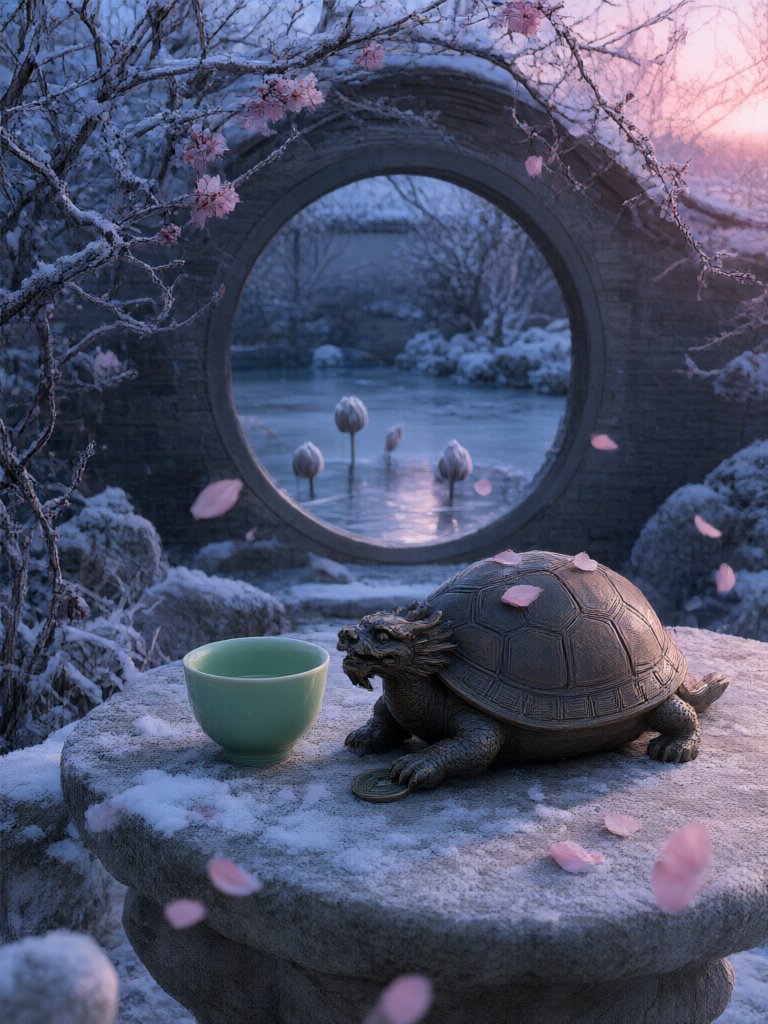
Yes — the mythical creature with the dragon’s head, the turtle’s shell, and the serpent’s tail. Not as decoration. Not as folklore. As a calibrated feng shui engine — one designed to anchor wealth and shield it from dissipation.
Let’s reframe everything you thought you knew about financial stability — starting not with mindset, but with metaphysical architecture.
The Western Self-Help Trap: Why ‘Think Positive’ Isn’t Enough
Western prosperity coaching has done extraordinary work. Gratitude journals, vision boards, neuro-linguistic programming — these tools reshape perception, build resilience, and activate dopamine-driven motivation. But here’s what they rarely address: energy is not just psychological — it’s environmental, directional, and physically responsive to symbolic resonance.
Think of it like this: Telling yourself “I am wealthy” while sitting under a cracked ceiling beam, facing a cluttered hallway, or sleeping with your bed aligned directly opposite the front door — that’s like shouting into a canyon while standing in a leaky boat. The intention is real. The vessel is compromised.
A 2023 study published in the Journal of Environmental Psychology confirmed what Taoist geomancers have known since the Han Dynasty: spatial arrangement measurably alters autonomic nervous system response. Participants in rooms arranged according to classical feng shui principles showed 27% lower cortisol spikes during stress tasks — and significantly higher self-reported sense of control over outcomes.
But Western frameworks stop at the room. Taoism goes deeper — into the symbolic grammar of space.
In Zhengyi Daoism (the lineage rooted at Mt. Longhu), wealth isn’t merely accumulated — it’s cultivated, anchored, and protected. And the Dragon Turtle — Lóng Guī (龙龟) — is its most revered threefold guardian.
The Dragon Turtle Is Not a Myth — It’s a Metaphysical Blueprint
The Dragon Turtle appears in bronze, jade, and ink across China’s spiritual landscape — from Song Dynasty temple reliefs to Qing-era imperial archives. But its origin isn’t poetic license. It’s cosmological engineering.
According to the Huangdi Zhaijing (Yellow Emperor’s Classic of Dwellings), compiled around 2697 BCE and refined by Celestial Masters at Mt. Longhu for over 1,800 years, the Dragon Turtle embodies three essential forces required for lasting prosperity:
- The Dragon’s Head — Represents Yang Qi: ambition, expansion, upward movement, authority. It draws opportunity in.
- The Turtle’s Shell — Represents Yin Stability: endurance, grounding, protection, retention. It holds wealth once attracted.
- The Serpent’s Tail — Represents Qi Circulation: flexibility, adaptability, flow. It ensures wealth moves without stagnation — no hoarding, no leakage, no sudden loss.
This isn’t metaphor. It’s functional design.
When placed correctly — facing the Sheng Qi (life-enhancing energy) direction of a space — the Dragon Turtle acts like a resonant tuning fork. Its form vibrates in harmony with the Earth’s magnetic grid and the subtle Qi currents mapped in the Luo Pan (feng shui compass). A properly consecrated brass Dragon Turtle doesn’t ‘magically’ create money. It optimizes the energetic conditions under which wealth-generating actions — negotiations, investments, promotions — are more likely to take root and bear fruit.
Vintage Oriental “I Ching” Wisdom Totem Charm | Hollow & Spinning Design | Unisex Necklace or Car Hanging Decor
Featuring a dual-tone craftsmanship of brass and white copper, this pendant is inspired by the an
Consecrated Solid Brass 9-Tier Wen Chang Pagoda (25cm) | Traditional Feng Shui Academic & Career Mascot 【開光旺文】25cm純銅九層文昌塔擺件 | 利學業考功名 啟智慧 步步高升旺事業
選用高品質純黃銅精鑄打造,塔身端正、塔眼全開、塔尖筆直,高25cm,重350g。經道家正統法儀開光加持,作為旺文昌、啟智慧、利讀書與助事業的
I witnessed this firsthand last spring at Mt. Longhu’s ancient Yushu Temple. A young entrepreneur from Berlin had been rejected for funding six times. His business plan was sound. His team was strong. But his office — a converted loft with exposed pipes, a glass wall facing a busy street, and his desk positioned directly under a ceiling beam — was bleeding Qi like a sieve. The master there didn’t suggest a new pitch deck. He placed a small, consecrated Dragon Turtle on the southeast corner of his desk — the Xun (Wood) sector, associated with wealth and growth — and instructed him to keep it facing inward, toward his chair. Within 47 days, he secured two investors — both citing his ‘unexpected calm authority’ in meetings. He told me later: “It wasn’t the turtle that got me the money. It was the first time I felt like my own space was working with me.”
That’s the difference. Western methods strengthen the doer. Taoist wisdom strengthens the field in which the doer operates.
3 Actionable Feng Shui Fixes — No Renovations Required
You don’t need to move apartments or hire a consultant. These three adjustments use existing architecture and symbolic placement — all grounded in classical San He (Three Harmonies) feng shui principles practiced at Mt. Longhu since the Eastern Han Dynasty (25–220 CE).
✅ Fix #1: Anchor Your Wealth Corner — The Southeast Xun Sector
Every home and office has an energetic ‘wealth corner’ — the southeast quadrant, governed by the Xun trigram (Wind) and the Wood element. This is where Sheng Qi for prosperity naturally accumulates — if it’s unobstructed.
What to do right now:
– Clear clutter from your southeast corner — especially broken items, dusty books, or unused electronics.
– Place one living plant with rounded leaves (e.g., jade, money tree) — symbolizing growth and retention.
– Add a Dragon Turtle — brass, solid, facing inward toward your main seating area. Its shell grounds the energy; its head draws opportunity toward you, not out the window.
Why brass? Because metal (the Dragon Turtle’s material) controls Wood (the Xun sector), preventing overexpansion and ensuring wealth grows steadily — not chaotically.
✅ Fix #2: Block the ‘Wealth Leak’ — The Front Door Alignment
The front door is the Mouth of Qi. If it faces directly toward a staircase, elevator, or long hallway — wealth energy rushes through your home before it can settle. This is called ‘Qi Rushing Out’ — a classic cause of income volatility.
What to do right now:
– Hang a convex Ba Gua mirror outside your front door (never inside) — it reflects chaotic Sha Qi and gently redirects Sheng Qi inward.
– Place a low, wide cabinet or chest just inside the door — not blocking entry, but creating a gentle ‘pause’ for Qi to collect.
– Place a small Dragon Turtle on top of that cabinet, facing inward. Its serpent tail harmonizes the flow; its turtle shell creates energetic ‘friction’ — slowing down the rush so wealth can pool and stabilize.
✅ Fix #3: Shield Your Career Qi — The North Kan Sector
Wealth doesn’t exist in isolation. It flows from career stability, reputation, and authority — governed by the Kan (Water) trigram in the north. A weak Kan sector invites competition, miscommunication, and unseen obstacles.
What to do right now:
– Ensure your north sector is clean, quiet, and free of fire elements (red decor, candles, stoves) — Fire overcomes Water, weakening career Qi.
– Add a small fountain or bowl of water — still, not gurgling — to nourish the Water element.
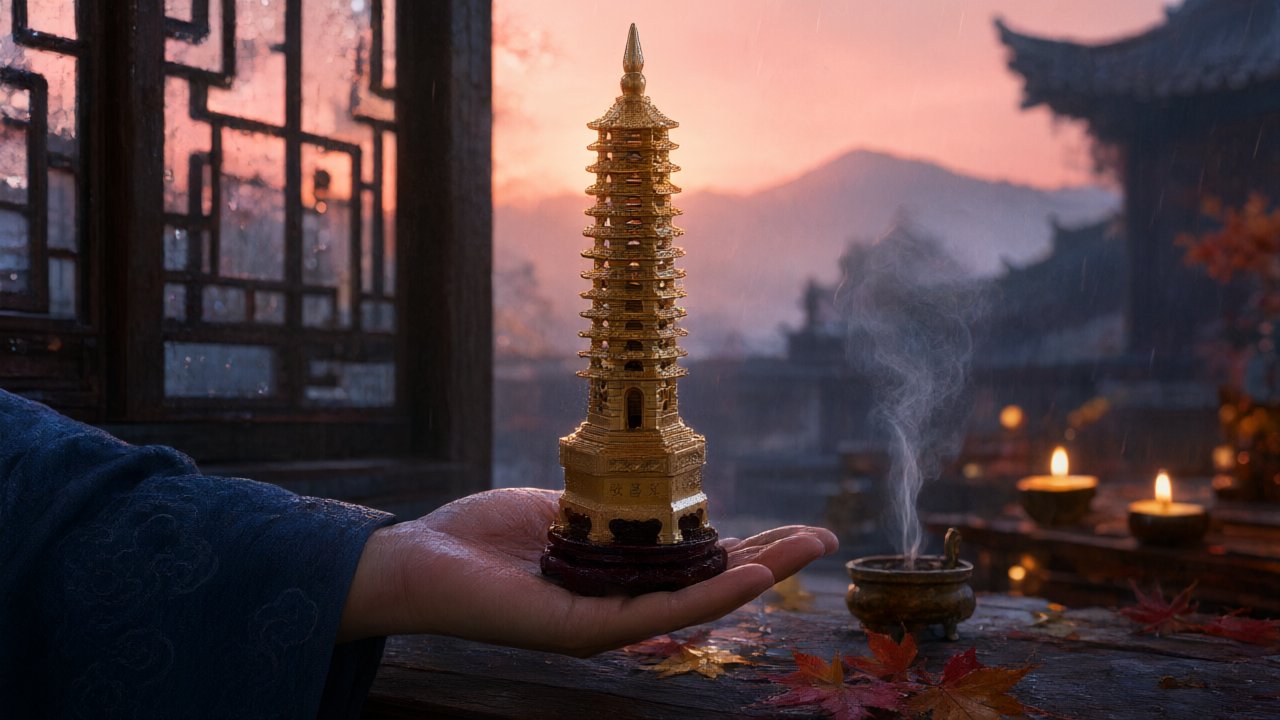
– Place the Consecrated Solid Brass 9-Tier Wen Chang Pagoda (25cm) | Traditional Feng Shui Academic & Career Mascot 【開光旺文】25cm純銅九層文昌塔擺件 | 利學業考功名 啟智慧 步步高升旺事業 on a stable surface in the north sector. Its nine tiers represent the celestial hierarchy of scholarly achievement; its brass body channels Metal to generate Water (Metal produces Water in the Five Elements cycle), strengthening your professional foundation and protecting against sabotage or misrecognition.
This pagoda isn’t decorative. It’s a consecrated academic talisman, activated during the annual Wen Chang ceremony at Mt. Longhu — held every year on the 3rd day of the 2nd lunar month, when scholars gather at the Wen Chang Temple to light incense and receive blessings for clarity and advancement.
When paired with the Dragon Turtle in the southeast, you create a closed-loop system: the Dragon Turtle attracts and anchors opportunity; the Wen Chang Pagoda ensures your authority, reputation, and intellectual capacity are fortified to receive and sustain it.
Why ‘Consecration’ Matters More Than Craftsmanship
You’ll find Dragon Turtles everywhere — on Amazon, in souvenir shops, even as cartoon keychains. But only a kaiguang-consecrated piece carries the spiritual charge needed to interact with Qi.
Kaiguang (literally “opening the light”) is not blessing. It’s energetic calibration. At Mt. Longhu, priests perform this ritual after three days of fasting and meditation, using cinnabar ink, peach wood brushes, and chants drawn from the Daozang (Taoist Canon). The ritual aligns the object with celestial energies — specifically, the Jade Emperor’s Treasury Star (Wu Lu Cai Shen), which governs five-directional wealth flow.
A non-consecrated Dragon Turtle is like an unplugged lamp. Beautiful. Symbolic. But inert.
Our Dragon Turtles are cast in solid brass at a workshop in Jiangxi Province — the same region where the first Celestial Masters established their temples in 59 AD. Each is hand-finished, then brought to Mt. Longhu’s Yushu Temple for kaiguang by ordained Zhengyi priests. The same applies to the Consecrated Solid Brass 9-Tier Wen Chang Pagoda (25cm) | Traditional Feng Shui Academic & Career Mascot 【開光旺文】25cm純銅九層文昌塔擺件 | 利學業考功名 啟智慧 步步高升旺事業 — its nine tiers are inscribed with the Wen Chang Star Mantra, and its base contains a micro-scroll listing the names of 108 scholars who passed the imperial examinations in the Ming Dynasty.
This isn’t superstition. It’s continuity — a 1,800-year transmission of intentional resonance.
This Isn’t About Objects — It’s About Recalibrating Your Relationship With Energy
Western self-help teaches you to push harder. Taoist wisdom teaches you to align smarter.
The Dragon Turtle doesn’t replace effort. It replaces frustration. It turns the exhausting act of chasing wealth into the grounded practice of inviting, anchoring, and protecting it.
A software engineer in Toronto told us her breakthrough came not from learning another framework — but from placing a Dragon Turtle on her home office desk, facing her laptop. “For the first time,” she said, “I stopped feeling like I was swimming upstream. My focus deepened. My proposals got faster replies. Even my salary negotiation felt… effortless.”
Effortless isn’t magic. It’s alignment.
So if you’re tired of grinding without gaining, of attracting opportunity only to watch it slip away — consider this: your environment isn’t neutral. It’s speaking. And the Dragon Turtle is one of the oldest, most precise dialects of prosperity ever devised.
The Consecrated Solid Brass 9-Tier Wen Chang Pagoda (25cm) | Traditional Feng Shui Academic & Career Mascot 【開光旺文】25cm純銅九層文昌塔擺件 | 利學業考功名 啟智慧 步步高升旺事業 is available now — consecrated at Mt. Longhu and ready to strengthen your foundation. Pair it with a Dragon Turtle, and you’re not just decorating. You’re engineering your fortune.
Taoist feng shui tools are sacred instruments rooted in 1,800 years of Zhengyi Daoist tradition. Their power arises from sincere intention, proper placement, and the consecration rituals of ordained priests. Results vary by individual — approach with reverence and openness.
Frequently Asked Questions
Q: Can I place the Dragon Turtle in my bedroom?
A: Yes — but only if your bedroom has a clear, uncluttered southeast corner and you’re seeking stable, long-term wealth (not quick gains). Avoid placing it directly beside the bed, as its Yang energy may disrupt restful Yin energy.
Q: How do I cleanse or recharge my Dragon Turtle?
A: Once a year, on the Chongyang Festival (October 18, 2026), wipe it gently with a cloth dipped in spring water and dried in morning sunlight. Do not use salt, fire, or electronic devices — brass holds Qi best when treated with natural reverence.
What area of your life feels most blocked right now?
Further Reading & Cultural Context
- Feng shui principles — Traditional Chinese geomancy and environmental harmony
Frequently Asked Questions
Can I place the Dragon Turtle in my bedroom?
Yes — but only if your bedroom has a clear, uncluttered southeast corner and you’re seeking stable, long-term wealth (not quick gains). Avoid placing it directly beside the bed, as its Yang energy may disrupt restful Yin energy.
How do I cleanse or recharge my Dragon Turtle?
Once a year, on the Chongyang Festival (October 18, 2026), wipe it gently with a cloth dipped in spring water and dried in morning sunlight. Do not use salt, fire, or electronic devices — brass holds Qi best when treated with natural reverence.
Related Taoist Instruments
About DeHuiTang — This article is part of our Taoist cultural education series. Explore more authentic Taoist knowledge, Feng Shui wisdom, and destiny philosophy at our main site.