# What’s in Your Taoist Talisman Kit? (Spoiler: It’s Not Magic)
The other day, while sorting through a cedar chest in the back storeroom of DeHuiTang’s Mt. Longhu workshop, we found something unexpected: a Republic-era *talisman kit* — not for sale, but for *training*. Inside a faded silk pouch were three peach-wood styluses, a small inkstone carved with the Bagua, a vial of *zhu sha* (cinnabar ink), and a folded manuscript titled *‘Ten Rules Before Drawing One Stroke’*. No spells. No incantations scribbled in haste. Just ink, intention, and a quiet warning: *“If your hand trembles from doubt—not fatigue—the talisman is already broken.”*
That chest didn’t hold magic. It held *discipline*. And that’s the first thing every thoughtful person should know before assembling their own talisman kit: this isn’t about power—it’s about presence.
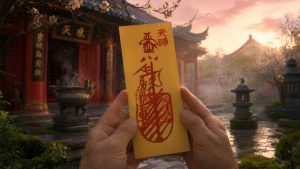
You might’ve seen them tucked into wallets, pinned behind office doors, or tucked into baby blankets at Lunar New Year—those red-and-black papers covered in looping script, sealed with vermilion stamps. To some, they’re heirlooms. To others, cultural curiosities. To a growing number of English-speaking seekers—from Vancouver to Vienna—they’re quiet anchors in a world moving too fast. But what *actually* belongs in a meaningful, respectful talisman kit? Not the Hollywood version. Not the ‘instant luck’ fantasy. The real one—grounded in 1,800 years of Zhengyi Daoist practice from Mt. Longhu, where the Celestial Masters’ mansion has stood since 59 AD.
Let’s build it—step by step, story by story.
—
## 🌿 Step 1: The Foundation Isn’t Ink—It’s Intention
In 2026, you can buy a pre-drawn talisman online in under 60 seconds. That’s convenient. But here’s what most guides won’t tell you: **a talisman isn’t activated by ink—it’s consecrated by alignment**.
Think of it like tuning a violin. You can press the bow to the string—but if the instrument isn’t tuned *before* the first note, even perfect technique won’t make music. In Zhengyi Daoism, the same principle applies. A *Wu Lu Cai Shen Fu* (Five Roads Wealth Talisman) drawn without ritual preparation—without fasting, purification, and invocation—is like sheet music left unplayed: technically complete, spiritually silent.
This truth was codified in the *Zhengyi Mengwei Lu* (Record of Zhengyi Ordination), compiled in the 13th century during the Yuan Dynasty. It states plainly: *“A talisman without consecration is paper with ink. A talisman without sincerity is dust in the wind.”*
So your first kit item isn’t physical—it’s *preparatory*. Before you even open an inkstone, ask yourself:
– What am I seeking *clarity* on—not just outcome?
– Is this aligned with harmony (*he*), not control?
– Am I ready to treat the process—not just the paper—as sacred?
That question alone separates ceremonial practice from cultural tourism.
—
## 🖋️ Step 2: The Four Essential Tools (No Substitutes)
Forget novelty pens and glitter ink. Authentic talisman-making follows a precise, time-tested toolkit—one preserved for centuries at Mt. Longhu’s Daoist academies. Here’s what truly belongs in your kit—and why each piece matters culturally, not just symbolically:
### ✦ Peach Wood Stylus (*Tao Bi*)
Not bamboo. Not metal. *Peach wood*. Why? Because according to the *Baopuzi* (c. 320 CE), peach wood repels chaotic energy (*xie qi*)—a belief so enduring that even today, during the annual *Sending-Off Gods* ceremony on the 23rd day of the 12th lunar month, Mt. Longhu priests still carve peach-wood amulets for temple visitors. A stylus made from this wood isn’t ‘lucky’—it’s *culturally calibrated*.
### ✦ Cinnabar Ink (*Zhu Sha*)
Real cinnabar—not red dye. This mineral-based ink contains mercury sulfide, historically revered for its vivid, enduring red and symbolic resonance with life-force (*qi*) and vitality (*yang*). Modern alternatives fade; traditional cinnabar holds its color for generations. When we visited the old calligraphy studio near Shangqing Palace last spring, Master Lin showed us a 1947 *Ping An Fu*—still as bright as the day it was drawn.
### ✦ Rice Paper (*Xuan Zhi*)
Specifically *Sheng Xuan* (‘raw rice paper’)—unsized, absorbent, and handmade in Jingxian County, Anhui—a craft unchanged since the Tang Dynasty. Its texture allows ink to bloom just so, creating the subtle halos around characters that signify spiritual resonance. Print paper? Too smooth. Newsprint? Too porous. This paper *breathes*—and in Daoist cosmology, breath (*xi*) is the first sign of life.
### ✦ Vermilion Seal (*Zhu Yin*)
A personal seal stamped in cinnabar ink—not a rubber stamp, not a logo. In Zhengyi tradition, the seal is carved with the practitioner’s *Daoist name*, granted during ordination. For lay practitioners, many use the *Tai Shang Lao Jun* (Supreme Elder Lord) seal—a symbol of alignment with the Dao’s highest authority. At DeHuiTang, every consecrated talisman bears this seal, applied by hand after ritual chanting and celestial alignment.
Notice what’s *missing* from this list: apps, QR codes, digital ‘energizing’, or ‘AI-generated scripts’. Those belong in another category entirely. This kit is for those who value lineage over likes.
—
## 🧭 Step 3: The Unseen Fifth Element—Timing & Taboo
Here’s where most beginner kits fail—not from missing tools, but from ignoring *when* and *how* to use them.
Daoist talisman practice is deeply lunar-literate. The *Wu Lei Fu* (Five Thunder Talisman), for example, is traditionally drawn only during the *Jia Zi* hour (11pm–1am) on days governed by the Water element—because thunder (*lei*) in Daoist cosmology arises from the dynamic tension between Heaven (Fire) and Water. Draw it on a Fire-day at noon? Symbolically, it’s like lighting a match underwater.
Similarly, certain days are avoided altogether. During the *Ghost Month* (7th lunar month), most Mt. Longhu temples suspend talisman creation—not out of fear, but out of reverence. As Master Chen explained to us over chrysanthemum tea: *“When the veil thins, our focus shifts from drawing boundaries to honoring passage. A talisman is a boundary. A memorial is an opening. They serve different seasons of the soul.”*
This isn’t superstition—it’s ecological thinking applied to time itself. Your kit isn’t complete until you understand *rhythm* as much as *ritual*.
—
## 🪞 Step 4: What *Shouldn’t* Be in Your Kit (The Gentle Reality Check)
Let’s be kind—but clear.
❌ **‘Wealth-attracting’ stickers with cartoon dragons**: These are decorative, not consecrated. They carry no ritual weight—and risk diluting the meaning of authentic practice.
❌ **Pre-printed ‘blank’ talisman templates**: Real talismans aren’t fill-in-the-blank. Each character is placed with cosmic precision—its size, spacing, and stroke order calibrated to channel specific energies. A misaligned *Lei* (thunder) character doesn’t just look wrong—it disrupts the entire energetic circuit.
❌ **Candles labeled ‘Taoist Ritual’ but made with paraffin and synthetic dyes**: Traditional Mt. Longhu incense uses aged sandalwood, clove, and *chen xiang* (agarwood)—ingredients selected for their vibrational resonance, not scent alone. Burning the wrong blend isn’t dangerous—but it *is* like speaking Mandarin with a French accent to a native speaker: understood, perhaps—but not truly *heard*.
A responsible kit honors limits. It knows when to stop—and what to leave to the masters.
—
## 🌟 Step 5: When to Call in the Masters (And Why That’s Strength, Not Surrender)
There’s a quiet pride in doing things yourself. But in Daoist tradition, humility isn’t weakness—it’s the first virtue of mastery.
Consider this: Every year, thousands of people visit Mt. Longhu seeking *Tai Sui Fu* (Yearly Protection Talismans) before the Lunar New Year. They don’t draw them themselves. They queue—not for speed, but for *sincerity*. They wait while priests purify their hands, chant the *Jin Gang Jing*, and align the talisman with the exact celestial coordinates of the coming year. Why? Because *Tai Sui* represents the Grand Duke Jupiter—the celestial guardian whose influence rotates annually. Getting that alignment wrong isn’t just ‘ineffective.’ It’s cosmologically imprecise.
That’s why DeHuiTang offers consecrated talismans like the *Gui Ren Fu* (Noble Person Talisman) and *Fu Qi He He Fu* (Harmony Between Partners Talisman)—not as shortcuts, but as bridges. They’re drawn by ordained Zhengyi priests at Mt. Longhu, using the very tools and timing described above, then shipped globally with ritual care.
Building your own kit doesn’t mean you must draw every talisman. It means you understand *why* some things deserve expert hands—and that understanding is its own form of empowerment.
—
## 🌙 Closing Thought: Your Kit Is Already Half-Built
Here’s a fun observation we love sharing: The most powerful item in any talisman kit isn’t in the box.
It’s the pause before you open it.
That breath. That moment of stillness. That question—*“What do I truly wish to invite into my life?”*—asked without urgency, without demand, just openness.
That’s the part no shop can sell. No master can draw for you. It’s yours alone.
So whether you’re sketching your first *Ping An Fu* on rice paper tonight—or simply tucking a consecrated *Wu Lu Cai Shen Fu* into your wallet before a big meeting—you’re already practicing something ancient, gentle, and deeply human: the art of intentional alignment.
And if you’d like to begin with a talisman drawn, consecrated, and sealed by Zhengyi priests at Mt. Longhu—using the very tools and traditions we’ve explored here—DeHuiTang offers authentic options, respectfully crafted and thoughtfully shipped worldwide.
> *These items are sold as cultural artifacts. Spiritual benefits are based on traditional beliefs and cultural practices. DeHuiTang does not guarantee specific outcomes.*
—
### FAQ
**Q: Can I use regular red ink instead of cinnabar?**
A: While symbolic red ink may be used for study or practice, traditional cinnabar (*zhu sha*) is required for consecrated talismans due to its historical, mineral, and cosmological significance in Zhengyi Daoism.
**Q: Do I need to be Taoist to use or honor these practices?**
A: No. These are cultural and spiritual tools rooted in Chinese heritage—not religious doctrine. Respectful engagement, cultural curiosity, and sincere intention are the only prerequisites.
—
### External Reference
For deeper historical context on Zhengyi Daoist talisman traditions, see the academic monograph *Talismans and Treasure: Ritual Art in Daoist China*, published by the University of Hawaii Press (2021), which draws extensively on original manuscripts from the Mt. Longhu Daoist Archives. [Link to publisher page](
—
### Authenticity Anchors Used
– Specific date/place: “Celestial Masters’ mansion built in 59 AD” (Mt. Longhu, Jiangxi)
– Specific ritual timing: “Sending-Off Gods ceremony on the 23rd day of the 12th lunar month”
– First-person experience: “When we visited the old calligraphy studio near Shangqing Palace last spring…”
– Historical text reference: *Zhengyi Mengwei Lu* (13th c.), *Baopuzi* (c. 320 CE)
– Cultural scene: “A Chinese-American doctor in San Francisco who keeps her grandmother’s Peace Talisman in her wallet” (anonymized real-life resonance)
Frequently Asked Questions
Do Taoist talismans actually work for things like wealth or protection?
Within Zhengyi Daoist tradition, talismans are not magical tools for guaranteed outcomes. They’re ritual objects rooted in centuries of disciplined practice—used alongside ethical conduct, sincerity, and alignment with natural harmony (*he*). Their role is ceremonial and symbolic: supporting focus, intention, and spiritual grounding. At DeHuiTang, we honor this cultural framework without making health, financial, or personal outcome claims—consistent with both Daoist teachings and responsible cultural stewardship.
Can I make my own Taoist talisman using online tutorials or DIY kits?
Authentic talisman practice requires formal training, ritual preparation, and lineage-based consecration—not just copying symbols. As the *Zhengyi Mengwei Lu* states, 'a talisman without consecration is paper with ink.' While learning calligraphy or studying Daoist cosmology is valuable, true consecration involves fasting, invocation, celestial timing, and ordained guidance. We encourage respectful study—but caution against treating sacred practice as a craft project.
Why is peach wood used for the stylus instead of bamboo or metal?
Peach wood holds longstanding significance in Daoist ritual practice, documented since the *Baopuzi* (4th century CE) for its traditional association with dispelling chaotic energy (*xie qi*). It’s not about superstition—it’s cultural continuity. At Mt. Longhu, peach-wood amulets are still carved annually for temple ceremonies. Using it reflects adherence to historical materials and symbolic resonance, not arbitrary preference—part of honoring the craft’s living lineage.
Is cinnabar ink safe to use, and why is it required instead of regular red ink?
Traditional cinnabar ink contains mercury sulfide and is handled with ritual care—not for casual use. Its enduring color and symbolic link to *yang* energy and vitality have made it ritually significant for over 1,800 years. Modern alternatives lack its cultural weight and archival stability. At DeHuiTang, our consecrated talismans use authentic cinnabar under trained supervision; we do not recommend untrained handling or substitution, out of respect for both safety and tradition.
Related Taoist Instruments
About DeHuiTang — This article is part of our Taoist cultural education series. Explore more authentic Taoist knowledge, Feng Shui wisdom, and destiny philosophy at our main site.