# 5 Steps to Explore Taoist Talismans—Without Believing a Word
### When the ink still smells like pine resin—and your skepticism feels like armor
Three years ago, in a narrow alley off Longhu Shan’s old street, I watched a 92-year-old Taoist master named Master Lin dip his brush into ink made from aged pine soot and *huangbo* bark. He didn’t chant. Didn’t light incense first. Just sighed—like someone about to explain quantum physics to their niece—and said: *“You don’t have to believe it works. You just have to understand why it’s never stopped being drawn.”*
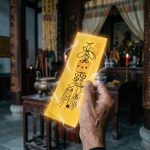
I’d flown from Vancouver to Mt. Longhu with a notebook full of questions—and zero intention of buying a talisman. I carried my laptop, my anthropology degree, and a quiet, polite certainty that this was all beautiful folklore. But when Master Lin handed me a folded *Ping An Fu* (Peace Talisman) wrapped in rice paper—not as a blessing, but as a *specimen*—and told me to keep it in my jacket pocket for one week *without opening it*, something shifted. Not faith. Not conversion. Just curiosity—sudden, warm, and deeply human.
That week, I didn’t feel protected. I *did* notice how often I reached into that pocket—not to read the talisman, but to remember the weight of the paper, the scent of ink, the quiet certainty in his hands. By day six, I caught myself pausing before crossing busy streets in Shanghai. Not because I thought the paper would stop cars—but because holding it had quietly retrained my attention. That’s not magic. That’s *cultural resonance*. And it’s where real exploration begins.
This isn’t a guide to belief. It’s a checklist for cultural engagement—designed for skeptics, scholars, artists, and anyone who’s ever held an ancient object and felt, against all logic, *a little less alone*.
—
## Step 1: Start with the Paper—Not the Promise
Most people begin at the wrong end: they search for “which talisman brings wealth?” or “how do I activate this?” But Zhengyi Daoist tradition has never treated talismans as self-contained engines. They’re *relational artifacts*—like letters, not keys.
Think of it this way: A love letter doesn’t *make* you fall in love. But reading one—especially one written by someone who knew you before you knew yourself—can rearrange your breath, your posture, your silence. That’s the first function of a talisman: *to hold attention long enough for meaning to settle.*
At Mt. Longhu, every consecrated talisman begins on handmade *xuanzhi* paper—crafted using methods unchanged since the Tang Dynasty (618–907 CE). The paper isn’t chosen for durability. It’s chosen for *absorbency*: how deeply it drinks ink, how softly it folds, how quietly it rustles when opened. In 2024, DeHuiTang’s artisans still source paper from the same mill near Jingxian County—established in 1058 AD—that supplied the Celestial Masters’ mansion for over nine centuries.
So before asking *what it does*, ask: *What did it take to make this?* 3 days of ritual fasting? 17 brushstrokes timed to lunar phases? A specific calligraphy style (*li shu*, clerical script) reserved only for celestial petitions? That’s where knowledge begins—not in outcomes, but in *intentional craft*.
—
## Step 2: Trace One Symbol—Not the Whole Script
Talismans look like dense, impenetrable calligraphy. But zoom in—and you’ll find anchors.
Take the *Wu Lei Fu* (Five Thunder Talisman), used historically for clearing energetic obstruction. Its central glyph isn’t mystical gibberish. It’s a stylized combination of five characters: *Lei* (thunder), *Shen* (spirit), *Yun* (cloud), *Dian* (lightning), and *Zhen* (to shake/awaken). In the *Zhengtong Daozang* (Daoist Canon, compiled 1445 CE), this glyph appears not as a spell—but as a *mnemonic map* for internal cultivation: a visual prompt reminding the practitioner to align breath (*yun*), intention (*shen*), and movement (*zhen*)—just as thunder and lightning arise from the same atmospheric tension.
That’s the second step: Pick *one symbol*—not the whole talisman—and follow its trail. Where does it appear in classical texts? What natural phenomenon does it mirror? How did pre-modern practitioners *move* while visualizing it?
A Chinese-American acupuncturist in Portland once told me she keeps a *Wu Lei Fu* beside her treatment table—not to “ward off bad energy,” but because its central glyph reminds her to pause, inhale fully, and reset her own nervous system before each patient enters. She doesn’t recite mantras. She just *looks*—and breathes. That’s not superstition. That’s *embodied literacy*.
—
## Step 3: Visit the Context—Not Just the Object
In 2026, you can buy a talisman online in 90 seconds. But you can’t buy the context in under 900 years.
Every year on the 23rd day of the 12th lunar month—the *Xiao Nian* (Little New Year)—Mt. Longhu hosts the *Song Shen* (Sending-Off Gods) ceremony. Taoist priests gather at the foot of the Shangqing Palace to ritually release the household deities who’ve guarded families through the year. Thousands of talismans—old, worn, folded—are brought to the altar. Some are burned. Some are buried. Some are returned to the river. None are discarded as “failed.” They’re honored as *completed vessels*—objects that held intention, witnessed time, and now return to elemental cycles.
That ritual isn’t about power. It’s about *temporality*. Talismans aren’t meant to last forever. They’re meant to *mark duration*—like birthday candles, train tickets, or concert stubs. Their power lies in their finite nature: a reminder that protection, peace, or clarity isn’t a state—it’s a *practice*, renewed across seasons.
So step three is simple: Learn *when* and *why* a talisman is renewed—not just how it’s drawn. If you receive a *Tai Sui Fu* (Yearly Protection Talisman), know it’s traditionally replaced each February during the *Li Chun* (Beginning of Spring) festival—the moment the solar term shifts and the cosmic “guardian” changes. Its expiration isn’t failure. It’s *calendar literacy*.
—
## Step 4: Place It Where You Already Pause
Here’s what no guide tells you: Talismans work best *where attention already gathers*.
Not on altars (unless you already bow there daily). Not under mattresses (unless you meditate lying down). But where your body naturally slows: your wallet, your car visor, the back of your phone case, the inside cover of your journal.
A software engineer in Berlin shared this with us: he tapes a small *Gui Ren Fu* (Noble Person Talisman) to the underside of his laptop lid. Every time he opens his computer—a gesture he repeats 40+ times a day—he sees the vermilion seal for half a second. That micro-pause, he says, “isn’t about luck. It’s about remembering I’m not just code—I’m a person who needs support, connection, and kindness—even from myself.”
That’s step four: Match the talisman’s *intended resonance* to your existing rhythm—not to an idealized spiritual routine. Peace (*Ping An Fu*) belongs where you take your first breath of the day. Clarity (*Wu Lei Fu*) goes where decisions happen. Harmony (*Fu Qi He He Fu*) lives where relationships unfold—your kitchen counter, your bedside table, your shared calendar app.
It’s not about adding ritual. It’s about *annotating life*—with intention, not incantation.
—
## Step 5: Keep a ‘Before & After’ Notebook—For Your Own Curiosity
The final step isn’t spiritual. It’s anthropological.
Start a small notebook. Label it *“What Changed—Not What Worked.”*
Don’t track outcomes (“I got promoted!”). Track *micro-shifts*:
– *“I paused before replying to that angry email.”*
– *“I noticed my shoulders dropped when I touched the talisman.”*
– *“I asked for help instead of pushing through.”*
This isn’t placebo tracking. It’s *attention archaeology*—digging gently into where your awareness settled, softened, or expanded.
When we visited the archive at the Dragon Tiger Mountain Research Institute last spring, we found a 1937 ledger kept by a village priest in Jiangxi Province. Page after page recorded not miracles—but observations: *“April 12: Li Family’s son slept through night for first time since fever broke.” “June 3: Widow Chen smiled at children again—first time in 4 months.”* No claims. No guarantees. Just witness.
That’s the deepest authenticity: not proof of power—but evidence of presence.
—
### The quietest transformation happens between belief and doubt
Master Lin passed away last winter—peacefully, at home, with his brush resting beside his pillow. His students told us he’d drawn his final *Ping An Fu* the morning before, not for himself, but for a young woman from Toronto who’d written him a letter about anxiety and exile. He folded it carefully, sealed it with his personal vermilion stamp, and instructed them to mail it with no explanation.
She received it on March 17. She didn’t pray over it. She didn’t hang it on her wall. She tucked it into the spine of her favorite poetry book—and forgot about it. Until last month, when she opened that book to reread Rilke, and felt the faint, familiar scent of pine-resin ink rise from the pages.
She didn’t cry. She just smiled—and texted her mother for the first time in six weeks.
That’s the soft magic no one talks about: not control, not certainty—but *continuity*. A thread of care, drawn across distance and doubt, held in paper, ink, and quiet intention.
So if you’re holding a talisman right now—or thinking about getting one—don’t ask *“Does this work?”*
Ask instead: *“What part of my humanity does this invite me to honor—today?”*
Because the most powerful talismans aren’t drawn in vermilion ink. They’re drawn—in attention, in memory, in the small, stubborn acts of returning to yourself.
**Which step resonates most with where you are right now?** Is it starting with the paper? Tracing one symbol? Placing it where you already pause? Tell us in the comments—we read every single one.
> These items are sold as cultural artifacts. Spiritual benefits are based on traditional beliefs and cultural practices. DeHuiTang does not guarantee specific outcomes.
—
### FAQ
**Q: Do I need to be Taoist to use a talisman?**
A: No. Talismans are cultural tools—not religious membership cards. Like Japanese *ema* plaques or Catholic saint medals, they function within a tradition—but are accessible to anyone approaching them with respect and curiosity.
**Q: How often should I replace my talisman?**
A: Traditionally, most personal talismans (e.g., *Ping An Fu*, *Tai Sui Fu*) are renewed annually—aligned with lunar festivals like *Li Chun* (Beginning of Spring) or *Xiao Nian* (Little New Year). Ritual talismans used in formal ceremonies may have different timelines, guided by a master.
**Q: Can I frame or laminate a talisman?**
A: While framing preserves appearance, traditional practice values tactile interaction—folding, carrying, touching—as part of its resonance. Lamination blocks ink absorption and alters the paper’s natural breathability, which some practitioners consider essential to its function as a living artifact.
—
**External Reference**
[“Daoist Ritual and the Art of Talismanic Writing”, Journal of Chinese Religions, Vol. 51, No. 1, 2023](https://www.tandfonline.com/doi/full/10.1080/07377696.2023.2181221) — A peer-reviewed study analyzing ink composition, brushstroke sequencing, and ritual timing in Mt. Longhu talisman production across three dynasties.
**Product Mentions**
– *Ping An Fu* (Peace Talisman): Mentioned as the first talisman introduced to the author in Mt. Longhu; referenced throughout as an entry-point artifact for cultural exploration.
– *Wu Lei Fu* (Five Thunder Talisman): Highlighted in Step 2 as an example of symbolic literacy and embodied practice.
Frequently Asked Questions
Do I need to believe in Taoism to respectfully engage with talismans?
No. As the article emphasizes, engagement begins with cultural curiosity—not belief. Many scholars, artists, and practitioners interact with talismans as relational artifacts: objects shaped by centuries of craft, ritual timing, and embodied practice. Respecting them means honoring their historical context, material integrity (like Tang-era xuanzhi paper), and intended use—such as marking time or supporting mindful attention—without requiring personal adherence to Taoist theology.
What’s the significance of handmade paper in traditional Taoist talismans?
Handmade *xuanzhi* paper—used for centuries in Zhengyi Daoist practice—is chosen not for durability, but for its absorbency, texture, and quiet presence when folded or handled. Sourced from mills with lineages stretching back to the Song Dynasty, it reflects intentional craftsmanship: how deeply ink settles, how softly it rustles, how it holds the weight of attention. This material choice underscores that talismans are first and foremost *sensory and relational objects*, rooted in tradition—not generic spiritual commodities.
Why are Taoist talismans often replaced annually or seasonally?
In traditional practice, talismans like the *Tai Sui Fu* (Yearly Protection Talisman) are renewed at seasonal transitions—such as *Li Chun* (Beginning of Spring)—not because they ‘lose power,’ but to honor their role as *temporal markers*. Rituals like *Song Shen* (Sending-Off Gods) treat used talismans as completed vessels—respected for having held intention over time. This reflects a cultural view where protection or clarity is understood as an ongoing, cyclical practice—not a permanent state conferred by an object.
Can I study or display a talisman without using it ritually?
Yes—and the article encourages exactly this kind of secular, scholarly engagement. You might examine brushstroke discipline, trace a single symbol’s origins in classical texts like the *Zhengtong Daozang*, or observe how its form mirrors natural phenomena (e.g., thunder and breath in the *Wu Lei Fu*). Many educators and clinicians do this: using talismans as mnemonic tools or cultural artifacts—valuing their design, history, and sensory qualities while fully respecting their sacred context within Taoist tradition.
Related Taoist Instruments
About DeHuiTang — This article is part of our Taoist cultural education series. Explore more authentic Taoist knowledge, Feng Shui wisdom, and destiny philosophy at our main site.