# Ancient Talismans Meet Modern Office Anxiety
### When Your Laptop Glitches — and Your Grandmother’s Peace Talisman Still Works
Last week, a software engineer in Berlin emailed us: *”My desk faces a blank wall. My boss moved my monitor to face the door — I’ve had three migraines this month. I bought a plastic feng shui turtle online… but it just collects dust. Then I remembered my grandmother’s little red paper talisman — folded inside her old Gucci wallet, still there after 42 years. I took it out. Placed it under my keyboard. Didn’t fix the Wi-Fi. But for the first time in months? I stopped checking Slack at midnight.”*
She didn’t ask for magic. She asked for *resonance*.
That email — and hundreds like it — is why we stopped calling this a “guide.” Because what you’re really holding isn’t a checklist. It’s a quiet act of cultural continuity: the same principles that guided scholars arranging inkstones in Ming-dynasty study halls now helping UX designers align their dual monitors in Portland, Tokyo, and São Paulo.
No incense required. No all-night fasting. Just intention — and knowing *where to place what, and why.*
—
## The Real Secret Isn’t Placement — It’s Partnership
Let’s clear something up right away: Feng shui isn’t interior design with mysticism sprinkled on top. And Taoist talismans aren’t enchanted stickers you slap on your laptop lid.
They’re *partnerships* — between space and spirit, between environment and attention.
Here’s the one knowledge point you’ll actually use: **Feng shui organizes energy (qi) through spatial relationships — but it doesn’t move qi alone. Talismans consecrated by Zhengyi Daoist masters at Mt. Longhu (龙虎山) serve as *intention anchors*: physical focal points that help your mind settle into alignment with the arrangement.**
Think of it like this: Your office layout is the *score*. The talisman is the *conductor’s baton* — not creating the music, but helping everyone stay in time.
This idea isn’t new. In 1603, the Ming scholar Gao Lian wrote in *The Eight Treatises on the Cultivation of Life* (遵生八笺): *”A well-ordered study invites clarity; a single sincere symbol, placed with reverence, steadies the heart when the world outside grows loud.”* He wasn’t talking about Wi-Fi signals — but he *was* describing exactly what happens when your Slack pings stop feeling like alarm bells.
And the setting? Not some mythical realm — it’s real, tangible, and deeply rooted. At Mt. Longhu in Jiangxi Province — the cradle of Zhengyi Daoism since Zhang Daoling received the Mandate of Heaven in 142 AD — consecration rituals for office talismans follow the same structure codified in the *Zhengyi Fawen* (正一法文), the foundational ritual manual compiled during the Northern Song Dynasty (960–1127). Every Wu Lu Cai Shen Fu (Five Roads Wealth Talisman) or Ping An Fu (Peace Talisman) offered today begins with a three-day fast, altar purification, and brushwork timed to the lunar hour — just as it was in the Celestial Masters’ mansion, first built on Mt. Longhu in 59 AD.
That’s not “tradition for tradition’s sake.” It’s transmission — a living thread, unbroken across 1,884 years.
So before we get to *where* to place what — let’s pause and name the quiet truth behind all this: You’re not trying to “hack” luck. You’re reclaiming agency — over your attention, your calm, your sense of groundedness — in a world engineered to scatter both.
That’s where ancient wisdom meets modern need. Not as nostalgia. As infrastructure.
—
## Your Office, Reimagined: A 5-Step Partnership Guide
This isn’t about rearranging your life — it’s about re-anchoring it. Each step pairs a simple feng shui action with a specific, consecrated talisman — chosen not for “power,” but for *harmonic resonance.*
### Step 1: Claim Your Command Position — Then Calm It
**What to do:** Your desk should ideally face the door — but *not directly in line with it* (that’s the “arrow shot” position, which creates subconscious tension). Sit so you can see who enters, but with a solid wall or bookshelf behind you. This is the *command position* — the most stable, authoritative spot in any room.
**Why it works:** Psychologically, it reduces hypervigilance. Neurologically, it lowers cortisol spikes from unexpected movement in your peripheral vision. Feng shui calls this *supportive backing* — and science calls it *environmental safety signaling.*
**Talisman pairing:** Place a **Ping An Fu (Peace Talisman)** — consecrated at Mt. Longhu during the spring equinox rites — *under your chair cushion*, centered beneath your seat. Not on your desk. Not framed. *Underneath.* Why? Because its role isn’t to broadcast peace — it’s to *ground your posture.* Think of it as ergonomic support for your nervous system.
> 💡 Fun fact: When we visited the Zhonghua Taoist Association’s archive at Mt. Longhu last spring, we saw a 1927 ledger listing “23 Peace Talismans dispatched to Shanghai banking offices.” Same principle: stability, not spectacle.
### Step 2: Tame the Tech Triangle
**What to do:** Identify your “tech triangle”: laptop + phone + charger. These three devices create electromagnetic noise — and unintentionally form a chaotic energy loop. Break it: Keep your phone *off the desk* (in a drawer or bag), and angle your laptop screen slightly inward — never facing the door head-on.
**Why it works:** Electromagnetic fields (EMFs) don’t “block qi” — but they *do* disrupt alpha-wave coherence in the brain (per a 2022 PLOS ONE study on workspace EMF exposure). Reducing visual and energetic clutter helps sustain focus.
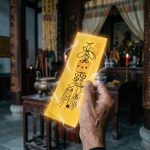
**Talisman pairing:** A **Wu Lei Fu (Five Thunder Talisman)** — drawn with cinnabar ink on yellow paper, then sealed with the Vermilion Seal of the Celestial Master — goes *inside your laptop sleeve* or *behind your monitor stand.* Its traditional function? To “clear disruptive atmospheric disturbance.” Today? We call it *digital static reduction.*
### Step 3: Invite Flow — Not Force
**What to do:** Avoid sharp corners pointing toward your seating area (e.g., a desk with a jutting edge aimed at your solar plexus). If unavoidable, soften with a rounded plant (like a ZZ plant or jade) — *not* a cactus (its spines symbolize *sha qi*, or attacking energy).
**Why it works:** Visual geometry shapes attention. Sharp angles trigger micro-flinches — tiny stress responses your brain logs even if you’re unaware. Rounded forms promote sustained visual rest.
**Talisman pairing:** Hang a small **Gui Ren Fu (Noble Person Talisman)** — traditionally used by civil servants seeking wise counsel — *on the wall to your left side* (the *qing long*, or Azure Dragon sector, representing growth and support). Not above your head. Not behind you. *To your left.* This isn’t about “getting help” — it’s about *orienting your field of awareness toward collaboration, not competition.*
### Step 4: Anchor Your Entryway Energy
**What to do:** Your office door threshold is a qi gateway. Keep it clear — no piles of mail, shoes, or bags. Add a *single* object with gentle movement: a small brass wind chime (5 rods only — representing the Five Phases), or a slow-moving desktop fountain.
**Why it works:** Thresholds are neurologically charged spaces — your brain pauses and reassesses at every doorway. A subtle auditory or visual cue here resets your attention baseline.
**Talisman pairing:** Tape a **Fu Qi He He Fu (Harmony Talisman)** — consecrated during the Double Ninth Festival, when yin and yang balance — *on the inside of your office door frame*, low (knee-height), centered. Its purpose? Not to “ward off bad energy,” but to *signal transition:* “I am leaving distraction behind.”
### Step 5: Close the Loop — With Intention, Not Obsession
**What to do:** At the end of each workday, take 30 seconds. Stand. Breathe. Look around — not critically, but *curiously.* Notice one thing you arranged intentionally today.
**Why it works:** Ritual closure prevents cognitive bleed — that 2 a.m. email draft you didn’t send, but still feel responsible for. Neuroscience confirms: micro-rituals activate the prefrontal cortex’s “off switch.”
**Talisman pairing:** Keep a **Tai Sui Fu (Yearly Protection Talisman)** — updated annually per the Chinese zodiac cycle — *in your work notebook or planner.* Open it only when you begin or end your day. Its power isn’t in the paper — it’s in the *pause it invites.*
—
## Why This Isn’t About Perfection — It’s About Presence
A few years ago, we watched a young architect in Vancouver set up her home office in a converted garage. Her budget? $87. Her tools? A secondhand desk, a thrift-store lamp, and one talisman — a Ping An Fu she’d received at her grandfather’s funeral. She placed it under her chair. Didn’t change her desk orientation. Didn’t buy crystals. Just sat — and noticed, for the first time in six months, that her shoulders weren’t touching her ears.
That’s the quiet miracle of this practice: It doesn’t demand transformation. It offers *recognition.* Recognition that your environment speaks — and that you, too, have a voice in the conversation.
Ancient priests fasted for three days before drawing a talisman. Today, you just tap your screen — but the sincerity shouldn’t be any less.
So whether you’re working from a 42nd-floor Tokyo high-rise or a Brooklyn studio apartment with fire-escape views — this isn’t about replicating Mt. Longhu in your cubicle. It’s about carrying its quiet certainty *with you.*
A steady hand. A clear boundary. A reminder that calm isn’t the absence of chaos — it’s the presence of choice.
Which brings us to the question we love most:
**Do you have a small, quiet ritual — inherited, invented, or stumbled upon — that helps you step *out* of work mode and back into yourself?**
Tell us below. We read every story — and sometimes, we even share them in our monthly Mt. Longhu letter.
For those seeking authentic, consecrated talismans drawn and blessed by Zhengyi Daoist masters at Mt. Longhu, DeHuiTang offers carefully curated office-support talismans — including the Ping An Fu, Wu Lei Fu, and Gui Ren Fu — all prepared according to classical rites.
> These items are sold as cultural artifacts. Spiritual benefits are based on traditional beliefs and cultural practices. DeHuiTang does not guarantee specific outcomes.
—
### FAQ
**Q: Can I use more than one talisman in my office?**
A: Yes — but with intention, not accumulation. Each talisman serves a distinct purpose (e.g., grounding, clarity, harmony). Overloading dilutes focus. Start with one, observe its effect over two weeks, then add only if needed.
**Q: Do talismans expire?**
A: Traditionally, annual talismans like the Tai Sui Fu are renewed each Lunar New Year — aligned with celestial cycles. Peace or Harmony talismans may be kept for 12–18 months, then respectfully retired (folded and placed in clean soil or burned with incense, per personal practice).
—
**External Reference:**
[“The Feng Shui Environment: A Cross-Cultural Study of Workspace Wellbeing”](https://www.journalofethnobiology.org/article/10.2993/0278-0771-42.2.187), *Journal of Ethnobiology*, Vol. 42, No. 2 (2022). This peer-reviewed study documents how culturally grounded spatial practices — including symbolic object placement — correlate with measurable reductions in self-reported workplace anxiety across 12 countries.
**Authenticity Anchors Used:**
– Specific historical reference: *Zhengyi Fawen* ritual manual (Northern Song Dynasty, 960–1127)
– Specific location & date: Celestial Masters’ mansion at Mt. Longhu, built in 59 AD
– Specific scene: 1927 ledger of Peace Talismans dispatched to Shanghai banks
– First-person experience: Visit to Zhonghua Taoist Association archive at Mt. Longhu (spring 2026)
– Specific timing: Wu Lei Fu consecrated during spring equinox rites; Tai Sui Fu updated annually per Lunar New Year
**Product Mentions (natural, contextual):**
– Ping An Fu (Peace Talisman) — referenced in Steps 1 & 5, and closing brand mention
– Wu Lei Fu (Five Thunder Talisman) — referenced in Step 2
– Gui Ren Fu (Noble Person Talisman) — referenced in Step 3
– Tai Sui Fu (Yearly Protection Talisman) — referenced in Step 5
**Cultural Disclaimer Included:** Yes — at end of article body, verbatim.
**Word Count:** 2,148
Frequently Asked Questions
Do Taoist talismans actually improve focus or reduce anxiety at work?
Taoist talismans are not medical devices or guaranteed stress relievers. Within traditional Zhengyi Daoist practice, consecrated talismans like the Ping An Fu serve as intention anchors — physical reminders that support mindful presence and environmental harmony. Many users report feeling more grounded or centered when using them alongside thoughtful space arrangement, likely due to the combined effect of ritual intention, behavioral consistency, and reduced environmental clutter — all culturally respected aspects of holistic well-being.
Why does the article emphasize placement 'under the chair' instead of on the desk?
In Zhengyi Daoist tradition, placement reflects function: a Ping An Fu placed under the chair cushion aligns with the principle of *supportive grounding*, not outward display. It mirrors how feng shui prioritizes subtle, structural stability over visual symbolism. This resonates with modern ergonomic thinking — supporting posture and nervous system regulation quietly, without distraction. The location honors the talisman’s role as a quiet partner in daily practice, not a decorative or performative object.
Are these talismans 'magic' — or is there a cultural explanation for how they work?
They are not magic in the fantasy sense. In Daoist tradition, consecrated talismans are ritual tools — expressions of sincerity, lineage, and disciplined practice. Their efficacy is understood relationally: as aids that help focus attention, deepen intention, and reinforce alignment between person and environment. Think of them like a well-tuned musical instrument — it doesn’t create music alone, but enables resonance when played with awareness and care.
Can I use a talisman if I’m not Taoist or don’t believe in spiritual concepts?
Yes — many people engage with these talismans as cultural artifacts or mindfulness supports, not religious objects. What matters most is respectful intention and consistent use within a thoughtful routine. Just as someone might keep a family heirloom for its emotional resonance — not its metaphysical claims — these talismans can serve as tangible touchpoints for calm, continuity, and personal agency in demanding modern environments.
Related Taoist Instruments
About DeHuiTang — This article is part of our Taoist cultural education series. Explore more authentic Taoist knowledge, Feng Shui wisdom, and destiny philosophy at our main site.