Your Lunar Birth Year Is Blocking Love — Taoist Wisdom for Valentine’s
You check your calendar, light a candle, and whisper your hopes into the quiet of Valentine’s Eve — yet again. You’ve dated thoughtfully, opened your heart, even tried manifestation apps and rose quartz grids. But something keeps repeating: the right person slips away just as things deepen… or you keep meeting kind, capable people who somehow never align with your rhythm. It’s not your fault. And it’s not bad luck.
It’s your lunar birth year — quietly shaping your Yin Yuan (姻缘), the celestial blueprint of love destiny — interacting with the energetic currents of this season. Not metaphorically. Not symbolically. In the living cosmology of Zhengyi Daoism, your birth year is a resonant frequency — one that either harmonizes with or disrupts the flow of relationship energy in 2026. And right now, as we stand at the Xiayuan Festival on November 23, 2026 — the 15th day of the 10th lunar month — the gates between human intention and celestial resonance are especially open.
This isn’t about finding a partner. It’s about removing an invisible interference pattern from your own energetic field — one rooted in 1,800 years of observation, codified by the Celestial Masters of Mt. Longhu (龍虎山), and still practiced today in consecration halls where talismans are drawn under star-aligned incense smoke.
Why “Trying Harder” Doesn’t Fix Love Energy — The Yin Yuan Principle
Western dating culture teaches us to optimize: better bio, clearer boundaries, faster replies. Taoist metaphysics offers a different lens — one that doesn’t blame effort, but reveals structure. At its core is Yin Yuan: not “fate” in a fatalistic sense, but the dynamic interplay between your innate relational resonance (Yin) and the cosmic conditions that nurture or obstruct it (Yuan).
Think of it like tuning a guqin. You can press the strings with perfect technique — but if the bridge is misaligned, the note will sound strained no matter how skilled your hands. Your lunar birth year is part of that bridge. It determines your Yin Yuan Palace, a sector in your personal BaZi chart that governs attraction patterns, emotional compatibility, and the quality of commitment you naturally invite.
This principle appears across classical texts — most directly in the Yangzhai Sanyao (《陽宅三要》, Three Essentials of Yang Dwellings), which links residential harmony to marital stability, and implicitly in the Qingjing Jing (《清靜經》, Scripture of Clarity and Stillness), where inner stillness is named as the prerequisite for true resonance with another. But the clearest operational framework comes from the Zhengyi lineage’s ritual practice: love is not summoned by desire alone — it is anchored by alignment.
Here’s what’s traditionally observed: certain lunar birth years enter periods of Yin Yuan conflict when planetary energies shift — particularly during seasonal transitions like the Xiayuan Festival, when the Water element (governing emotion, intuition, and deep bonds) reaches its peak potency in the lunar calendar. If your birth year falls into a conflicting cycle — say, the Year of the Dog (2018, 2006, 1994) or the Year of the Rat (2020, 2008, 1996) — your natural resonance may temporarily clash with the dominant relationship energy of the year. That doesn’t mean love is impossible. It means your field is vibrating at a frequency that scatters connection rather than attracting and holding it.
This isn’t superstition. It’s energetic hygiene — the same way you wouldn’t leave a window open during a storm, Taoist masters advise adjusting your spiritual environment before major relational intentions.
3 Practical Steps to Harmonize Your Yin Yuan Before Valentine’s
You don’t need to recalculate your BaZi chart or fast for three days. These steps are grounded in documented feng shui and Zhengyi ritual practice — simple, immediate, and designed for modern life.
1. Reset Your Bedroom’s Relationship Quadrant (Southwest Corner)
In classical feng shui, the southwest corner of any space governs Yin Yuan — love, marriage, and committed partnership. This is not symbolic decoration; it’s a directional anchor point for relational qi. On November 23 — Xiayuan Festival — water energy is strong, and the southwest quadrant becomes especially receptive.
Handcrafted Cupronickel Ten-Thousand Names Tablet Pendant | Wan Shen Hui Daoist Bagua Exorcism Talisman Necklace
万神讳项链,白铜精制,银金双色。吊坠为令牌/碑形,上承金焰拱券、嵌红宝石,中央嵌描金八卦太极,牌面满布阴刻「万神讳」诸神秘讳与符字。「万神讳」总摄万神名讳,为道教著名伏魔驱邪之秘讳,传统上被视为
Mt. Longhu Celestial Master Consecrated Love Harmony & Relationship Synergy Talisman (Yin Yuan He He Fu)
Love is not random — it is written in the stars. The Love Harmony Talisman is the 1,800-year-old
What to do today: Clear clutter from the southwest corner of your bedroom (stand at your bed’s headboard and face the direction halfway between south and west). Place two identical items there — not one, not three. Traditionally: two smooth river stones, two ceramic doves, or two unlit white candles in brass holders. The duality represents balance; the material (stone, ceramic, metal) grounds the Water energy of the season. Leave them undisturbed for 7 days — through Christmas on December 25, 2026 — to complete the seasonal circuit.
Why two? Because He He (和合), meaning “harmony and union,” is encoded in duality. This mirrors the ritual logic behind the Yin Yuan He He Fu, where paired symbols — the He He Er Xian (Harmony-and-Union Immortals), twin lotuses, or interlocking yin-yang glyphs — are drawn to stabilize resonance.
2. Wear or Carry a Symbol of “Unbroken Continuity” — Not Just “Love”
Most love talismans focus on attraction. But Yin Yuan blockage often manifests not as absence, but as interruption: connections that begin warmly but fade without cause; proposals accepted then withdrawn; long-term partners who suddenly withdraw emotionally. This signals a disruption in continuity — the energetic thread that sustains bonds over time.
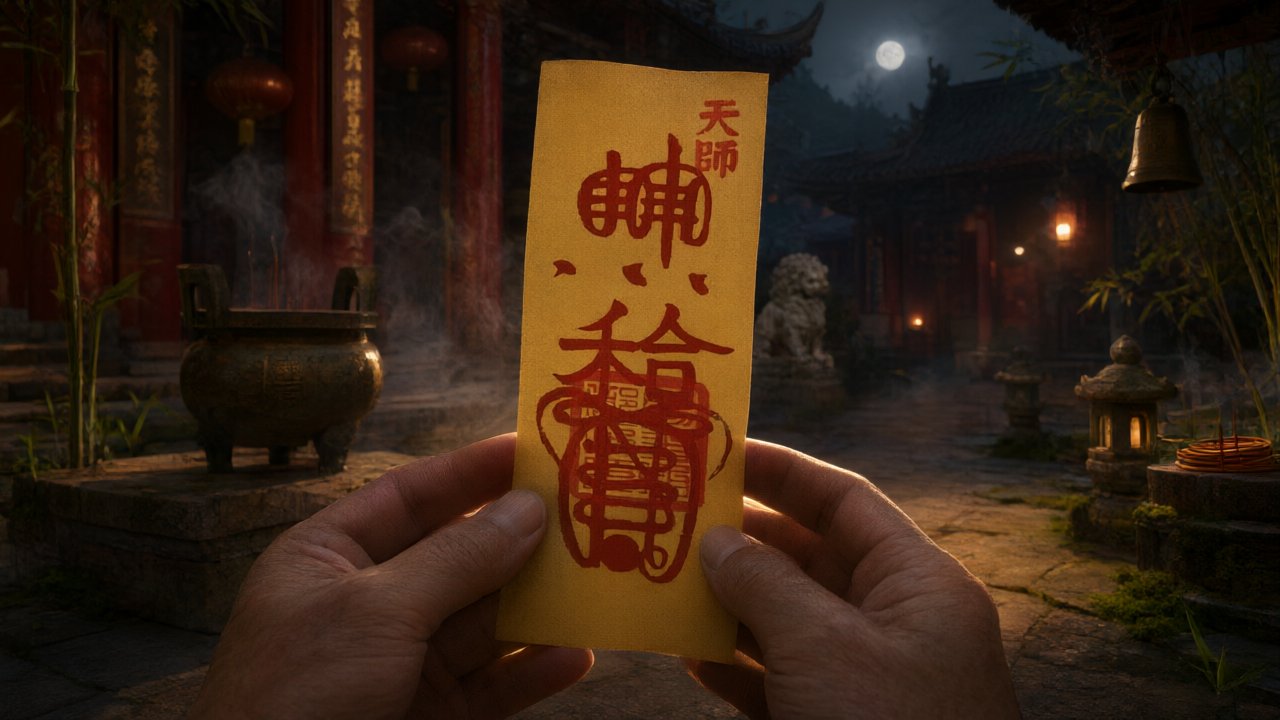
Taoist tradition addresses this with objects embodying wu jian duan (無間斷), “unbroken continuity.” A silk cord tied in a single, seamless knot — worn on the left wrist — is one such tool, used since the Song Dynasty in rites for marital longevity. But for those seeking deeper anchoring, the Mt. Longhu Celestial Master Consecrated Love Harmony & Relationship Synergy Talisman (Yin Yuan He He Fu) serves precisely this function. Drawn by ordained priests of the Zhengyi lineage on Mt. Longhu, it incorporates the He He Er Xian iconography alongside the Shuang Fei Yan (paired swallows) — birds that return to the same nest year after year — and the Lian Li (lotus-root) glyph, whose segmented stem conceals an unbroken fiber running its full length.
This is not a “love spell.” It is a resonance stabilizer — consecrated during the Xiayuan Festival’s peak Water energy to reinforce the continuity frequency in your personal field.
3. Practice the “Three Breaths of Mutual Arrival” Each Morning
Ancient Taoist texts emphasize that love energy flows not from projection (“I want you”) but from mutual arrival — the conscious, embodied recognition of shared presence. The Qingjing Jing teaches: “When the heart is clear, the mirror reflects without distortion. When the breath is still, the vessel holds without spilling.”
Try this each morning for seven days, beginning November 23:
- Sit comfortably. Place one hand over your heart, the other over your lower abdomen (the Dantian — energy center).
- Inhale slowly through the nose for a count of four — feeling your hands rise together.
- Hold gently for a count of two — sensing the warmth between palms and skin.
- Exhale fully through the mouth for a count of six — imagining breath flowing outward, not just releasing, but reaching — toward the space where another’s presence would naturally reside.
Repeat three times. No visualization needed. Just breath, touch, and direction. This simple act retrains your nervous system to orient toward mutual resonance — not solitary longing. It echoes the dual cultivation practices found in the Baopuzi, where inner stillness and outer alignment are inseparable.
Why Consecration — Not Just Intention — Matters for Love Energy
You may wonder: Can’t I just draw my own symbol? Write an affirmation? Light a pink candle?
Yes — and many do. But the Mt. Longhu Celestial Master Consecrated Love Harmony & Relationship Synergy Talisman (Yin Yuan He He Fu) operates on a different register: kaiguang (開光), or “opening the light.” This is not magic in the Hollywood sense. It is a documented ritual process passed down through the Zhengyi lineage since Zhang Daoling founded the Way of the Celestial Masters on Mt. Longhu in 142 CE.
Kaiguang involves three precise stages: first, purification of the paper and ink with sacred water and peach wood smoke; second, invocation of the He He Er Xian and the Wen Chang star (governing harmony and clarity in relationships); third, breath-infusion — where the priest exhales qi into the talisman while tracing the central glyph, aligning its resonance with celestial timing. The result is not a static object, but a living frequency anchor — calibrated to support the specific energetic work of Yin Yuan stabilization.
This is why the talisman is traditionally carried in the left sleeve (closest to the heart) or placed inside a bedside drawer — never hung openly like decor, but kept in proximity to your personal field. Its power lies not in display, but in sustained, quiet resonance.
For those preparing for Valentine’s Day 2026 — or navigating a relationship that feels stuck in repetition — this talisman offers more than hope. It offers structural support. It does not guarantee outcomes (no tradition does), but it strengthens the container in which love can take root, deepen, and endure.
In Closing: Love as Energetic Alignment, Not Just Emotion
Valentine’s Day is often framed as a test of romance — a day to prove devotion or secure affection. Taoist wisdom invites us to reframe it as something quieter, deeper, and far more empowering: a seasonal checkpoint for relational resonance.
Your lunar birth year isn’t a sentence. It’s data — part of a living cosmology that has helped generations navigate love not as chaos, but as a field they can learn to harmonize. The tools are ancient, but their application is profoundly practical: clear the southwest corner, wear continuity, breathe toward mutual presence, and — if you feel called — welcome a consecrated resonance anchor into your daily life.
The Mt. Longhu Celestial Master Consecrated Love Harmony & Relationship Synergy Talisman (Yin Yuan He He Fu) is available for those seeking authentic, lineage-grounded support this Valentine’s season. For deeper guidance, explore our free Yin Yuan Seasonal Alignment Guide, designed specifically for the Xiayuan-to-Christmas window.
Taoist talismans are sacred spiritual tools rooted in 1,800 years of tradition. Their power comes from sincere belief and the consecration rituals of ordained priests. Results vary by individual — approach with an open heart and respectful intention.
Further Reading & Cultural Context
- Taoism on Wikipedia — Overview of Taoist philosophy, history, and practices
- Mid-Autumn Festival traditions — History and cultural significance of the Mid-Autumn Festival
FAQ
What is the Xiayuan Festival, and why does it matter for love energy?
Xiayuan Festival falls on November 23, 2026 — the 15th day of the 10th lunar month. In Taoist cosmology, it marks the peak of Water energy, which governs emotion, intuition, and deep relational bonds. This makes it a potent time for setting intentions and performing rituals related to Yin Yuan (love destiny) — a practice documented in classical feng shui texts and upheld by the Zhengyi lineage on Mt. Longhu.
Can I use the Yin Yuan He He Fu if I’m not in a relationship?
Yes. The talisman supports all forms of relational harmony — including self-relationship, familial bonds, and friendships. Its core function is stabilizing Yin Yuan resonance, which begins with inner alignment. Many who carry it report greater clarity in boundary-setting and deeper trust in their own relational instincts — foundational qualities for any healthy connection.

How is this different from a generic “love amulet”?
Unlike mass-produced charms, the Yin Yuan He He Fu is drawn by ordained Zhengyi priests on Mt. Longhu using traditional cinnabar ink, rice paper, and ritual timing aligned with lunar phases and stellar positions. Its iconography — the He He Er Xian, paired swallows, and lotus-root glyph — is selected for its specific function: reinforcing continuity and mutual resonance, not just initial attraction.
Go Deeper
- BaZi Chart Reading — free, takes about two minutes: read your Four Pillars chart for this year
- If you want the physical remedy behind this article, browse our consecrated talismans and feng shui pieces.
Frequently Asked Questions
What is the Xiayuan Festival, and why does it matter for love energy?
Xiayuan Festival falls on November 23, 2026 — the 15th day of the 10th lunar month. In Taoist cosmology, it marks the peak of Water energy, which governs emotion, intuition, and deep relational bonds. This makes it a potent time for setting intentions and performing rituals related to Yin Yuan (love destiny) — a practice documented in classical feng shui texts and upheld by the Zhengyi lineage on Mt. Longhu.
Can I use the Yin Yuan He He Fu if I’m not in a relationship?
Yes. The talisman supports all forms of relational harmony — including self-relationship, familial bonds, and friendships. Its core function is stabilizing Yin Yuan resonance, which begins with inner alignment. Many who carry it report greater clarity in boundary-setting and deeper trust in their own relational instincts — foundational qualities for any healthy connection.
Related Taoist Instruments
About DeHuiTang — This article is part of our Taoist cultural education series. Explore more authentic Taoist knowledge, Feng Shui wisdom, and destiny philosophy at our main site.