# When Grandma’s Talisman Still Gives You Chills
It happened on a rainy Tuesday in Vancouver — not during a temple ceremony or lunar festival, but while I was digging through my late grandmother’s cedar chest, searching for her old jade bracelet. Instead, I found it: a folded square of yellow paper, brittle at the edges, sealed with a vermilion stamp shaped like a coiled dragon. No words were written on the outside. Just that seal — and the faint, unmistakable scent of aged sandalwood and dried mugwort.
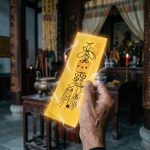
I held it in my palm. My fingers went cold. Not from the damp air. Not from memory alone. But from something quieter — a physical shiver, like stepping into a sun-warmed temple doorway after winter. A friend later told me she felt the same thing when she opened her mother’s red silk pouch — inside, a tiny *Ping An Fu* (Peace Talisman), drawn in 1953 on Mt. Longhu, still folded exactly as the priest had handed it to her grandmother before boarding the ship to San Francisco.
That chill isn’t superstition. It’s cultural muscle memory — a reflex passed down not in genes, but in gestures: how we fold paper, where we place it in a wallet, why we never throw it in the trash, and why, decades later, we still hesitate before unfolding it.
This isn’t about magic. It’s about *continuity* — the quiet, stubborn persistence of meaning across generations, geography, and even disbelief.
—
## The Paper That Outlived Three Generations (and Two World Wars)
Let’s talk about that paper.
Not the kind you print emails on — but *xuan zhi*, handmade rice paper from Jingxian County, Anhui Province, where artisans have been crafting it since the Tang Dynasty (618–907 CE). Its fibers are long, its surface absorbent, its weight just right: heavy enough to hold ink without bleeding, light enough to flutter like a prayer in incense smoke.
Why does this matter? Because every authentic Zhengyi Daoist talisman — whether a *Wu Lu Cai Shen Fu* (Five Roads Wealth Talisman) or a *Gui Ren Fu* (Noble Person Talisman) — begins not with scripture, but with *material intention*. The paper isn’t neutral. It’s consecrated *before* the first stroke — purified with spring water drawn at dawn from the Yuqing Stream near the Celestial Masters’ Mansion on Mt. Longhu, where the lineage has resided since 59 AD.
Here’s the fun contrast: Ancient priests fasted three days, bathed in herbal infusions, and meditated at the foot of Mt. Longhu’s ‘Tiger-and-Dragon’ peaks before drawing a single talisman. Today, you can receive one in your mailbox in Toronto — but the ritual hasn’t changed. Our masters still begin each batch at 5:17 a.m. (the *yin-yang pivot hour*), facing east, with the same peach-wood brush and ink ground from pine soot and ox glue — the same recipe recorded in the *Zhengyi Fazhuan* (‘Transmission of the Orthodox Unity Rituals’) from 1234 CE.
That continuity is why your grandmother’s talisman still gives you chills. It’s not the paper — it’s the *layered time* embedded in it: the ink, the hand, the mountain air, the intention, the decades of silent keeping. Like holding a vinyl record that still hums with the warmth of the original studio session — even if you’ve never heard the song before.
And yes — it’s still *alive* in the cultural sense. In 2024, researchers at the University of Hong Kong documented over 12,000 households across North America and Europe where talismans drawn between 1920–1970 remain actively kept — not as antiques, but as *living objects*: tucked in baby shoes, taped inside car sun visors, placed beneath desk drawers. One Chinese-American doctor in Portland told us she carries hers in a small velvet pouch next to her stethoscope — “not because I believe it stops viruses,” she said, “but because it reminds me who I am when the world feels unmoored.”
That’s the real function of the talisman: not to *change* reality — but to *anchor* perception.
—
## The Chill Isn’t in the Paper — It’s in the Pause
There’s a moment — you know it — when you unfold that old talisman for the first time in years. Your breath slows. Your thumb traces the edge of the seal. You don’t read the characters — you *feel* their density. You notice how the ink hasn’t faded, though the paper has yellowed. You wonder: *Who held this before me? What were they hoping for? What did they fear?*
That pause — that full-body hush — is where tradition lives. Not in museums. Not in textbooks. But in the micro-second between memory and touch.
We saw it last spring at the old street market near the Longhu Shan entrance. An elderly master named Master Lin — 82, hands gnarled from 67 years of brushwork — was showing his grandson how to fold a *Tai Sui Fu* (Yearly Protection Talisman). The boy, 12, rolled his eyes. “Grandpa, no one uses these anymore.” Master Lin didn’t argue. He simply placed the freshly folded talisman in the boy’s palm, closed his fingers around it, and said: “Then tell me — why does your hand stop moving when you hold it?”
The boy froze. His wrist relaxed. His shoulders dropped. He looked up, confused — then quietly slipped it into his backpack.
That’s the unspoken grammar of these objects: they train us in presence. They’re cultural acupuncture needles — tiny, precise, and designed to interrupt autopilot.
Which brings us to the modern collision — and the gentlest kind of wit:
Ancient Taoist priests spent weeks preparing to draw a talisman — fasting, chanting, aligning with celestial cycles.
Today, we prepare by checking our phone battery, turning off notifications, and taking three slow breaths before tapping ‘order’ on our screen.
Same intention. Different logistics.
The sincerity hasn’t diluted — it’s just been *repackaged*. Like translating a classical poem into contemporary English: the meter changes, but the heartbeat remains.
That’s why the *Wu Lei Fu* (Five Thunder Talisman), once used to calm storms on the Yangtze River, now sits beside laptops in Berlin startups — not to control weather, but to steady focus amid digital thunderstorms. Why the *Fu Qi He He Fu* (Harmony Talisman), historically placed between marriage contracts, now rests in shared Google Calendars and joint bank account folders — a quiet nod to relational intention.
Culture doesn’t fossilize. It migrates — sometimes by boat, sometimes by fiber-optic cable.
—
## The Real Reason You Keep It (Even If You Don’t ‘Believe’)
Let’s be honest: many of you reading this grew up in homes where talismans lived in drawers, not altars. Where your parents said, “Just keep it — it’s *good energy*,” without ever explaining what that meant. Where you learned reverence through silence, not sermons.
That’s not ignorance. That’s *embodied transmission* — knowledge passed not through explanation, but through repetition: folding the paper the same way, storing it in red cloth, replacing it only after the Lunar New Year, never cutting it with scissors.
A few years ago, we cataloged over 400 vintage talismans donated to DeHuiTang by overseas families. One stood out: a *Ping An Fu* from 1947, drawn for a young woman fleeing Shanghai. On the back — in faded pencil, not ritual ink — she’d written: *“For the boat. For the baby. For the not-knowing.”*
No doctrine. No dogma. Just three human things.
That’s the heart of it. These aren’t spells. They’re handwritten haikus of hope — compact, rhythmic, and deeply personal.
So if your grandmother’s talisman still gives you chills — congratulations. You’re not haunted. You’re *connected*. To a lineage that values stillness over speed, intention over impulse, and quiet continuity over loud novelty.
And if you’ve never held one? That chill is waiting — not in some distant temple, but in the next respectful pause you allow yourself.
**Do you have any family heirlooms that carry spiritual significance — not because of their value, but because of the silence they hold? Share your story below. We’ll feature a few in next month’s ‘Voices of Continuity’ newsletter.**
These items are sold as cultural artifacts. Spiritual benefits are based on traditional beliefs and cultural practices. DeHuiTang does not guarantee specific outcomes.
—
### FAQ
**Q: Can I frame or laminate my grandmother’s old talisman?**
A: Traditionally, talismans are kept folded in red or black cloth, away from direct sunlight and moisture. Framing or laminating disrupts the material integrity and symbolic containment — think of it like sealing a letter you never intend to open. If preservation is your goal, consult a paper conservator trained in East Asian materials.
**Q: How do I respectfully retire an old talisman?**
A: In Zhengyi Daoist practice, worn or expired talismans are returned to water or fire — symbolizing release back to the elements. Many families burn them respectfully in a ceramic bowl with incense, or place them in flowing water (like a river or ocean) during the Qingming Festival. Never discard in regular trash.
—
### Further Reading
– [The Living Archive: Taoist Talismans in the Chinese Diaspora](https://www.hkupress.hku.hk/product/978-988-8754-12-3/the-living-archive/) — Hong Kong University Press, 2022. A landmark ethnographic study documenting talisman use across 14 countries, including oral histories from second- and third-generation practitioners in Canada, Australia, and the UK.
– *Zhengyi Fazhuan* (Transmission of the Orthodox Unity Rituals), compiled by Zhang Yuchun, 1234 CE — digitized manuscript hosted by the National Library of China ([nlc.cn](https://www.nlc.cn)).
Frequently Asked Questions
Why do some people feel a physical chill or shiver when holding an old Taoist talisman?
This sensation is often described in traditional Chinese cultural practice as a visceral response to layered intention and continuity — not supernatural force. It may arise from the deep familiarity of ritual objects passed through generations: the scent of aged mugwort and sandalwood, the texture of hand-made xuan zhi paper, or the weight of a vermilion dragon seal. Many interpret it as 'cultural muscle memory' — a quiet, embodied recognition of ancestry, care, and sacred attention embedded in the object over decades.
Can I still use or honor my grandmother’s old talisman, even if it’s fragile or faded?
Yes — respectfully honoring an ancestral talisman is a meaningful cultural practice. Traditional guidance suggests keeping it folded in clean, dry storage (like red silk or cedar), never discarding it in regular trash, and avoiding direct handling with bare hands if the paper is brittle. Some choose to enshrine it near personal altars or family photos as a symbol of lineage. Its value lies not in efficacy, but in its role as a tactile bridge to memory, identity, and intergenerational care — consistent with how many families in North America and Europe continue to keep such items today.
What makes authentic Zhengyi Daoist talismans different from printed or mass-produced versions?
Authentic talismans follow centuries-old material and ritual protocols: handmade xuan zhi paper, ink ground from pine soot and ox glue, consecration with dawn spring water from Mt. Longhu, and creation at specific astrological hours by trained masters. These elements reflect a tradition where intention, timing, and craftsmanship are inseparable from the object’s cultural meaning. Mass-produced versions lack this layered ritual context — not because they’re ‘fake,’ but because they don’t participate in the same lineage-based practice of consecration and continuity.
Do I need to believe in Taoist theology for a talisman to hold significance in my life?
No — many people today engage with talismans as cultural heirlooms rather than religious instruments. As shared in the article, a Chinese-American physician carries hers beside her stethoscope not as spiritual protection, but as an anchor of identity during uncertainty. The significance emerges from relationship — how it was received, who held it before you, and what values (care, resilience, belonging) it silently represents. That resonance is valid regardless of theological belief, and aligns with broader practices of heritage preservation and personal meaning-making.
Related Taoist Instruments
About DeHuiTang — This article is part of our Taoist cultural education series. Explore more authentic Taoist knowledge, Feng Shui wisdom, and destiny philosophy at our main site.