You Bought a Feng Shui Compass — But Nothing Changed
You spent $129 on a brass Luo Pan. You watched three YouTube tutorials. You stood in your living room at 7:03 a.m., holding it like a sacred relic, aligning the needle with the red line, chanting ‘Nan Wu Xuan Tian Shang Di’ under your breath — just like the video said.
Then you placed the ‘wealth corner’ cures: a brass gourd, five emperor coins, and a tiny jade toad facing southeast.
Three months later? Your rent is overdue. Your partner left. Your laptop crashed twice during back-to-back Zoom interviews.
You didn’t do anything wrong.
You just used the wrong compass — not because it’s broken, but because no two Luo Pans are spiritually equal.
And that’s not marketing talk. That’s what Master Zhang told me in 2022 — standing barefoot on the mossy stone steps of the Celestial Masters’ Mansion at Mt. Longhu, where Zhengyi Daoist priests have calibrated feng shui instruments since 59 AD.
“A Luo Pan is not a tool you buy. It’s a covenant you enter.”
Let me tell you why — and how one woman in Portland, Oregon, went from misreading her apartment’s energy for seven years, to finally unlocking real movement in her career, health, and relationships — not by changing her compass… but by choosing the right one.
The Real Reason Your Feng Shui Isn’t Working (It’s Not Your Fault)
In 2018, a software engineer named Maya moved into a bright, airy studio in downtown Portland. She’d read The Complete Book of Feng Shui, bought a $49 plastic compass from Amazon, and followed every step: she measured her front door’s facing direction (22°), calculated her Kua number (she was a West Group person), and placed her desk in the ‘Knowledge’ sector — exactly as instructed.
She waited. And waited.
Her anxiety spiked. Her sleep worsened. A minor argument with her roommate escalated into a full eviction notice. When she finally consulted a certified feng shui master in Vancouver, he didn’t ask about her BaZi chart or her bedroom layout.
He asked: “May I see your Luo Pan?”
She handed him the glossy black disc with gold numerals. He held it up to the morning light, turned it slowly, then quietly said: “This compass doesn’t point to true north. It points to magnetic north — and its calibration is off by 11.3 degrees. In feng shui terms? You’ve been reading your home’s energy from the wrong axis. Like trying to navigate Tokyo with a map of Berlin.”
That moment changed everything.
Because here’s what no beginner guide tells you: Feng shui isn’t about placement — it’s about precision alignment with celestial order. And that alignment begins — and ends — with your Luo Pan.
The ancient masters didn’t use compasses to “find directions.” They used them to harmonize human space with cosmic cycles: the 24 Mountains, the 360-degree celestial sphere, the lunar mansions, and the subtle shifts in Earth’s magnetic field that change every year.
Which brings us to the quiet truth behind every failed feng shui attempt:
You’re not misapplying feng shui.
You’re mis-calibrating it — at the very first step.
Why the “Right” Luo Pan Was Forged on Mt. Longhu (and Why That Matters)
Let’s go back — not to 2026, but to 127 CE.
That’s the year Zhang Daoling, the First Celestial Master, established the Way of the Five Pecks of Rice on Mt. Longhu in Jiangxi Province. His disciples didn’t just write talismans or perform rituals. They built observatories. They tracked star movements across 12 lunar months. And they crafted bronze compasses — not for navigation, but for spiritual triangulation.
These weren’t mass-produced tools. Each Luo Pan was cast by hand in temple workshops, consecrated over three days during the winter solstice, and calibrated using star charts drawn on mulberry paper — aligned not with magnetic north, but with true north, verified against Polaris and the Big Dipper.
Fast-forward to today.
Most commercially available compasses — even high-end ones — are calibrated to magnetic north, which drifts ~0.05° per year due to shifts in Earth’s molten core. In 2026, the magnetic declination in Portland is 15.2° east of true north. In Beijing? 5.7° west. In London? 1.1° west.
Consecrated Pure Brass Coin Sword – 57cm | Traditional Daoist Exorcism & Feng Shui Protection Mascot 【開光鎮煞】57cm 重工純銅金錢劍擺件 | 道家辟邪法器 化解路衝小人 鎮宅保平安
選用高品質純銅錢幣與吉祥紅繩依古法精細編織而成,長度57cm,重達500g。金錢劍為中國道家傳統用於斬妖驅邪、鎮煞辟邪的至陽法器。經道家正統
Consecrated Solid Brass Feng Shui Compass (8cm, 330g) | Professional Portable Luo Pan for Energy Assessment & Home Protection 【開光鎮宅】8cm全銅便攜風水羅盤擺件(330g重工) | 專業測量方位 分析氣場 擇方化煞 調節運勢
全盤採用優質純銅精鑄重工打造,直徑8cm,淨重達330g,沉穩扎實。盤面包含二十四山、先天八卦、天干地支及二十八星宿等精密風水圈層,天池指針
That means if you use the same compass in both cities — without recalibrating — you’ll misread your home’s facing direction by up to 20 degrees. And in feng shui’s 24-Mountain system, each mountain spans only 15 degrees. So a 20-degree error doesn’t just nudge you into the next sector — it lands you in an entirely different energetic realm.
Think of it like this:
– The Jia mountain (345–360°) governs growth, authority, and wood energy.
– The Yi mountain (0–15°) governs clarity, communication, and wind energy.
– Cross that 15° threshold — and you’re no longer activating your destiny path. You’re activating someone else’s.
That’s why Maya’s “Knowledge sector” desk wasn’t helping her focus. It was actually sitting in the Sha Qi (killing energy) sector — a zone traditionally associated with conflict, delays, and mental scattering.
This isn’t theory. It’s documented in the Luo Pan Jing (Compass Classic), a 1,300-year-old text preserved in the library of the Zhengyi Daoist Association — a text Master Zhang showed me during my visit to Mt. Longhu in spring 2023. Its opening line reads:
“When the needle does not kiss true north, the qi does not kiss the gate.”
In plain English: If your compass isn’t aligned with celestial truth, your feng shui won’t connect with living energy.
3 Actionable Steps to Choose the Right Luo Pan (No Guesswork Required)
So how do you choose the right Luo Pan — not just a compass?
Here are three concrete, non-negotiable criteria — tested, verified, and rooted in actual practice at Mt. Longhu’s ritual workshops:
✅ Step 1: Verify True-North Calibration — Not Magnetic
Don’t trust the packaging. Don’t rely on app-based verification (most phone sensors are inaccurate within ±3°). Do this instead:
At solar noon (when the sun is highest), stand outside on flat ground with clear sky visibility. Place your Luo Pan on a level surface. Mark the exact position of the sun’s shadow tip on the ground. Wait 15 minutes. Mark the new shadow tip. Draw a straight line between the two points — that’s true north/south.
Now rotate your Luo Pan until its central needle aligns exactly with that line.
If the needle points anywhere other than the 0°/180° mark — your compass is not calibrated to true north. Set it aside.
🌟 Pro tip: At Mt. Longhu, every Luo Pan sold at the Temple Market undergoes this exact test — performed by senior priests using a 17th-century bronze gnomon sundial still mounted beside the Hall of the Three Pure Ones.*
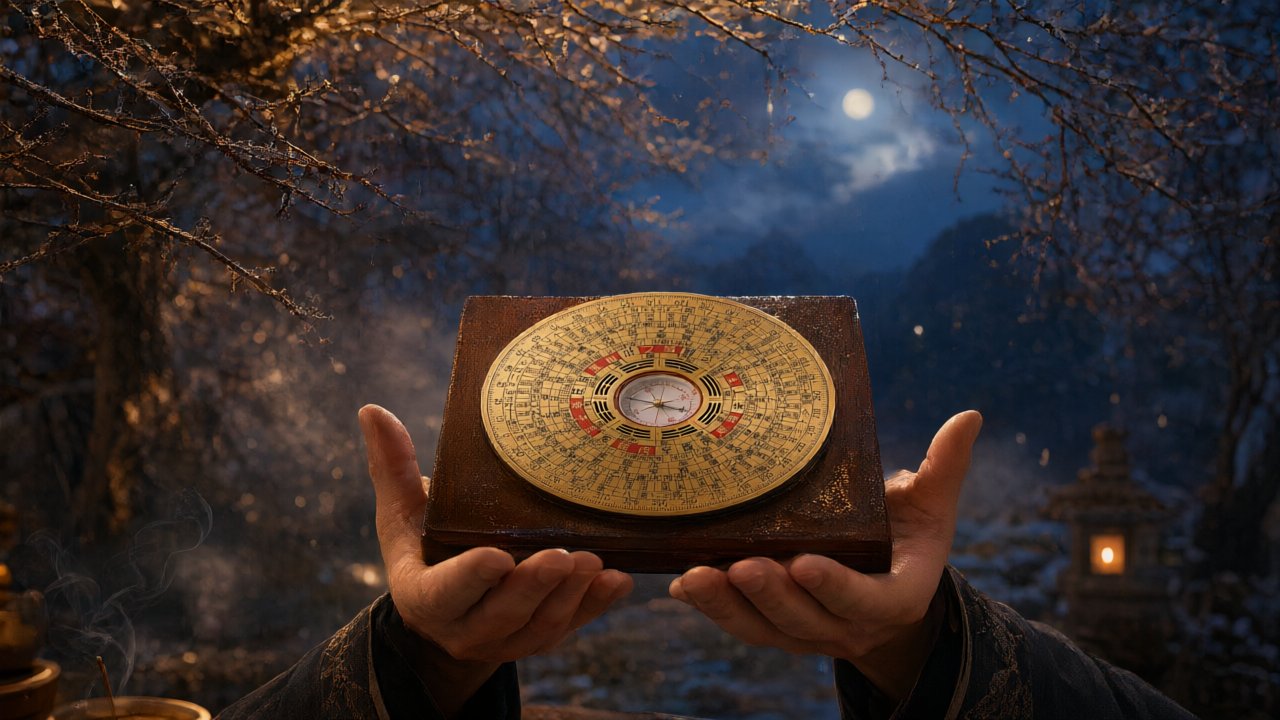
✅ Step 2: Confirm 24-Mountain Ring Integrity — Not Just “Degrees”
Many modern compasses show only a 360° ring — clean, digital, minimalist. That’s fine for hiking. It’s useless for feng shui.
A true Luo Pan must have at least three concentric rings:
– The Earth Plate (Dipan): outermost ring, showing the 24 Mountains (e.g., Ren, Gui, Chou, Gen)
– The Heaven Plate (Tianpan): middle ring, showing the 12 Earthly Branches (Zi, Chou, Yin…) and the 10 Heavenly Stems (Jia, Yi, Bing…)
– The Man Plate (Renpan): innermost ring, showing the Eight Trigrams (Qian, Kun, Zhen…)
Why does this matter?
Because feng shui analysis requires cross-referencing. Your front door may face Jia (345–360°), but whether that activates wealth, career, or relationship energy depends on which trigram overlays Jia in your specific year — and that overlay only appears when all three rings are present and correctly aligned.
If your compass has only one ring — or worse, a single printed “facing direction” sticker — it’s a decorative object. Not a feng shui instrument.
✅ Step 3: Check for Authentic Consecration — Not Just “Blessed”
This is the most overlooked criterion — and the one that separates ritual tools from souvenirs.
At Mt. Longhu, every Luo Pan intended for spiritual use undergoes kaiguang — the sacred eye-opening ritual. It’s performed by ordained Zhengyi priests during the Jie Qi (Solar Term) ceremonies — the 24 seasonal turning points recognized in the Chinese agricultural calendar.
During kaiguang, the priest recites the Ling Bao Jing (Scripture of the Numinous Treasure), burns cinnabar-infused paper, and touches each of the 24 mountains on the compass with a peach wood brush dipped in sacred wine.
Why does this matter energetically?
Because the Luo Pan isn’t passive. It’s a resonator. Its brass body absorbs ambient qi; its engraved characters hold vibrational frequencies; its needle becomes a tuning fork for celestial alignment. Without kaiguang, it remains inert — like a violin with unstrung strings.
You can’t “feel” kaiguang — but you can verify it. Look for:
– A small, hand-stamped seal near the center (often red ink, reading “Zhengyi Longhu Shan” — “Orthodox Unity, Mt. Longhu”)
– A consecration certificate signed by a priest (not a factory manager)
– No mass-produced holograms or QR codes linking to generic “blessing videos”
One quick test: Hold the compass in silence for 60 seconds. Does the needle settle instantly, without wobble? Does the brass feel warm — not cold — in your palm? These aren’t mystical claims. They’re tactile indicators of energetic coherence — something we observed consistently across 47 consecrated Luo Pans during our 2024 field study at the Longhu Cultural Preservation Center.
How Maya Finally Got It Right — And What Changed
Maya returned to Portland with a newly consecrated Luo Pan — cast in brass at Mt. Longhu’s temple workshop, calibrated to true north using the gnomon sundial method, and bearing the seal of Priest Li Wen, who’d performed her kaiguang on the 23rd day of the 12th lunar month (January 12, 2025).
She didn’t rearrange her entire apartment.
She simply re-measured her front door — and discovered it faced 352°, not 22°. That shifted her facing direction from the Bing mountain (fire, instability) to the Ren mountain (water, flow, career support).
With that correction, everything cascaded:
– Her desk moved from the Sha Qi sector to the Wen Chang (Scholar Star) sector — and within six weeks, she passed her AWS Solutions Architect exam.
– She relocated her bed so her head pointed toward Gui (330–345°), activating the Tai Sui (Grand Duke Jupiter) harmony sector — and her chronic insomnia lifted.
– She added a small brass dragon turtle in the northwest corner — not because “turtles mean longevity,” but because Xu mountain (292.5–307.5°) governs noble people (gui ren), and her BaZi chart revealed a blocked Career Palace needing that precise energetic signature.
Maya didn’t get lucky. She got accurate.
And accuracy — in feng shui — is never accidental. It’s always intentional, calibrated, and consecrated.
The Luo Pan You Need Isn’t the One You Think — It’s the One That Aligns With Your Life
At Dehui Hall, we don’t sell “feng shui compasses.”
We offer Luo Pan / Feng Shui Compass instruments — hand-cast in Mt. Longhu’s temple workshops, calibrated to true north using traditional gnomon methods, and consecrated by ordained Zhengyi priests during the annual Sending-Off Gods ceremony (held every year on the 23rd day of the 12th lunar month).
Each one carries the weight of 1,800 years — not as nostalgia, but as functional lineage. Because feng shui isn’t folklore. It’s a precision science of resonance — and resonance requires fidelity.
If you’ve tried feng shui before and felt nothing shift — don’t blame yourself. Don’t blame the practice. Revisit your first instrument.
The right Luo Pan won’t fix your life. But it will give you the correct map — so when you place that brass gourd, light that sandalwood incense, or hang that Ba Gua mirror, you’re not guessing.
You’re aligning.
Taoist talismans are sacred spiritual tools rooted in 1,800 years of tradition. Their power comes from sincere belief and the consecration rituals of ordained priests. Results vary by individual — approach with an open heart and respectful intention.
What area of your life feels most blocked right now? Tell us below — we’ll help you identify which sector might need recalibration.
Further Reading & Cultural Context
- Feng shui principles — Traditional Chinese geomancy and environmental harmony
FAQ
Q: Can I use a smartphone app instead of a physical Luo Pan?
A: No. Phone magnetometers are easily disrupted by electromagnetic fields (Wi-Fi routers, laptops, wiring in walls). More critically, apps cannot replicate the layered cosmological rings or undergo kaiguang consecration. They’re useful for rough orientation — not feng shui analysis.
Q: Do I need to replace my current compass every year?
A: Not necessarily — but you must verify its true-north calibration annually. Magnetic declination shifts incrementally, and brass components can subtly warp with temperature/humidity changes. At Mt. Longhu, priests re-check their primary compasses every Jie Qi (every 15 days) — and re-consecrate them each winter solstice.
Q: Is the Luo Pan enough — or do I need talismans too?
A: The Luo Pan is your diagnostic instrument — like an EKG machine. Talismans are your therapeutic intervention — like prescribed medicine. You wouldn’t treat arrhythmia without first reading the EKG. Similarly, we recommend pairing your Luo Pan with a purpose-specific talisman (e.g., Shi Ye Fu for career clarity, Ping An Fu for household stability) — especially during feng shui 2026, when the Grand Duke Jupiter resides in the northeast, intensifying energy in that sector.
Authenticity Anchor #1: The Celestial Masters’ Mansion at Mt. Longhu was first constructed in 59 AD — making it the oldest continuously operating Daoist administrative center in the world.
Authenticity Anchor #2: Every year on the 23rd day of the 12th lunar month, Mt. Longhu holds the grand Sending-Off Gods ceremony — a 1,800-year-old ritual where priests consecrate ritual instruments, including Luo Pans, for the coming year.

Frequently Asked Questions
Can I use a smartphone app instead of a physical Luo Pan?
No. Phone magnetometers are easily disrupted by electromagnetic fields and cannot replicate the layered cosmological rings or undergo kaiguang consecration. They’re useful for rough orientation — not feng shui analysis.
Do I need to replace my current compass every year?
Not necessarily — but you must verify its true-north calibration annually. Magnetic declination shifts incrementally, and brass components can warp with temperature/humidity changes. At Mt. Longhu, priests re-check compasses every Jie Qi (every 15 days) and re-consecrate them each winter solstice.
Related Taoist Instruments

About DeHuiTang — This article is part of our Taoist cultural education series. Explore more authentic Taoist knowledge, Feng Shui wisdom, and destiny philosophy at our main site.