# Taoist Talismans Aren’t Magic — They’re Something Deeper
### When Grandma’s Folded Paper Still Feels Like Home
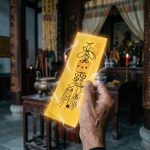
The other day, a woman in Vancouver emailed us with a photo: a small, slightly yellowed square of rice paper folded three times, sealed with a vermilion stamp that had blurred at the edges. Her grandmother had slipped it into her school lunchbox every Monday for twelve years — not as a charm, but as *a quiet word she couldn’t say aloud*: “I’m holding space for you.”
She didn’t call it a talisman. She called it *“Nai Nai’s little peace”.*
That piece of paper sat in a Ziploc bag inside her wallet for another 23 years — through med school, residency, and two cross-country moves. She told us, *“I never believed it ‘worked’ — but I always believed *she* did.”*
That’s the quiet truth no museum label captures: Taoist talismans aren’t spells cast *at* the world. They’re handwritten prayers cast *into* relationship — with ancestors, with intention, with the quiet rhythm of things unfolding just as they should.
And yet — here we are in 2026, scrolling past TikTok videos titled “3-Second Luck Boost” while ancient priests on Mt. Longhu still fast for three days before drawing a single Wu Lei Fu (Five Thunder Talisman). The contrast isn’t ironic. It’s illuminating.
So let’s pause the scroll — not to chase miracles, but to remember what these papers *actually* were built to do.
—
## The Ink Was Never the Point — The Intention Was
Here’s the one thing most people get wrong about Taoist talismans: they think the power is *in the symbol.*
It’s not.
The power is in the *ceremony*, the *lineage*, and the *living breath* behind the brushstroke.
Let’s go back to the source: Mt. Longhu (Dragon & Tiger Mountain) in Jiangxi Province — the cradle of Zhengyi Daoism and home to the Celestial Masters since Zhang Daoling received the *Dao* there in 142 CE. The first Celestial Masters’ mansion was built in 59 AD — yes, *before* the Roman Empire fell — and has been continuously occupied for over 1,800 years. That’s longer than Oxford University, the Vatican Library, or the oldest continuously operating brewery in the world.
Every year on the 23rd day of the 12th lunar month, Mt. Longhu holds the grand *Sending-Off Gods Ceremony* (Song Shen), where thousands gather to ritually release the household deities who’ve watched over them all year. Before that, priests spend three days in seclusion — fasting, bathing, chanting the *Ling Bao Jing*, and preparing their minds like blank scrolls. Only then do they sit before the altar, light incense, and begin drawing talismans — not with ink, but with *qi-infused cinnabar*, guided by celestial timing and ancestral invocation.
A Wu Lu Cai Shen Fu (Five Roads Wealth Talisman) isn’t drawn to “make money.” It’s drawn to align the bearer’s *action, attitude, and openness* with abundance already flowing — like tuning a radio to a frequency, not creating the signal.
Think of it like this: A violin isn’t music. The musician isn’t music. But when breath meets bow meets string — *that resonance* is where meaning lives.
Talismans are the violin. The priest’s training? The musician. Your sincerity? The breath.
That’s why authenticity matters — not as mystique, but as continuity. When we receive a consecrated talisman from Mt. Longhu today, we’re not buying a relic. We’re receiving a *living thread* — one that stretches back to Zhang Daoling’s first disciples, to Ming Dynasty temple scribes, to the master who drew your Peace Talisman last Tuesday morning while the mist still clung to the peaks.
And that thread doesn’t vanish because you live in Berlin, Buenos Aires, or Brisbane. It simply changes language — from classical Chinese characters to silent understanding, from altar smoke to subway silence, from ritual gesture to the way you pause before opening an email, or hold your breath before saying “yes” to something new.
—
## The Real Ritual Happens After You Unfold It
We once asked a 92-year-old master craftsman in the old street of Shangqing Town — the historic heart of Mt. Longhu — what he thought people *really* needed from talismans today.
He smiled, wiped his ink-stained fingers on his apron, and said: *“Not more power. More pause.”*
Then he held up a freshly drawn Ping An Fu (Peace Talisman), still damp at the edges: *“This paper doesn’t stop storms. But it reminds you — when your chest tightens and your thoughts race — that you’re allowed to return to stillness. That’s the real consecration.”*
That moment changed how we curate at DeHuiTang. We stopped asking, *“What does this talisman do?”* and started asking, *“What does this talisman invite?”*
– The **Wu Lu Cai Shen Fu** invites gratitude before ambition — noticing the wealth already present: time, health, trust.
– The **Gui Ren Fu** (Noble Person Talisman) invites generosity — not waiting for help to arrive, but becoming the helper.
– The **Fu Qi He He Fu** (Harmony Between Partners Talisman) invites listening before speaking — especially when silence feels heavier than words.
Even the **Tai Sui Fu**, worn each year to harmonize with the ruling star deity, isn’t about dodging fate — it’s about *adjusting posture*. Like a sailor trimming sails not to command the wind, but to move *with* it.
That’s the quiet revolution of these artifacts: they don’t change external conditions. They recalibrate internal compasses.
Which brings us to the most overlooked ritual of all — the one that happens *after* you receive your talisman.
No incense required. No chanting necessary.
Just this:
1. Hold it in both hands for ten seconds — not as an object, but as a *witness* to your intention.
2. Say (aloud or silently): *“I am choosing to hold space for ______.”*
3. Place it somewhere visible — not hidden in a drawer, but near your desk, your bedside table, or tucked into your journal.
That’s it. That’s the modern ceremony.
Ancient priests fasted for three days. Today, you give ten seconds — and that’s enough, *if the attention is real.*
Because sincerity isn’t measured in duration. It’s measured in presence.
We’ve seen doctors in San Francisco keep their Peace Talisman in their white coat pocket — not for luck in surgery, but as a reminder to breathe before entering a patient’s room. We’ve seen teachers in Melbourne tape a tiny Gui Ren Fu to their lesson plan binder — not to attract “good students,” but to soften their own expectations. And yes — we’ve seen that Vancouver woman finally unfold her Nai Nai’s talisman last spring… and write her grandmother’s name on the back, in English, for the first time.
That’s the lineage continuing — not in flawless transmission, but in tender, imperfect translation.
So if you’ve ever held a talisman and wondered, *“Does this really work?”* — the answer isn’t in the paper. It’s in the pause you allow yourself after reading these words. In the breath you take before clicking away. In the quiet acknowledgment that *you*, right now, are part of something much older — and much gentler — than algorithms or outcomes.
That’s the original ‘Good Vibes Only’ energy — not forced positivity, but rooted presence. Not magic. *Meaning.*
—
### What’s *your* quiet ritual?
Do you have a family heirloom — a folded paper, a worn coin, a stone from a sacred place — that carries spiritual significance *not because of what it promises, but because of who gave it to you?*
Tell us below. We read every story — and we’ll share a few next week in our *Living Lineage* newsletter.
These items are sold as cultural artifacts. Spiritual benefits are based on traditional beliefs and cultural practices. DeHuiTang does not guarantee specific outcomes.
For those seeking authentic, consecrated talismans drawn by Zhengyi Daoist masters on Mt. Longhu, DeHuiTang offers the Wu Lu Cai Shen Fu, Ping An Fu, and other traditionally blessed items — each carrying the quiet weight of 1,800 years of unbroken practice.
Frequently Asked Questions
What is the difference between a Taoist talisman and a 'lucky charm'?
A Taoist talisman is not a magical lucky charm meant to manipulate outcomes. Rooted in Zhengyi Daoist tradition, it’s a consecrated object created through disciplined ritual, lineage-based training, and intentional alignment — not superstition. Its purpose is cultural and spiritual: to serve as a focal point for reflection, continuity with ancestors, and mindful presence. At DeHuiTang, each talisman is drawn by Mt. Longhu priests following centuries-old protocols — honoring relationship over results, sincerity over spells.
Do I need to believe in Taoism to respectfully use a talisman from DeHuiTang?
No — respect, not belief, is central. Many recipients connect with talismans as cultural heirlooms, meditative anchors, or expressions of intergenerational care (like the ‘Nai Nai’s little peace’ story). DeHuiTang honors these diverse relationships: whether you practice Daoism, honor family tradition, or simply value intentionality, the talisman invites pause, presence, and personal meaning — without requiring doctrinal adherence or spiritual conversion.
How are DeHuiTang’s talismans consecrated, and why does that matter?
Each talisman is hand-drawn by ordained Zhengyi Daoist priests on Mt. Longhu — the historic seat of the Celestial Masters since 142 CE. Consecration involves fasting, chanting sacred texts, celestial timing, and cinnabar ink infused with focused qi. This isn’t symbolic decoration; it’s a living ritual act rooted in unbroken lineage. That continuity matters because it reflects commitment to craft, reverence, and transmission — turning paper into a quiet vessel for shared human values like peace, harmony, and gratitude.
Can I keep a talisman in my wallet or wear it daily?
Yes — and how you carry it reflects your intention. Traditionally, talismans are placed where they support mindful awareness: near your desk, bedside, or journal — not hidden away. Keeping one in your wallet or bag is common, especially for talismans like Ping An Fu (Peace) or Gui Ren Fu (Noble Person), as gentle reminders to return to stillness or generosity. The key isn’t location, but conscious engagement: holding it briefly each day can anchor presence, honoring its role as a companion in daily life.
Related Taoist Instruments
About DeHuiTang — This article is part of our Taoist cultural education series. Explore more authentic Taoist knowledge, Feng Shui wisdom, and destiny philosophy at our main site.