# What Is an Exorcism Talisman (驱鬼符) in Taoist Tradition? A Cultural and Historical Guide
In the rich tapestry of East Asian spiritual traditions, the **exorcism talisman (驱鬼符)** holds a distinctive place—not as a tool of fear or fantasy, but as a solemn expression of Taoist cosmology, ritual discipline, and compassionate intervention. Rooted in the Zhengyi Daoist lineage of Mt. Longhu (龙虎山), the exorcism talisman is one of the most historically documented and ritually nuanced categories of *fu* (符)—consecrated symbolic inscriptions used for spiritual alignment, protection, and energetic harmony.
This article offers a respectful, culturally grounded exploration of the exorcism talisman: its origins in Han- and Tang-era liturgical practice; its philosophical foundations in *yin-yang*, *qi*, and celestial bureaucracy; its proper consecration by ordained priests; and its role within broader Taoist approaches to well-being and environmental balance. We also clarify common misconceptions—especially those arising from popular media—and offer practical guidance for those seeking authentic understanding or meaningful engagement with this tradition. By the end, readers will appreciate the exorcism talisman not as a relic of superstition, but as a cultural artifact embodying over 1,800 years of disciplined spiritual craftsmanship.
—
## Historical Origins: From Han Dynasty Rituals to Mt. Longhu’s Celestial Masters
The earliest antecedents of the exorcism talisman appear in Han dynasty (206 BCE–220 CE) texts such as the *Wu Shi Er Bing Fang* (Fifty-Two Remedies) and *Yunmeng Qin Slips*, where inscribed bamboo strips and vermilion-charred wood were employed in rites addressing *gu* (ghostly or disruptive influences) and *bing* (spiritual afflictions). These early practices reflected a worldview in which illness, misfortune, or emotional unrest could stem not only from physical causes—but also from imbalances in the human-spirit interface: disharmony between the living and ancestral realms, violation of ritual propriety, or encroachment by wandering *yin*-energy.
By the Eastern Han (25–220 CE), Zhang Daoling—the First Celestial Master—founded the Zhengyi Daoist tradition on Mt. Longhu in Jiangxi Province. His *Zhengyi Mengwei Lu* (Records of the Orthodox Unity Covenant) systematized ritual responses to spiritual disturbances, integrating older shamanic and alchemical knowledge into a structured liturgical framework. Crucially, Zhengyi Daoism did not view “ghosts” (*gui*) as inherently malevolent beings, but rather as *unresolved energies*: spirits without proper burial rites, ancestors estranged through neglect, or fragmented *hun* (ethereal soul) fragments dislodged by trauma or sudden death. The purpose of the exorcism talisman was thus never to “destroy,” but to *reconcile*, *redirect*, or *reintegrate*—a nuance often lost in translation.
Over centuries, the art of *fu* evolved alongside imperial patronage, temple networks, and scholarly commentary. Tang dynasty (618–907) texts like the *Taishang Dongxuan Lingbao Dingguan Jing* emphasized the talisman’s function as a *celestial warrant*—a document signed by heavenly officials and activated through priestly virtue (*de*), correct breath (*qi*), and precise calligraphic form. This bureaucratic metaphor was not mere symbolism: it reflected the Tang cosmological model in which heaven, earth, and humanity formed an interdependent administrative system, with ordained priests serving as authorized intermediaries.
Today, authentic exorcism talismans continue to be produced exclusively within this lineage—most notably at Mt. Longhu’s Shangqing Palace and affiliated temples—by priests who have undergone decades of training in scripture, ritual movement (*bu dou*, stellar pacing), incantation (*zhou*), and calligraphic discipline. Their authority is not self-proclaimed, but conferred through formal ordination (*guan*), transmission (*chuan*), and ongoing ethical cultivation.
—
## Understanding “Gui” (Ghost): Beyond Western Notions of Haunting
To understand the exorcism talisman, one must first reframe the term *gui* (鬼). In English, “ghost” evokes images of spectral figures, jump scares, or vengeful spirits—a legacy of Gothic fiction and Hollywood horror. In classical Chinese cosmology, however, *gui* denotes a specific category of *yin*-dominant energy that has lost its natural course of transformation.
According to the *Huangdi Neijing* and later Taoist commentaries, human life is sustained by two soul components: the *hun* (ethereal soul, associated with *yang*, thought, and ascent) and the *po* (corporeal soul, associated with *yin*, sensation, and descent). At death, the *hun* ideally ascends to join the ancestral realm, while the *po* returns to earth. When this process is disrupted—due to violent death, unperformed funeral rites, unresolved emotional attachments, or geographical dislocation—the *po* may linger, manifesting as *gui*: not as a conscious entity with intent, but as a localized field of stagnant *yin*-energy capable of affecting mood, sleep, focus, or environmental harmony.
This concept bears no resemblance to demonic possession in Abrahamic traditions. There is no “fallen angel” or “evil force” to battle. Rather, *gui* is understood as a *natural phenomenon of imbalance*, much like fog forming in a valley—neither moral nor immoral, but requiring appropriate conditions to dissipate. The exorcism talisman functions less like a weapon and more like a *ritual catalyst*: a precisely calibrated instrument designed to restore flow, invite celestial order, and support the natural resolution of energetic disturbance.
Contemporary practitioners and scholars—including Dr. Livia Kohn, Professor Emerita of Religion at Boston University—note that Taoist exorcism rituals are always paired with offerings, memorial rites, and ethical reflection. As she observes in *Taoist Mystical Philosophy*: “The goal is never expulsion for its own sake, but restoration of relational harmony—with ancestors, with community, and with the Dao itself.”
—
## How Is an Exorcism Talisman Consecrated? The Ritual Integrity Behind the Symbol
An exorcism talisman is not printed, copied, or mass-produced. Its efficacy—within the tradition—is inseparable from the *consecration process* (*kai guang*, “opening the light”), which unfolds over hours or days and involves three interdependent dimensions: *form*, *sound*, and *intention*.
**1. Form (Xing 形):** The talisman’s visual structure follows strict canonical rules. It typically includes:
– A *fu tou* (talisman head), often bearing the seal of the Celestial Master or a celestial general;
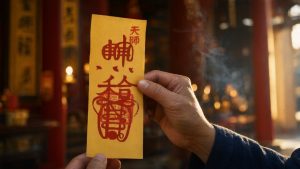
– A central *fu zhi* (talisman body), composed of esoteric characters (*yun* or *lei wen*, thunder script), star maps, and divine names written in cinnabar ink on yellow paper or silk;
– A *fu wei* (talisman tail), containing instructions for activation, disposal, or invocation.
Each stroke must be executed in a single breath, without hesitation or correction—reflecting the Taoist principle that *qi* flows only where attention is unified.
**2. Sound (Sheng 声):** Consecration incorporates *zhou* (incantations) drawn from scriptures like the *Lingbao Jing*. These are not “spells” but vibrational resonances intended to harmonize the practitioner’s *qi* with celestial frequencies. The priest chants while tracing the talisman’s strokes in the air (*xu fu*), then transfers that resonance onto the physical medium.
**3. Intention (Yi 意):** Most critically, the priest must embody *de* (virtue) and *jing* (reverent focus). Classical texts warn that a talisman inscribed by someone lacking moral grounding or ritual purity may be inert—or worse, destabilizing. This underscores why authenticity depends not on the object alone, but on the integrity of the entire chain: lineage → ordination → training → intention.
For those seeking authentic exorcism talismans rooted in this tradition, DeHuiTang offers items consecrated by ordained Zhengyi priests from Mt. Longhu, following time-honored protocols. The **Qu Xie Fu (驱邪符)**—a closely related protective talisman—shares foundational principles with the exorcism talisman, emphasizing the gentle dispersion of disruptive *yin*-influences through celestial alignment and ritual clarity.
—
## Using an Exorcism Talisman Respectfully: Guidelines for Contemporary Practitioners
While traditional use involved temple-based rituals led by priests, many sincere seekers today wish to engage with these artifacts respectfully in personal practice. Below are culturally informed guidelines—drawn from temple protocols and modern pastoral counsel—designed to honor the tradition’s depth and avoid appropriation or misunderstanding.
✅ **Do:**
– Treat the talisman as a sacred object: store it in a clean, elevated space, away from clutter or foot traffic;
– Accompany its placement with quiet reflection or simple offerings (e.g., clean water, incense, a sincere intention);
– Understand it as *supportive*, not substitutive—complementing, not replacing, ethical conduct, self-cultivation, or professional care when needed;
– Dispose of worn or expired talismans respectfully: burn them fully in a safe container, collect the ash, and bury it beneath a tree or scatter it in flowing water—symbolizing return to natural cycles.
❌ **Don’t:**
– Carry it as a “lucky charm” without context or reverence;
– Use it to target others, manipulate situations, or assert control;
– Display it casually among decorative objects or in inappropriate spaces (e.g., bathrooms, bedrooms used solely for rest);
– Assume it replaces medical, psychological, or social support—Taoist tradition has long affirmed the value of skilled physicians (*yi xian*) and wise counselors (*xian sheng*).
It is also important to recognize that not every experience of unease, anxiety, or environmental discomfort calls for ritual intervention. Taoist wisdom encourages discernment: sometimes the “disturbance” is an invitation to examine one’s lifestyle, relationships, or inner landscape. As the *Zhuangzi* reminds us: “When the ruler within is clear, the realm without settles of itself.”
For those new to Taoist practice, beginning with foundational disciplines—such as breath regulation (*tuna*), mindful walking (*bu dou*), or studying core texts like the *Dao De Jing*—often provides deeper grounding than any external artifact.
—
## Common Misconceptions and Cultural Sensitivity
Because of its visibility in film, literature, and online folklore, the exorcism talisman is frequently misrepresented. Clarifying these points supports both cultural respect and accurate understanding.
🔹 *Misconception: “Exorcism talismans are ‘magic’ tools for instant fixes.”*
Reality: Within Taoist tradition, no talisman operates independently of cosmic law (*li*), human virtue (*de*), or ritual sincerity (*cheng*). They are aids—not shortcuts—to alignment with the Dao.
🔹 *Misconception: “They’re meant to scare or punish spirits.”*
Reality: The Zhengyi canon consistently emphasizes compassion (*ci*) and benevolence (*ren*). Rituals include prayers for the peaceful transition of lingering energies, not condemnation.
🔹 *Misconception: “Anyone can make or use them effectively.”*
Reality: Just as one wouldn’t perform surgery without training, Taoist tradition reserves talisman creation for ordained priests who have mastered scripture, ritual, and self-cultivation over many years.
🔹 *Misconception: “They’re interchangeable with Buddhist or folk charms.”*
Reality: While syncretism exists in practice, the exorcism talisman belongs specifically to the Zhengyi liturgical system. Its structure, deities invoked (e.g., Zhao Gongming, Marshal Wen), and celestial bureaucracy differ meaningfully from Buddhist *dharani* scrolls or local folk amulets.
Approaching these artifacts with humility—not exotic fascination—honors the generations of priests, scholars, and artisans who have preserved this heritage. It also invites us to reflect on our own cultural frameworks: How do we understand unseen influences? What rituals help us restore balance? Where do we locate agency—in objects, in relationships, or in cultivated inner stillness?
—
## Conclusion: An Invitation to Deeper Understanding
The exorcism talisman (驱鬼符) is far more than a symbol—it is a convergence of cosmology, calligraphy, ethics, and celestial devotion. Its history stretches from Han dynasty bamboo slips to the incense-filled halls of Mt. Longhu’s Shangqing Palace; its philosophy rests on the quiet confidence that harmony is always possible, even amid disruption. To hold such an artifact is to touch a living thread in the fabric of Taoist civilization—one woven with reverence, precision, and enduring compassion.
If you feel drawn to explore these traditions with integrity, DeHuiTang welcomes you. Our collection includes consecrated talismans and ritual instruments created in collaboration with ordained Zhengyi priests from Mt. Longhu—each piece accompanied by context, care instructions, and historical background. Whether you seek the focused clarity of the **Qu Xie Fu (驱邪符)** or wish to learn more about the ceremonial peach wood sword used in traditional purification rites, our aim is to serve as a thoughtful bridge between ancient wisdom and contemporary life.
These items are sold as cultural artifacts. Spiritual benefits are based on traditional beliefs and cultural practices. DeHuiTang does not guarantee specific outcomes.
—
## Frequently Asked Questions (FAQ)
**Q: Can I use an exorcism talisman for protection in my home or office?**
A: Yes—many practitioners place consecrated talismans in entryways, altars, or study spaces as part of a broader practice of environmental harmony. Traditionally, they are affixed with red thread or mounted respectfully, never taped or pinned haphazardly. Always pair physical placement with mindful intention and regular upkeep.
**Q: Is there a difference between an exorcism talisman (驱鬼符) and a general protection talisman (护身符)?**
A: Yes. While both serve protective functions, the exorcism talisman specifically addresses *gui*-related energetic disturbances—often linked to ancestral or environmental imbalances. A general protection talisman (*hu shen fu*) focuses more broadly on sustaining personal *qi*, warding off everyday *xie qi* (disruptive energies), and supporting longevity and clarity.
**Q: Do I need to be Taoist to benefit from these talismans?**
A: No. Many people from diverse backgrounds appreciate them as cultural artifacts, artistic expressions of sacred geometry, or focal points for contemplative practice. What matters most is respectful engagement—not doctrinal adherence.
Related Taoist Instruments
About DeHuiTang — This article is part of our Taoist cultural education series. Explore more authentic Taoist knowledge, Feng Shui wisdom, and destiny philosophy at our main site.