Your Bed Is Under a Window — And That’s Why Everything Feels Off
You walk into your bedroom, pull back the curtains, and feel it — not quite restful, not quite safe. Your sleep is light. You wake up tired. Maybe you’ve had unexplained headaches, or your partner keeps snapping over small things. You rearrange the furniture, try new pillows, even switch mattresses — but that low hum of unease stays.
It’s not your imagination. It’s not bad luck. It’s not stress alone.
It’s your bed under the window.
That single placement — concrete, visible, everyday — is one of the most quietly destabilizing setups in traditional feng shui. And if you’ve forwarded this to a sibling, parent, or friend thinking “Wait — is their bed under a window too?”, then you’ve already felt the weight of what we’re about to unfold.
This isn’t about superstition. It’s about resonance — the way energy moves through space, how ancient masters mapped it, and why a 2,000-year-old compass still holds answers your therapist, your productivity app, and your self-help podcast haven’t named.
The Western Fix Trap: Why Rearranging Won’t Solve This
Western self-help culture teaches us to optimize. We track sleep cycles, journal gratitude, adjust blue-light exposure, and meditate at sunrise — all valuable tools. But when your environment itself is out of alignment with natural energetic flow, optimization becomes like polishing a cracked foundation.
Think of it like this: You wouldn’t expect a perfectly tuned engine to run smoothly on contaminated fuel. Yet many of us treat our homes as neutral containers — blank stages for our personal growth — rather than living systems with their own rhythms, boundaries, and energetic architecture.
That’s where feng shui diverges. Not as an alternative to psychology or wellness, but as its silent counterpart: the discipline of spatial intelligence. While therapy explores the inner landscape, feng shui reads the outer one — and the two speak the same language of balance, safety, and flow.
The bed-under-window issue is a perfect case study. In Western interior design, it’s often praised: “natural light,” “airy feel,” “scenic view.” In classical feng shui texts like the Yangzhai Sanyao (《陽宅三要》, Three Essentials of Yang Dwellings), it’s classified as a Sha Qi (killing energy) configuration — not because windows are evil, but because they represent an unshielded boundary. A window is an opening without a door — a place where energy rushes in and out without regulation, just as wind whistles through a cracked window frame. When your head rests directly beneath it, your body’s most vulnerable state — deep rest — occurs in the path of that ungrounded flow.
This isn’t about fear. It’s about physics — the physics of qi, as understood by generations of geomancers who charted mountains, rivers, and star paths from Mt. Longhu (龍虎山), the sacred seat of the Zhengyi Daoist lineage since the time of Zhang Daoling in the Eastern Han Dynasty.
Why the Luo Pan Is Not a Compass — It’s a Language
If you’ve ever held a feng shui compass — or seen one online — you may have assumed it’s just a fancy version of the one on your phone. It’s not. Not even close.
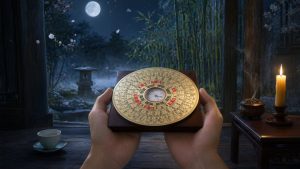
A standard magnetic compass points to north. A Luo Pan (罗盘) — the authentic feng shui compass used by practitioners for over 1,800 years — points to patterns. It doesn’t measure direction alone; it maps layers of meaning layered atop direction.
The Luo Pan is a concentric wheel — a mandala of cosmology carved in brass and wood. Its genius lies not in its precision, but in its polyphony: five primary rings, each representing a distinct system of celestial and terrestrial resonance. These aren’t decorative flourishes. They’re functional layers — like overlapping transparencies on an architectural blueprint — each revealing a different dimension of the space you inhabit.
And yet, most beginners never see past the outermost ring.
They mistake the Luo Pan for a tool that tells them where to place a plant. In truth, it tells them why that plant matters — and whether the soil beneath it, the light above it, and the history of the land around it are harmonized.
That’s why reading a Luo Pan isn’t about memorizing degrees. It’s about learning to listen — to decode the grammar of qi through symbols inherited from the Celestial Masters (天師道), refined across dynasties, and consecrated in temples on Mt. Longhu.
Let’s walk through those five essential layers — not as abstract theory, but as practical keys you can use this week.
Layer 1: The Earth Plate (Dì Pán) — Where Qi Enters the Ground
The outermost ring — the Earth Plate — is what most people recognize: the 24 Mountains, divided into 360°, marked with the Eight Trigrams (Bagua) and the Twelve Earthly Branches.
Handcrafted Cupronickel Ten-Thousand Names Tablet Pendant | Wan Shen Hui Daoist Bagua Exorcism Talisman Necklace
万神讳项链,白铜精制,银金双色。吊坠为令牌/碑形,上承金焰拱券、嵌红宝石,中央嵌描金八卦太极,牌面满布阴刻「万神讳」诸神秘讳与符字。「万神讳」总摄万神名讳,为道教著名伏魔驱邪之秘讳,传统上被视为
Consecrated Solid Brass Feng Shui Compass (8cm, 330g) | Professional Portable Luo Pan for Energy Assessment & Home Protection
全盤採用優質純銅精鑄重工打造,直徑8cm,淨重達330g,沉穩扎實。盤面包含二十四山、先天八卦、天干地支及二十八星宿等精密風水圈層,天池指針靈敏精確。經正統道家法儀開光加持,既是風水師與愛好者勘
But here’s what no app tells you: this layer doesn’t describe your location on Earth. It describes how Earth’s qi enters your home.
Each of the 24 Mountains corresponds to a specific energetic frequency — like musical notes on a scale. When your front door faces the Jia mountain (15°–30°), for example, it receives the Wood-element qi associated with growth, initiative, and new beginnings. Face Geng (255°–270°), and you receive Metal-element qi — sharp, decisive, structuring.
Why does this matter for your bed? Because the Earth Plate determines which directional energies are strongest in each room. If your bedroom occupies the Kan (North) sector — ruled by Water and the number 1 — and your bed sits with your head pointing south (Li fire), you’ve created a classic Water-Fire clash. That’s not “bad feng shui” — it’s energetic friction, often mirrored in restless sleep, emotional volatility, or difficulty making decisions.
Action step #1: Stand at your front door, facing outward. Use your phone’s compass (yes, start simple) to note the exact degree. Then consult a free 24-Mountain chart (we’ll link one below). That number is your home’s facing direction — the first key to unlocking every other layer.
Layer 2: The Heaven Plate (Tiān Pán) — The Celestial Clock Above You
Just inside the Earth Plate sits the Heaven Plate, rotating independently. It marks the 28 Lunar Mansions — star clusters observed by Chinese astronomers since the Warring States period — and aligns them with seasonal shifts and solar terms.
This layer answers: What celestial influence is currently active over your space?
Unlike Western astrology, which focuses on planetary positions relative to your birth, the Heaven Plate tracks real-time cosmic rhythm — the moon’s passage through constellations, the sun’s declination, and the energetic “season” of your home right now.
For example, November 10, 2026 falls during the Xiao Xue (Minor Snow) solar term — a time when Yin energy consolidates, earth settles, and protective, grounding forces dominate. During Xiao Xue, the Heaven Plate emphasizes stability, containment, and inward focus. That’s why a bed under a window — an open, exposed, Yin-deficient position — feels especially destabilizing this month. It contradicts the season’s natural invitation to gather, shelter, and consolidate.
Action step #2: Mark your calendar for the next solar term change — Da Xue (Major Snow) on December 6, 2026. Observe how your energy shifts in the days before and after. Does your need for quiet deepen? Does clutter feel heavier? That’s the Heaven Plate speaking — and your awareness of it is the first act of alignment.
Layer 3: The Lo Shu Square (Luò Shū) — The Numerical Heartbeat of Space
At the center of the Luo Pan lies the Lo Shu Square — a 3×3 grid containing the numbers 1–9, arranged so every row, column, and diagonal sums to 15. Discovered, legend says, on the back of a tortoise emerging from the Luo River over 4,000 years ago, this grid is the numerical soul of feng shui.
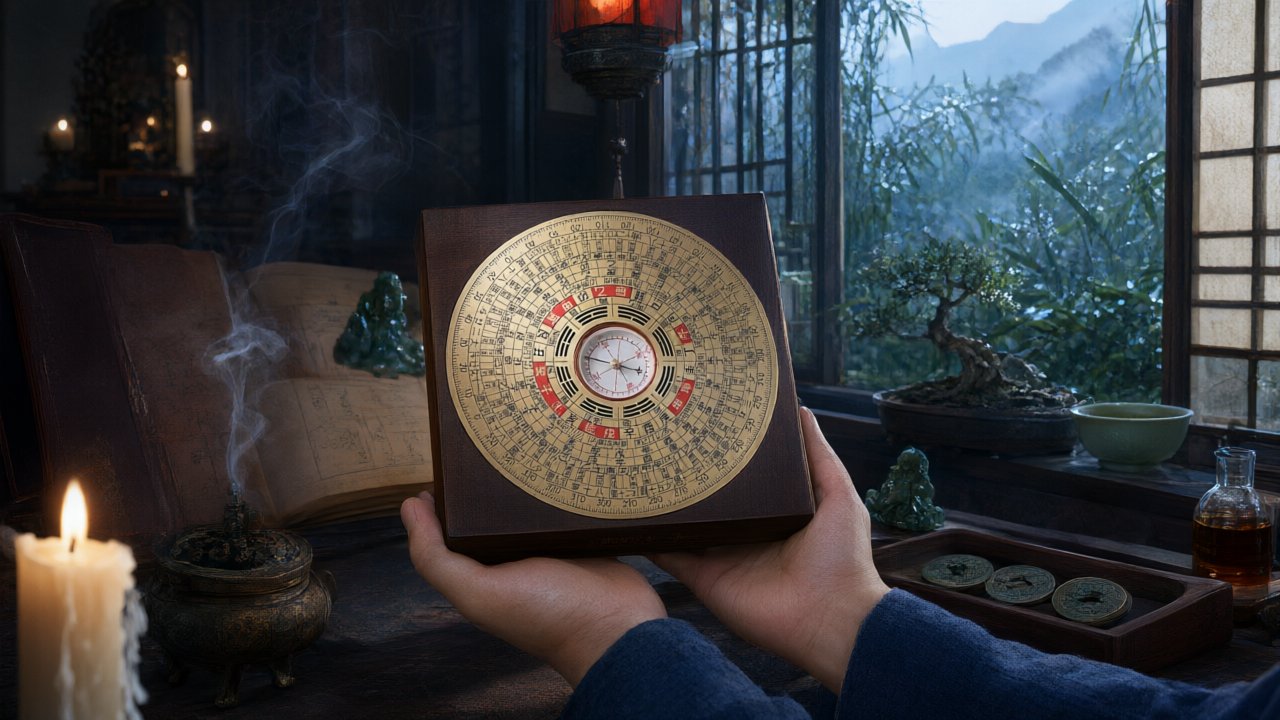
It maps energy distribution — not direction, not stars, but how qi pools, flows, and stagnates in three-dimensional space. Each number corresponds to a life area (Career = 1, Wealth = 8, Fame = 9, etc.) and an element (1 = Water, 8 = Earth, 9 = Fire).
Here’s the practical insight: Your bedroom isn’t just “a room.” It’s a numerical field. If your bed occupies the 8 sector (Southwest, Earth element), and you’re struggling financially, that’s not coincidence — it’s resonance. The Lo Shu tells you that Earth governs stability, resources, and trust. A bed placed here invites grounding — if the sector is clear and nourished. But if that corner holds broken electronics, dusty boxes, or a leaking faucet, the Earth energy is weakened — and so is your sense of financial security.
Action step #3: Print a simple Lo Shu grid. Tape it to your bedroom wall, aligned with true north. Walk slowly around the room, noting where each number falls. Don’t judge — just observe. Which number lands where your head rests? Which number is beneath your nightstand? That’s your spatial numerology — your home’s silent report card.
Layer 4: The Twenty-Four Mountains Ring — Precision Mapping for Real Homes
Between the Earth and Heaven Plates sits the most misunderstood layer: the Twenty-Four Mountains. It subdivides the 360° circle into 15° segments — not arbitrary, but calibrated to the Earth’s magnetic declination as observed from Mt. Longhu over centuries.
This is where “north” stops being a concept and becomes a location-specific frequency. Magnetic north shifts slightly depending on where you stand on the planet. The Twenty-Four Mountains ring was refined by Zhengyi Daoist geomancers working from the precise latitude and longitude of Mt. Longhu — ground zero for the transmission of feng shui as a sacred art, not a decorative trend.
So when a practitioner says “your wealth corner is at 127.5°,” they’re not quoting a global average — they’re referencing a lineage-based calibration. That’s why generic apps fail: they apply universal math to local resonance.
This layer explains why two homes facing the same compass degree can feel completely different. One may sit on a subtle ridge line that amplifies Wood energy; another, on a former riverbed that enhances Water. The Twenty-Four Mountains help distinguish between directional influence and terrestrial character.
Bonus insight: The Gui Ren Fu (Noble Person Talisman) is traditionally activated facing the Chou mountain (255°–270°) — the direction associated with mentors, helpers, and unexpected support. Placing it there isn’t magic. It’s resonance — aligning your intention with a directional frequency long associated with benevolent connection.
Layer 5: The Central Needle — Where All Layers Meet
At the very center of the Luo Pan sits the needle — but it’s not just magnetic. It’s dual-pointed: one end points to magnetic north, the other to true north, adjusted for local declination. Between them lies the Heavenly Stem and Earthly Branch alignment — the bridge between sky and soil.
This central axis is where all five layers converge. It’s not a measurement tool. It’s a focus point — like the eye of a storm, or the still center of a spinning wheel. When you hold the Luo Pan steady and let the needle settle, you’re not just finding north. You’re anchoring yourself in the convergence of cosmic pattern, earthly form, and human intention.
That’s why traditional practice requires stillness before reading: three slow breaths, feet grounded, spine upright. Because the Luo Pan doesn’t measure outside reality — it reveals the quality of your relationship to it.
Why “Just Buy a Compass” Misses the Point
You can buy a $12 plastic feng shui compass online. It will show you directions. It will not show you resonance.
What makes a Luo Pan authentic — and what makes ours different — is consecration. Just as a Taoist talisman gains power through ritual kaiguang (opening the eyes), a professional Luo Pan is not merely assembled. It is blessed — its brass purified with cinnabar ink, its needle aligned under the guidance of ordained priests from Mt. Longhu, its rings inscribed with reverence for the Yangzhai Sanyao and the Qingjing Jing (Classic of Clarity and Stillness).
The Consecrated Solid Brass Feng Shui Compass (8cm, 330g) | Professional Portable Luo Pan for Energy Assessment & Home Protection is forged in this tradition. Every gram of brass was cast in accordance with seasonal metal-smelting rites. Its 330g weight isn’t arbitrary — it mirrors the stabilizing mass required to hold steady in turbulent qi fields. Its 8cm diameter reflects the Bagua’s eight trigrams — a physical echo of cosmic order.
This isn’t a gadget. It’s a ceremonial instrument — one that transforms reading from data collection into dialogue. When you hold it, you’re not checking a box. You’re entering a conversation that began with Zhang Daoling on Mt. Longhu and continues today in homes across six continents.
We also offer the Brass Gourd (Tong Hu Lu) — a traditional feng shui cure shaped like the gourd of the Immortal Li Tieguai, symbolizing containment and healing. Place it near your bedroom window to gently absorb and transform the unshielded flow — a soft, elegant counterpoint to the structural fix of repositioning your bed.
In Closing: Your Home Is Already Speaking
Your home isn’t waiting for you to “fix” it. It’s already communicating — through the creak in the floorboard, the draft by the window, the way light pools in the hallway at 4 p.m., the inexplicable calm of one corner versus the tension of another.
The Luo Pan is simply the first dictionary in a language you already understand in your bones.
You don’t need to master all five layers today. Start with one: notice your bed. Notice the window. Notice how your body responds — not just in sleep, but in mood, clarity, and ease.
Then, if you’d like to go deeper, the Consecrated Solid Brass Feng Shui Compass (8cm, 330g) | Professional Portable Luo Pan for Energy Assessment & Home Protection is ready — not as a solution to be purchased, but as a companion to be honored.
Taoist talismans and feng shui instruments are sacred spiritual tools rooted in 1,800 years of tradition. Their power comes from sincere belief and the consecration rituals of ordained priests. Results vary by individual — approach with an open heart and respectful intention.
Further Reading & Cultural Context
- Feng shui principles — Traditional Chinese geomancy and environmental harmony
FAQ
Q: Do I need formal training to read a Luo Pan?
A: No. The five layers were designed to be accessible — not arcane. Start with the Earth Plate (facing direction) and Lo Shu grid. Mastery grows with practice, not prerequisites.
Q: Can I use my phone’s compass instead?
A: Yes — for initial orientation. But remember: your phone measures magnetism only. A Luo Pan measures resonance. Think of your phone as a pencil, and the Luo Pan as a full set of watercolor brushes.
Q: Is feng shui religious?
A: Classical feng shui is a metaphysical science rooted in Daoist cosmology, not a doctrine of worship. It shares philosophical foundations with Taoism — balance, flow, harmony — but requires no belief system to observe its effects.
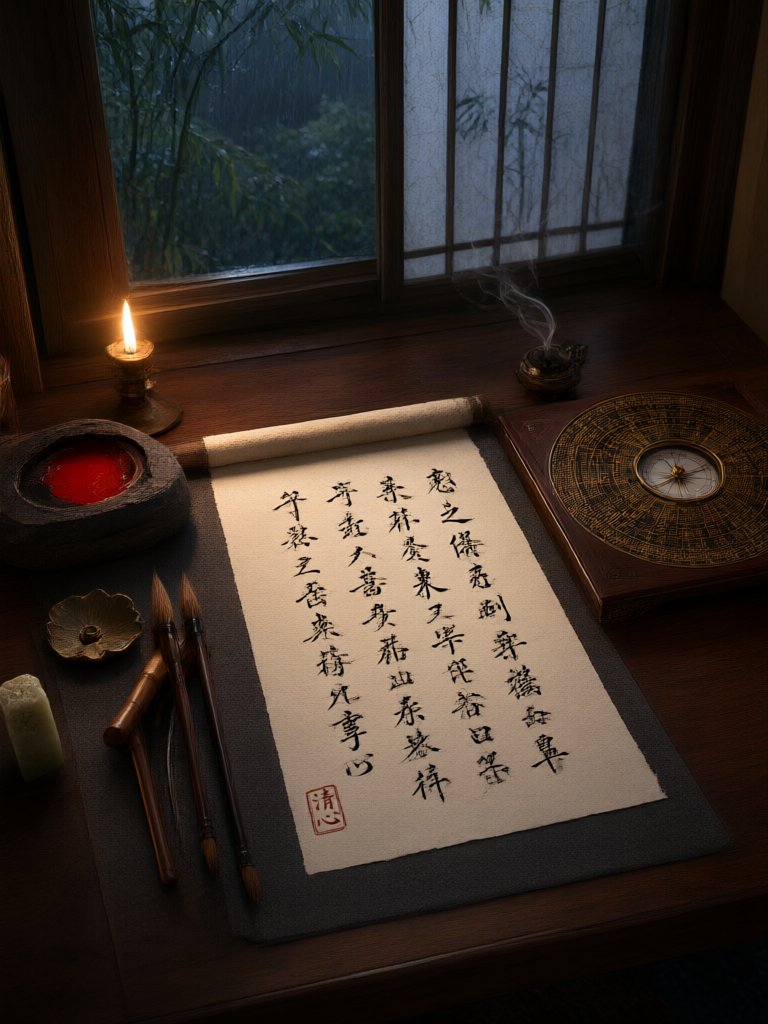
What’s your bedroom setup? Has this ever happened to you? Tell us your story.
Go Deeper
- Dream Interpretation — free, takes about two minutes: see what your recurring dream points to
- If you want the physical remedy behind this article, browse our consecrated talismans and feng shui pieces.
Frequently Asked Questions
Do I need formal training to read a Luo Pan?
No. The five layers were designed to be accessible — not arcane. Start with the Earth Plate (facing direction) and Lo Shu grid. Mastery grows with practice, not prerequisites.
Can I use my phone’s compass instead?
Yes — for initial orientation. But remember: your phone measures magnetism only. A Luo Pan measures resonance. Think of your phone as a pencil, and the Luo Pan as a full set of watercolor brushes.
Related Taoist Instruments
About DeHuiTang — This article is part of our Taoist cultural education series. Explore more authentic Taoist knowledge, Feng Shui wisdom, and destiny philosophy at our main site.