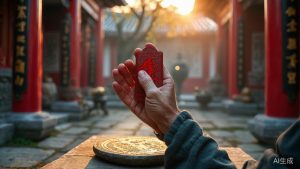
You Made the Move — But Everything Went Wrong
You signed the lease on the 12th. You submitted your resignation on the 19th. You booked the wedding date for the 28th — all with hope, preparation, and full confidence. Then, within days: the new apartment flooded. Your boss delayed your start date. The caterer canceled. It wasn’t bad luck. It wasn’t poor planning. It was timing — not the kind measured in hours and calendars, but in celestial rhythms, earthly energies, and ancient strategic awareness.
This isn’t superstition. It’s a system — one that guided generals into battle, emperors into coronation, and temple masters into ritual consecration for over 1,800 years. And today, ordinary people use it not to conquer kingdoms, but to choose when to sign the lease, submit the application, or say “yes” — without second-guessing.
That system is Qi Men Dun Jia (奇门遁甲), literally “Mysterious Gates Escaping Techniques.” And its most powerful modern expression isn’t hidden in a palace scroll — it’s a free, plain-language board reading you can run in under two minutes.
What Is Qi Men Dun Jia? Not Magic — Strategy, Refined
Qi Men Dun Jia is not fortune-telling. It is not divination in the tarot sense. It is, first and foremost, a strategic timing system born from battlefield necessity.
In the early Eastern Han Dynasty — around 25–220 CE — military strategists faced a problem no map could solve: how to move troops across shifting terrain while avoiding ambushes, navigating fog-laden valleys, and striking when enemy morale was low — not just when the sun rose. They needed more than geography. They needed energy geography.
So they synthesized three foundational pillars of Chinese cosmology:
- The Five Phases (Wu Xing) — wood, fire, earth, metal, water — as dynamic forces interacting in cycles of creation and control;
- The Eight Trigrams (Ba Gua) — symbolic representations of natural phenomena (heaven, lake, fire, thunder, wind, water, mountain, earth) — mapping directional energy;
- The Heavenly Stems and Earthly Branches — a 60-year cyclical calendar combining ten stems and twelve branches, used to track time at micro- and macro-levels.
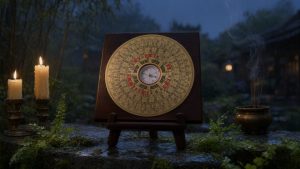
From this fusion emerged Qi Men Dun Jia: a rotating, three-layered cosmic board — the Heaven Plate, Earth Plate, and Human Plate — each containing symbols representing stars, gates, deities, elements, and directions. At any given moment, these layers align uniquely — like a celestial clock face — revealing which sectors of space and time are energetically supportive (open gates), obstructive (closed gates), concealed (hidden doors), or volatile (clashing elements).
Think of it not as predicting fate, but as reading atmospheric pressure before a storm — except the atmosphere is qi, the vital energy that flows through people, places, and plans.
This is why Qi Men Dun Jia was historically reserved for imperial councils and high-stakes decisions: because timing, in Taoist metaphysics, is never neutral. A decision made during a Sheng Men (Life Gate) alignment carries momentum; one made under Si Men (Death Gate) invites friction — not because the universe punishes, but because the energetic field resists cohesion.
From Battlefield to Bedroom: How It Entered Daily Life
Qi Men Dun Jia didn’t stay in the war room. By the Tang Dynasty (618–907 CE), court astrologers applied it to agricultural cycles — choosing when to plant rice or harvest tea based on soil qi and seasonal star positions. During the Song Dynasty (960–1279 CE), civil officials consulted it before submitting memorials to the emperor. And by the Ming era (1368–1644 CE), it had quietly entered temple practice — not for prophecy, but for ritual efficacy. Priests at Mt. Longhu, the sacred seat of the Zhengyi Daoist lineage, used Qi Men boards to select auspicious hours for talisman consecration (kaiguang), ensuring the spiritual charge would anchor deeply rather than dissipate.
But its true democratization came only recently — not through scrolls, but through clarity. For centuries, Qi Men required mastery of dozens of charts, memorization of 1,080 possible configurations, and fluency in classical texts like the Yangzhai Sanyao (《陽宅三要》) and the Qimen Yunting (《奇門演禽》). It was inaccessible — until teachers began translating its logic into plain human terms.
Today, the core question remains unchanged: “What energy supports this action — and where is it strongest right now?”
The answer no longer requires a decade of study. It requires only your name, birth date, and the nature of your move.
Why “Good Timing” Isn’t Just About Luck — It’s About Alignment
Let’s be precise: Qi Men Dun Jia does not claim to override cause and effect. You still need a strong résumé to land the job. You still need due diligence before buying property. What it reveals is something subtler — and profoundly practical: where your effort meets least resistance.
Imagine pushing a heavy door. You can push with all your strength — but if the hinge is rusted and the floor slopes downward, your energy scatters. Now imagine the same door, oiled, aligned, and slightly ajar. Your same effort opens it smoothly.
That’s the difference Qi Men highlights.
In traditional belief, every major life action — signing a contract, launching a business, moving house, proposing marriage — activates a specific qi field. That field interacts with the ambient qi of the time and place. When aligned, intention and environment reinforce one another. When misaligned, effort feels like swimming upstream — exhausting, slow, and strangely fragile.
This is why so many people report: “I did everything right — but it fell apart anyway.”
It’s rarely about what they did. It’s about when they did it — relative to the unseen architecture of qi.
Ancient masters didn’t call this “bad luck.” They called it shen shi bu he — “the spirit-time is not harmonized.” And harmony, in Taoist thought, is not passive. It is an active calibration — between self, action, and cosmos.
Three Ways to Use Qi Men Awareness — Starting Today
You don’t need to master all 1,080 configurations. You don’t need incense or chanting. You can begin applying Qi Men wisdom immediately — with three grounded, practical steps:
1. Pause Before the Big Click — Run a Free Board Reading
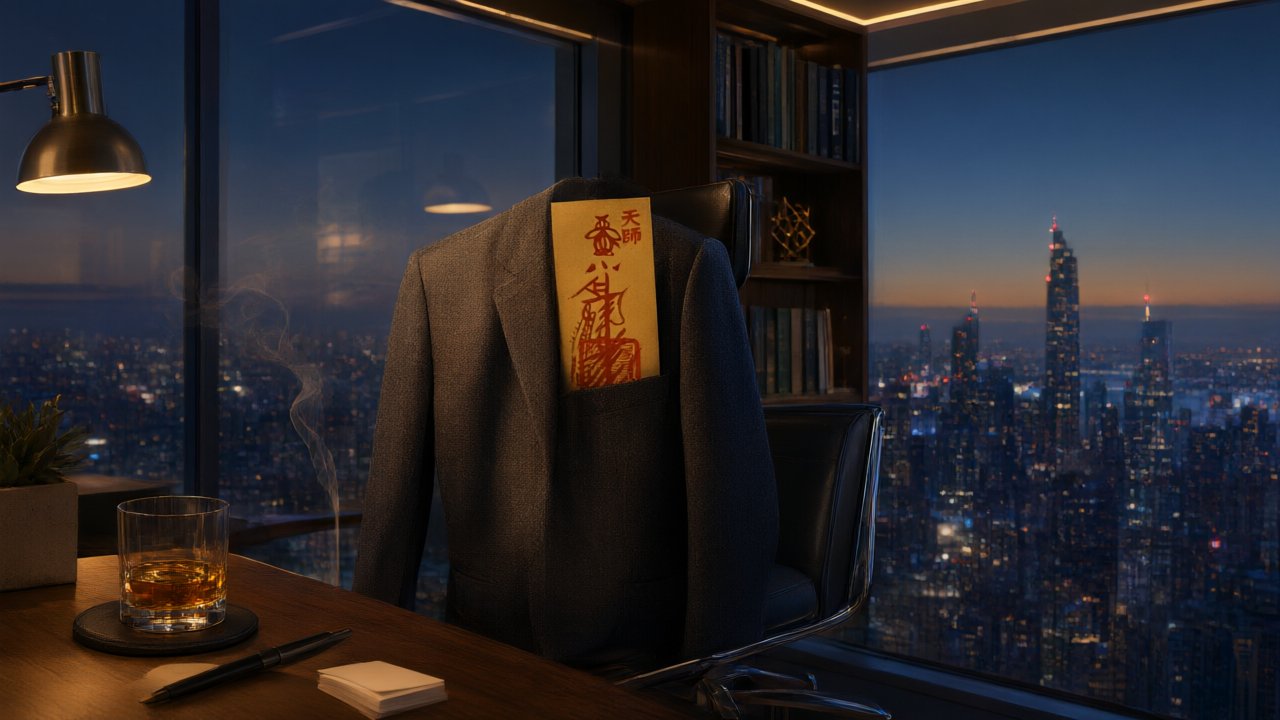
Before finalizing any irreversible decision — booking a flight, sending an offer letter, scheduling surgery, or even posting a public announcement — pause for 90 seconds. Enter your details into a Qi Men Dun Jia board tool. What you’ll receive isn’t a prediction — it’s a spatial-temporal map: a clear, color-coded view showing which directions and time windows over the next 72 hours are energetically open (Sheng Men), guarded (Xiu Men), or obstructive (Si Men). You’ll see whether your proposed action falls under a supportive star (Tian Rui) or a dispersing one (Tian Peng). This isn’t mysticism — it’s context. And context changes everything.
2. Anchor Your Intention With a Directional Focus
Once you’ve identified a favorable window, add a simple physical anchor. If your reading suggests the southeast sector is supportive for career moves, place your signed contract on a desk facing southeast for 10 minutes before submission. If your home-buying reading highlights the northwest, stand in that corner of your current living room while reviewing the mortgage terms. This isn’t symbolic theater — it’s energetic resonance. In feng shui tradition, direction is not abstract; it corresponds to elemental qualities (southeast = wood = growth; northwest = metal = authority). Aligning your action with its corresponding element deepens coherence.
3. Let Go of the “Perfect” Moment — Trust the Open Gate
Many get stuck waiting for a flawless alignment — a day with zero conflicting stars, all gates wide open, perfect weather. That day rarely exists. Qi Men teaches discernment, not perfection. Look instead for the least obstructed path: one open gate, one supportive star, one stable elemental pairing. That’s enough. As the Qingjing Jing reminds us: “When the mind is still, the qi settles. When the qi settles, the way reveals itself.” Your role isn’t to force cosmic perfection — it’s to recognize where the path already breathes.
The Real Power Lies in the Pause — Not the Prediction
Qi Men Dun Jia doesn’t promise success. It offers something far more valuable: agency within uncertainty.
We live in a world saturated with urgency — “apply now,” “book today,” “limited spots!” — yet we rarely ask: Is this moment actually working with me?
Qi Men answers that question — not with certainty, but with intelligence. It transforms decision-making from a leap of faith into a calibrated step. It replaces doubt (“Did I choose right?”) with reflection (“Where is my energy best received right now?”).
This is why it endures. Not because it controls destiny — but because it honors the truth that how we move matters as much as where we go.
The ancient generals didn’t win by charging blindly. They won by reading the wind, the slope, the light — and moving with them. You don’t need an army to apply that wisdom. You just need to know where the gates are open.
In Closing: Your Next Step Is Already Free
You don’t need a temple, a master, or a lifetime of study to begin. You need only a few moments — and the willingness to ask a different question.
Instead of “What should I do?”, try “When — and where — will this action meet the least resistance?”
That question is answered instantly by our free Qi Men Dun Jia board tool. Enter your name, birth date, and the nature of your upcoming move — and receive a plain-language, color-coded reading in under two minutes. No signup. No payment. No jargon. Just clarity, rooted in 1,800 years of strategic observation.
This is not magic. It is memory — of a time when humanity moved with the rhythms of heaven and earth, not against them.
Taoist talismans are sacred spiritual tools rooted in 1,800 years of tradition. Their power comes from sincere belief and the consecration rituals of ordained priests. Results vary by individual — approach with an open heart and respectful intention.
What big move have you been holding off on — simply because it didn’t feel right? Tell us below.
Further Reading & Cultural Context
- Taoism on Wikipedia — Overview of Taoist philosophy, history, and practices
- Talismans in world cultures — Cross-cultural overview of talismanic traditions
FAQ
Q: Is Qi Men Dun Jia the same as Feng Shui or Bazi?
A: No. Feng Shui focuses on spatial energy (how your environment affects you), Bazi (Four Pillars) analyzes your personal destiny blueprint from birth data, and Qi Men Dun Jia is a timing system — assessing the energetic quality of a specific moment for a specific action.
Q: Do I need to believe in it for it to work?
A: Belief isn’t required — awareness is. Just as knowing traffic patterns helps you avoid gridlock, understanding Qi Men alignments helps you navigate energetic flow. Its value lies in its utility, not its dogma.
Q: Can it predict the future?
A: No. Qi Men Dun Jia does not forecast events. It reveals the quality of opportunity inherent in a moment — like checking the tide chart before sailing. The outcome still depends on your skill, preparation, and integrity.
Q: Is this connected to Mt. Longhu or Zhengyi Daoism?
A: Yes. Historical records, including the Record of the Celestial Masters, describe how Qi Men principles were integrated into ritual timing at Mt. Longhu — especially for consecrating talismans and selecting dates for temple ceremonies. Its use reflects the Zhengyi lineage’s emphasis on harmony between human action and cosmic order.

Q: Why is November 9, 2026 mentioned?
A: Because it’s the Gregorian date of publication — grounding this article in real time. Today is the 1st day of the 10th lunar month, and no festival is observed. The Xiayuan Festival falls on November 23, 2026 — in 14 days.
Go Deeper
- Qi Men Dun Jia Chart — free, takes about two minutes: read the Qi Men Dun Jia board for direction and timing
- BaZi Chart Reading — free, takes about two minutes: read your Four Pillars chart for this year
Frequently Asked Questions
Is Qi Men Dun Jia the same as Feng Shui or Bazi?
No. Feng Shui focuses on spatial energy (how your environment affects you), Bazi (Four Pillars) analyzes your personal destiny blueprint from birth data, and Qi Men Dun Jia is a timing system — assessing the energetic quality of a specific moment for a specific action.
Do I need to believe in it for it to work?
Belief isn’t required — awareness is. Just as knowing traffic patterns helps you avoid gridlock, understanding Qi Men alignments helps you navigate energetic flow. Its value lies in its utility, not its dogma.
Related Taoist Instruments
About DeHuiTang — This article is part of our Taoist cultural education series. Explore more authentic Taoist knowledge, Feng Shui wisdom, and destiny philosophy at our main site.