You Can’t Stop Second-Guessing — Here’s What Liu Yao Says
You’ve already read the offer three times. You’ve drafted and deleted five versions of your reply. You’ve asked three friends — and gotten three different answers. Your stomach tightens every time you open the email. You’re not indecisive. You’re waiting for a sign.
That knot in your chest? That voice whispering “What if I choose wrong?” — it’s not anxiety. It’s your intuition sensing something deeper: a timing mismatch, an unseen friction in the flow, or a subtle misalignment between the opportunity and your true path. In Western self-help, we call this ‘analysis paralysis’. In ancient Chinese metaphysics, it has a name — and a method to resolve it: Liu Yao (Six Lines).
This isn’t fortune-telling. It’s not about predicting fate — it’s about reading the moment, like checking the tide before launching a boat. And it’s been used for over 1,800 years by scholars, generals, and ministers who faced decisions that shaped dynasties.
Let’s step away from affirmations and journal prompts — and into the quiet precision of a system that doesn’t ask what you want, but asks what the moment is offering.
Why Your Gut Won’t Settle (And Why That’s Actually Good)
Before we get to Liu Yao, let’s name what’s really happening when you stare at that contract or refresh your inbox for the fifth time.
It’s not weakness. It’s not lack of confidence. It’s your nervous system registering a subtle energetic dissonance — a mismatch between the external opportunity and your internal resonance. Modern psychology calls it cognitive dissonance. Taoist cosmology calls it qi bu tong — ‘blocked energy flow’ — especially in the Xin (Heart-Mind) and Yi (Intention) channels.
Think of your life as a river. A good decision isn’t just about choosing which bank to walk on — it’s about whether the current is carrying you with its natural momentum, or whether you’re trying to swim upstream against a hidden undertow. Liu Yao was designed to detect that undertow.
The reason you keep second-guessing isn’t that you’re broken — it’s that your body is holding a question your mind hasn’t yet translated into language. And Liu Yao gives you the vocabulary.
Liu Yao Is Not Astrology — It’s Real-Time Divination
Here’s where most people misunderstand Liu Yao.
It’s not based on your birth date, like Bazi or Ziwei Doushu. It doesn’t map your lifelong destiny. It doesn’t require your hour of birth or ancestral records. It’s not tied to the stars — it’s tied to the moment.
Liu Yao (六爻), meaning ‘Six Lines’, is one of the oldest forms of Chinese divination — first codified in the Yijing (I Ching), then refined over centuries into a precise, symbolic language of change. Its earliest systematic use appears in the Jing Shu (‘Classic of Divination’) attributed to Jing Fang (78–37 BCE), a Han dynasty scholar who served Emperor Yuan. But its real flowering came during the Tang and Song dynasties, when court diviners at Mt. Longhu — home of the Zhengyi Daoist lineage — integrated Liu Yao with ritual timing, celestial observation, and energetic diagnosis.
Unlike horoscopic systems that describe who you are, Liu Yao reads what is happening now. It treats each question — “Should I accept this job?”, “Is this deal aligned?” — as a living event with its own qi field, its own timing signature, and its own internal logic.
Here’s how it works:
- The Question Anchors the Moment — You focus clearly on one specific decision. Not “What should I do with my life?” but “Should I sign the lease for Apartment 4B on November 6th?”
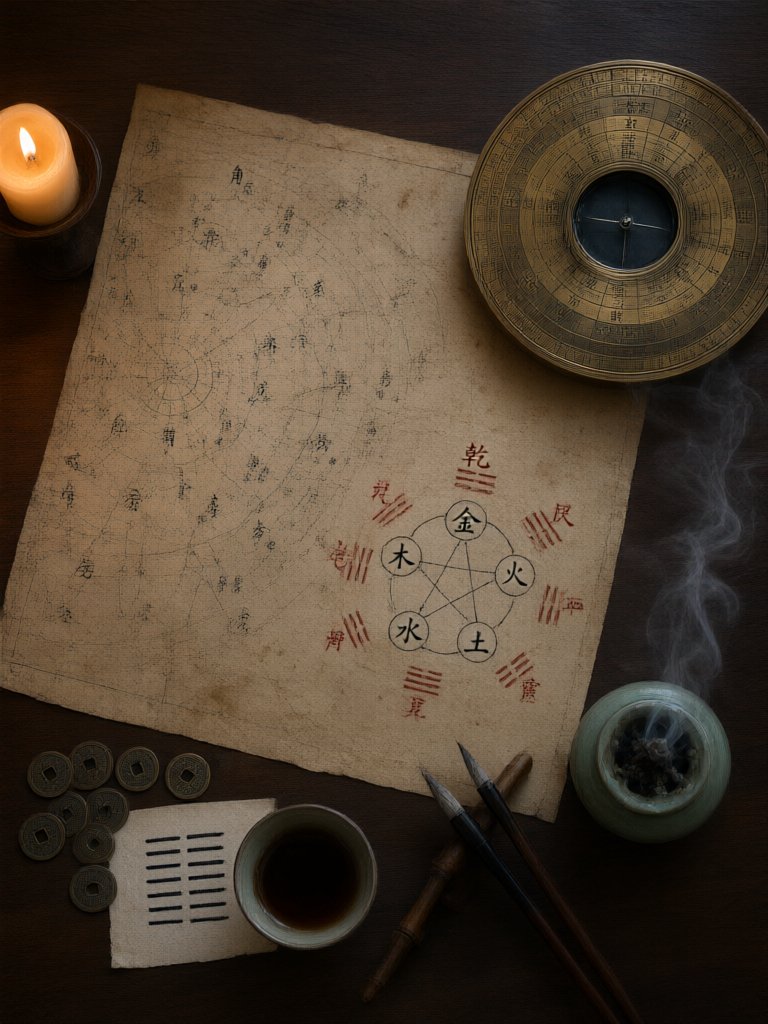
- The Hexagram Emerges — Traditionally, six yarrow stalks or three coins are cast — each throw generating a line (yin or yang), building a six-line hexagram from bottom to top. Each line carries meaning: position, movement, relationship to other lines, elemental resonance.
- The Lines Speak in Metaphor & Timing — The bottom line represents the root cause or foundation. The top line reveals the ultimate outcome — if the current energy continues unchanged. The middle lines show turning points, obstacles, helpers, and hidden influences.
Crucially, Liu Yao doesn’t say “Yes” or “No.” It says: “The opportunity is strong, but the timing is weak — wait until the Metal phase strengthens in late November.” Or: “The contract looks favorable, but the third line shows hidden legal friction — consult a specialist before signing.”
It’s diagnostic, not declarative.
And yes — this is the same system that guided the selection of auspicious days for imperial edicts, military campaigns, and temple consecrations across 1,800 years of Chinese history. Its power lies not in mysticism, but in structured attention: forcing clarity, revealing blind spots, and naming the invisible currents beneath surface-level logic.
How Liu Yao Sees Your Decision (Three Layers Most People Miss)
Most Western decision frameworks stop at pros-and-cons lists. Liu Yao goes three layers deeper — because reality operates on three levels: form, energy, and timing.
Layer 1: The Form — What You See on Paper
This is the contract, the job description, the salary figure — the visible structure. In Liu Yao, this is represented by the trigram (three-line symbol) formed by the lower three lines. It tells you: Is the foundation sound? Does the structure hold?
A stable trigram (e.g., Kan — Water, symbolizing depth and endurance) suggests long-term viability. A volatile one (Zhen — Thunder, sudden movement) signals rapid change — exciting, but potentially unstable without grounding.
Layer 2: The Energy — What You Feel in Your Gut
This is the unspoken vibe: the manager’s tone, the office silence, the way the numbers just barely add up. In Liu Yao, this is revealed by the moving lines — the lines that change from yin to yang or vice versa in the casting. These are the dynamic points — where energy is shifting, where friction or support is emerging.
A moving line in position two (the ‘minister’ position) might indicate a key person whose attitude will make or break the outcome. A moving line in position five (the ‘ruler’ position) points to external authority — like regulatory approval or board-level alignment.
This is why your gut won’t settle: your body senses a moving line before your mind names it.
Layer 3: The Timing — When the Door Opens (or Closes)
This is what makes Liu Yao uniquely practical. It doesn’t just tell you what — it tells you when. Using the Heavenly Stems and Earthly Branches, each line is assigned a seasonal and temporal resonance. The system identifies when certain energies peak — when support arrives, when resistance softens, when delays resolve.
For example, if your hexagram shows strong Metal element influence in the upper trigram — and today is November 6th, the 28th day of the 9th lunar month — Liu Yao notes that Metal energy is naturally strengthening as we approach the Xiayuan Festival on November 23rd. That’s not superstition — it’s observing how seasonal shifts correlate with collective human behavior: contracts signed in late autumn often see stronger enforcement in winter; hiring surges align with harvest-season financial liquidity.

Liu Yao doesn’t override your will. It maps the landscape so you can walk with awareness — not blindness.
Three Things You Can Do Right Now (Without Casting a Single Coin)
You don’t need yarrow stalks or a master to begin working with Liu Yao’s wisdom. Its principles are built into daily life — once you know where to look.
1. Ask the Question — Then Wait 24 Hours Before Acting
Liu Yao begins with intentional stillness. The act of framing your question clearly — writing it down in full, without hedging — activates your subconscious pattern recognition. Then, wait at least one full day before making any move. This mimics the traditional ‘incubation period’ between casting and interpretation.
Why? Because your nervous system needs time to surface what your conscious mind filtered out. That ‘aha’ moment while washing dishes? That’s your internal Liu Yao reading coming online.
2. Map the Five Elements in Your Decision
Every major decision involves five core forces: Wood (growth, initiative), Fire (passion, visibility), Earth (stability, resources), Metal (structure, boundaries), Water (flow, adaptability).
Grab a notebook. Draw five columns. For your job offer or deal, list:
– Where does it demand Wood? (e.g., “I’ll need to build a new team”)
– Where does it rely on Fire? (“High visibility role”)
– Where does it test Earth? (“Relocation means losing my support network”)
– Where does it require Metal? (“Strict compliance deadlines”)
– Where does it challenge Water? (“Unclear reporting lines”)
Now ask: Which element feels weakest in me right now? If your personal Wood energy is low (you’re exhausted, uninspired), a Wood-heavy role may drain you — even if it looks perfect on paper. Liu Yao would flag that imbalance as a ‘weak root’.
3. Check the Calendar — Not Just for Luck, But for Resonance
Liu Yao respects natural cycles. November 6th, 2026 falls on the 28th day of the 9th lunar month — a waning moon, nearing the end of autumn. In classical texts like the Yangzhai Sanyao, this phase is associated with consolidation, not expansion. It’s ideal for reviewing contracts, refining plans, and releasing old commitments — less ideal for launching entirely new ventures unless they’re deeply grounded in existing structure.
That’s why your hesitation might be perfectly timed: your intuition is syncing with the season. Use these final days to clarify terms, request amendments, or gather final references — not to rush a signature.
This Isn’t About Surrendering Choice — It’s About Sharpening It
Some people hear ‘divination’ and think of passive resignation — waiting for fate to deliver an answer. Liu Yao is the opposite.
It’s active discernment. It turns uncertainty into data — not statistical data, but energetic data: where support lives, where friction hides, where timing bends.
When the Tang dynasty general Guo Ziyi faced a critical decision before the An Lushan Rebellion, he didn’t pray for guidance — he cast Liu Yao, identified a hidden ‘moving line’ indicating betrayal within his ranks, and acted before the threat materialized. His choice wasn’t handed to him. It was revealed — then executed with precision.
That’s the power you access: not prediction, but pattern recognition at the level of qi.
You’re not asking Liu Yao what to do. You’re asking it: What is this moment actually showing me?
And once you see it — truly see it — the doubt doesn’t vanish. It transforms. It becomes clarity dressed in quiet.
Your Next Step Is Already Waiting
You don’t need to travel to Mt. Longhu. You don’t need to fast or study for years. You don’t need coins or yarrow stalks.
You already have everything you need: a clear question, a few minutes, and access to our free Liu Yao (Six Lines) divination reading tool.
It’s simple: enter your focused question — just one sentence, no more than 20 words — and the date you’re asking it (today is November 6th, 2026). In under two minutes, you’ll receive a complete, line-by-line interpretation: what each position reveals, where the energy flows, where it stalls, and what timing suggests.
This isn’t a generic reading. It’s generated using the same structural logic as the classical texts — adapted for modern clarity, but rooted in the Jing Shu, the Yijing, and the Zhengyi Daoist tradition of Mt. Longhu.
No signup. No payment. No hidden steps.
Just clarity — delivered.
In closing: doubt is not your enemy. It’s the first whisper of deeper knowing. When you stop fighting it — and start listening to what it’s pointing toward — you step into the oldest form of wisdom there is: knowing the moment, so you can meet it well.
Taoist talismans are sacred spiritual tools rooted in 1,800 years of tradition. Their power comes from sincere belief and the consecration rituals of ordained priests. Results vary by individual — approach with an open heart and respectful intention.
Has this ever happened to you? Tell us your story.
Further Reading & Cultural Context
- I Ching (Book of Changes) — Ancient Chinese divination text and philosophical classic
- I Ching (易经) — Book of Changes — One of the oldest Chinese classics, foundation of divination
Go Deeper
- Liu Yao Divination — free, takes about two minutes: ask one practical question and get a reading
- BaZi Chart Reading — free, takes about two minutes: read your Four Pillars chart for this year
Frequently Asked Questions
Is Liu Yao the same as the I Ching?
Liu Yao evolved from the Yijing (I Ching) but is a distinct, later-developed system focused on real-time question-based divination — not philosophical commentary. It uses the same hexagrams but interprets them through positional dynamics, moving lines, and seasonal timing.
Do I need to believe in it for it to work?
Liu Yao works like a diagnostic lens — its value lies in the structured reflection it invites, not in metaphysical belief. Many users report breakthroughs simply from the discipline of framing their question precisely and waiting for insight.
Related Taoist Instruments

About DeHuiTang — This article is part of our Taoist cultural education series. Explore more authentic Taoist knowledge, Feng Shui wisdom, and destiny philosophy at our main site.