That Heavy Feeling Above Your Bed Isn’t Imagined
You lie down. You’re tired — bone-deep tired. But the moment your head touches the pillow, something shifts. A low-grade pressure settles behind your eyes. Your shoulders tighten, even though you’re lying still. You wake up at 3 a.m. with your heart racing — not from a nightmare, but from a vague, suffocating weight pressing down on your chest. You’ve rearranged your bedroom three times. Changed mattresses. Tried sound machines and blackout curtains. Nothing eases it.
And when you glance up — there it is: the beam. Thick, wooden, painted white, running straight across the ceiling, directly over your bed. You’ve been told it’s “just architecture.” Your interior designer shrugged. Your landlord said, “It’s load-bearing — can’t touch it.”
But your body knows otherwise.
You’re not imagining the fatigue. You’re not overreacting to the insomnia. And you’re definitely not “just stressed.” What you’re experiencing is one of the oldest, most consistently documented energetic disruptions in Chinese metaphysics — and it has a name: Héng Liáng Yā Dǐng (横梁压顶), literally “Beam Pressing Down on the Crown.”
This isn’t superstition. It’s spatial physiology — observed, recorded, and ritually addressed for over 1,800 years by Taoist masters on Mt. Longhu, the cradle of Zhengyi Daoism.
Why Your Body Reacts Before Your Mind Does
Let’s be clear: this isn’t about beams being inherently evil. It’s about how human energy — what Taoists call Qi (气) — moves, pools, and responds to structural force.
Ancient masters didn’t measure electromagnetic fields or air pressure gradients — but they did map the body’s subtle energy pathways with astonishing precision. In the Huangdi Neijing (The Yellow Emperor’s Classic of Internal Medicine), written over 2,200 years ago, Chapter 22 states: “When Heaven’s Qi descends but cannot rise, the human spirit becomes heavy and the bones ache without cause.”
That “Heaven’s Qi” isn’t poetic metaphor. It refers to the ambient, vertical flow of cosmic and terrestrial energy that bathes all living space — especially where we rest for eight hours each night. When a solid, dense, horizontal beam crosses directly above the sleeping position, it creates what feng shui practitioners call a Sha Qi (煞气) line — not “killing energy,” as mistranslated in early Western texts, but “scraping energy”: a disruptive, compressive force that grinds against the body’s natural upward circulation during sleep.
Think of Qi like water flowing through a riverbed. A beam overhead acts like a submerged boulder — not blocking the flow entirely, but creating turbulence, eddies, and back-pressure right where your crown (Bai Hui point), third eye (Yin Tang), and heart (Shan Zhong) reside. These are the very points where your nervous system resets, your immune cells regenerate, and your subconscious processes emotion.
But here’s what makes Héng Liáng Yā Dǐng uniquely insidious: it doesn’t shout. It whispers — in exhaustion, in unexplained headaches, in irritability that flares mid-afternoon, in dreams where you’re trapped or falling. It erodes resilience slowly, like water wearing stone.
I saw this firsthand last spring, when a software engineer from Portland visited Mt. Longhu seeking help for chronic migraines and anxiety she’d carried for five years. Her new apartment had a stunning vaulted ceiling — and a massive Douglas fir beam running perfectly over her king-sized bed. She’d even hung dreamcatchers and crystals around it, hoping to “soften” it. But no amount of intention could override the physical geometry — nor the centuries-old understanding of how structure shapes spirit.
Her BaZi chart showed strong Metal and Water elements — both associated with clarity and calm. Yet her daily reality was fog and friction. The master who met her didn’t reach for a compass or a talisman first. He simply asked: “Where do you sleep?”
The Three-Step Restoration Protocol (No Renovation Required)
The good news? You don’t need to tear down drywall or hire a structural engineer. Taoist feng shui isn’t about fighting architecture — it’s about harmonizing with it. Here are three concrete, immediate, and deeply rooted-in-practice steps you can take — tonight.
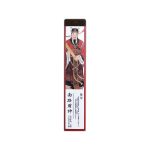
God of Wealth Incense – Zhao Gongming Chief God of Wealth (Wu Lu Cai Shen) 23cm Herbal Line Sticks | Opening Wide the Streams of Wealth (Guang Kai Ke Yuan)
北路正财神・赵公明 | Zhao Gongming, the Chief God of Wealth (North Road) 赵公明为道教护法正财神,统招财宝
Step 1: Redirect the Flow With Vertical Intention (Do This Tonight)
The core principle is simple: counter horizontal compression with vertical uplift. You don’t remove the beam — you recontextualize its energy.
Place two identical items — traditionally, brass Wu Lou (gourds) or tall, slender bamboo stalks — directly beneath the ends of the beam, aligned with your pillow and footboard. Not under the center. At the termini.
Why? Because in classical feng shui theory, a beam’s Sha Qi concentrates at its endpoints — like tension building at the ends of a drawn bow. By placing upright, hollow, resonant objects there, you create subtle acoustic and energetic “release valves.” Brass gourds, in particular, have been used since the Han Dynasty (206 BCE–220 CE) to absorb and transform stagnant Qi. Their shape mimics the human torso — hollow, receptive, capable of resonance.
If brass isn’t accessible, use two tall glass vases filled with clean water and fresh green stems (bamboo, lucky bamboo, or even long-stemmed peace lilies). Water is the ultimate conductor and transformer of Qi — and green stems represent Wood element, which controls Earth (the beam’s elemental association) and feeds Fire (your vitality).
Do this before bed. Say nothing. Just place them — and notice how your breath deepens the first night.
Step 2: Seal the Crown With Sacred Geometry (Activate Within 48 Hours)
Your Bai Hui point — the “hundred convergences” at the crown of your head — is the primary entry point for celestial Qi during rest. When a beam presses down, it disrupts this channel. The ancient remedy? Not shielding, but sanctifying.
This is where ritual meets resonance. On the evening of October 23, 2026 — the 14th day of the 9th lunar month — the moon is waxing toward full. In Zhengyi Daoist tradition, this phase is ideal for kaiguang (opening the light) rituals — moments when celestial alignment supports energetic activation.
Take a clean sheet of red paper (red = Fire element, which transforms stagnation) and draw a single, unbroken circle in black ink — no gaps, no corrections. Inside it, write the character 安 (Ān) — meaning peace, safety, stillness. Place this circle on your bedside table, facing upward, directly beneath the center of the beam.
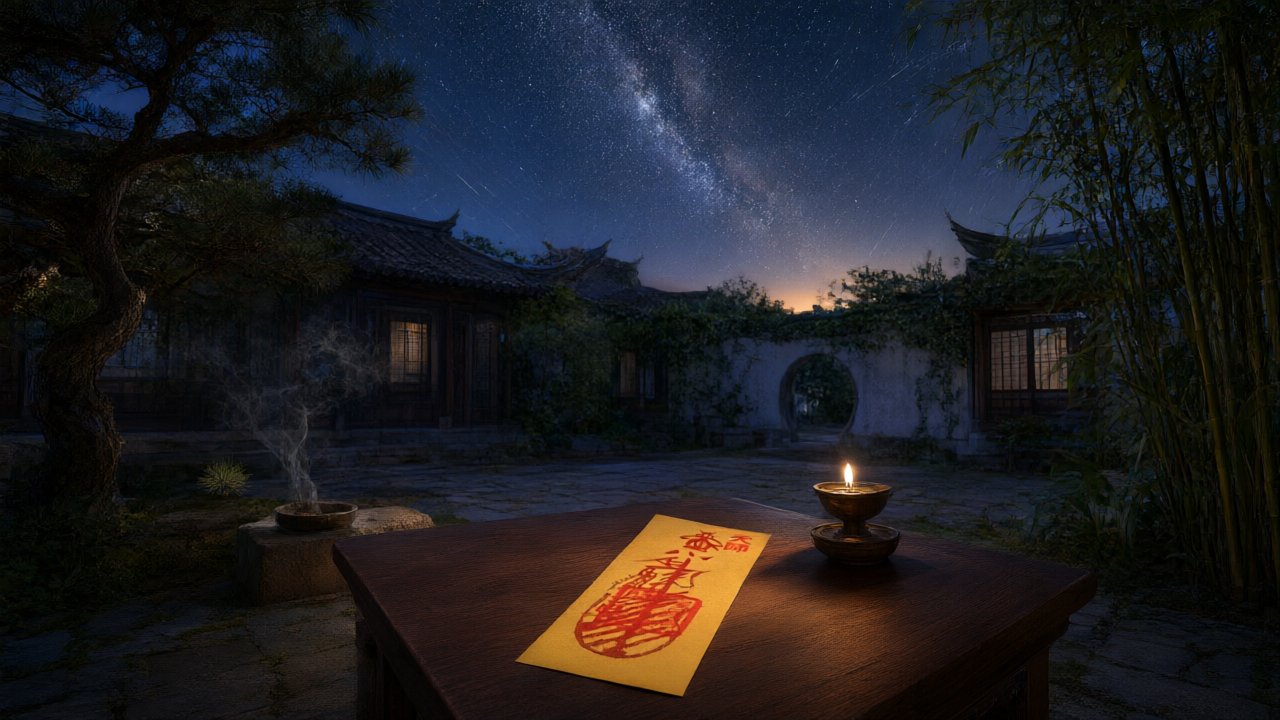
Why a circle? Because in the Yi Jing (I Ching), the circle represents Heaven — infinite, unbroken, sovereign. It doesn’t fight the beam; it invites Heaven’s order into the space beneath it. This isn’t decoration. It’s an energetic anchor — a tiny, silent declaration: “Here, the sky remains whole.”
Leave it for seven nights. Replace it on the 7th night — and observe your sleep depth.
Step 3: Anchor Your Spirit With Consecrated Presence (The Deeper Layer)
The first two steps address the structure and symbolism. But Héng Liáng Yā Dǐng isn’t just physical or symbolic — it’s spiritual. A beam overhead creates what Taoist priests call a “disrupted Wei Qi field” — your body’s subtle energetic boundary becomes porous, allowing ambient stress, unresolved emotions from the day, and even environmental Sha Qi to seep in during your most vulnerable state: deep rest.
This is where consecrated tools enter — not as magic wands, but as focal points for intention. A talisman isn’t a battery; it’s a tuning fork. When properly consecrated by ordained priests of the Celestial Masters’ lineage on Mt. Longhu, it holds the resonance of centuries of ritual — a frequency calibrated to stabilize, protect, and harmonize.
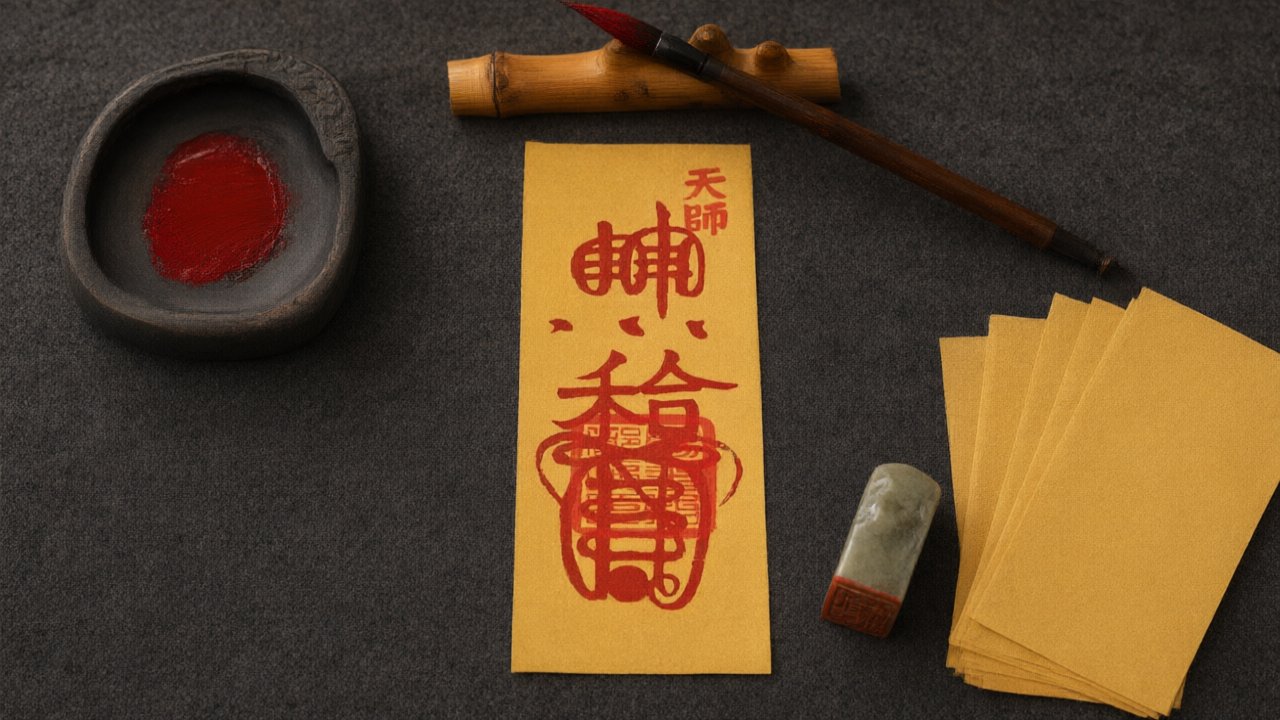
The Zhen Zhai Fu (镇宅符) — the Home Peace Talisman — is specifically designed for this. Its characters invoke the Four Celestial Guardians (Azure Dragon, White Tiger, Vermilion Bird, Black Tortoise), whose combined presence forms an unbroken energetic dome over any space. Unlike generic “protection” talismans, the Zhen Zhai Fu includes the Jiu Xing (Nine Stars) diagram — a celestial map used since the Tang Dynasty (618–907 CE) to neutralize oppressive earth energies.
At Dehui Hall, every Zhen Zhai Fu undergoes a 72-hour kaiguang process beginning at dawn on the 1st day of each lunar month — the same timing used for temple consecrations at the Shangqing Palace on Mt. Longhu. It is then wrapped in red silk and sealed with cinnabar wax — not as superstition, but as a physical seal of intent.
Place yours on your bedside table, beside the red circle — or affix it discreetly to the underside of your headboard, facing upward. No incense required. No chanting needed. Just knowing it’s there — a quiet, unwavering presence — changes the energetic signature of the space.
One client, a nurse in Toronto who’d suffered insomnia since moving into her loft apartment with exposed industrial beams, told us: “The first night I placed the Zhen Zhai Fu, I didn’t just sleep — I landed. Like my body finally remembered how to trust the ground beneath me.”
Why This Isn’t Just “Feng Shui” — It’s Living Heritage
It’s easy to dismiss Héng Liáng Yā Dǐng as outdated folklore — until your own body refuses to cooperate.
But consider this: the Celestial Masters’ mansion at Mt. Longhu was first built in 59 AD. For nearly 2,000 years, generations of Taoist priests have lived, slept, meditated, and healed in buildings with timber frames, stone lintels, and carved beams — many of which still stand today. They didn’t avoid beams. They learned to live with reverence inside them.
In the Zhengyi Fawen (Canon of Orthodox Unity), compiled in the 13th century, Section 47 reads: “When the roof’s bone presses upon the sleeper’s crown, let the heart hold Heaven’s circle, let the hands lift the gourd’s hollow, and let the spirit dwell within the Guardian’s seal. Then the beam becomes not a weight, but a roof — and the roof, a sky.”
That’s the shift. Not removal. Not resistance. Reframing.
The beam isn’t your enemy. It’s a reminder — of gravity, of structure, of limits. And Taoist wisdom teaches that true freedom isn’t found in escaping limits, but in aligning so deeply with natural law that even a beam becomes part of the harmony.
So if you wake tonight feeling that familiar pressure — don’t reach for another sleeping pill. Reach for a red sheet of paper. Place two gourds. And know that 1,800 years of quiet observation stands behind you.
Taoist talismans are sacred spiritual tools rooted in 1,800 years of tradition. Their power comes from sincere belief and the consecration rituals of ordained priests. Results vary by individual — approach with an open heart and respectful intention.
What area of your life feels most blocked right now?
Further Reading & Cultural Context
- Talismans in world cultures — Cross-cultural overview of talismanic traditions
- Taoism on Wikipedia — Overview of Taoist philosophy, history, and practices
FAQ
Q: Can I use a printed talisman image instead of a consecrated one?
A: A printed image carries aesthetic value and symbolic resonance — but not the energetic imprint of kaiguang. Consecration involves specific mudras, mantras, celestial timing, and priestly lineage. Think of it like a musical instrument: a photo of a violin isn’t the same as one tuned and played by a master.
Q: What if my beam isn’t wood — it’s steel or concrete?
A: Material doesn’t change the principle. Density and geometry do. Steel and concrete beams often carry stronger Sha Qi due to their mass and electromagnetic properties. The three-step protocol works identically — and the Zhen Zhai Fu is especially effective here, as its Nine Stars diagram was historically used to harmonize metal-heavy structures like imperial armories and temple bell towers.
Q: Do I need to face a certain direction when placing the talisman?
A: No. The Zhen Zhai Fu is designed to radiate protection omnidirectionally. Its power lies in its consecration, not its orientation — though placing it facing upward (toward the beam) reinforces the intention of lifting and stabilizing.

Note: This article references classical Taoist texts and practices from the Zhengyi Daoist tradition. All recommendations are for spiritual and energetic well-being. They are not substitutes for medical diagnosis or treatment.
Frequently Asked Questions
Can I use a printed talisman image instead of a consecrated one?
A printed image carries aesthetic value and symbolic resonance — but not the energetic imprint of kaiguang. Consecration involves specific mudras, mantras, celestial timing, and priestly lineage.
What if my beam isn’t wood — it’s steel or concrete?
Material doesn’t change the principle. Density and geometry do. Steel and concrete beams often carry stronger Sha Qi due to their mass and electromagnetic properties. The three-step protocol works identically.
Go Deeper
- Dream Interpretation — free, takes about two minutes: see what your recurring dream points to
- If you want the physical remedy behind this article, browse our consecrated talismans and feng shui pieces.
Related Taoist Instruments
About DeHuiTang — This article is part of our Taoist cultural education series. Explore more authentic Taoist knowledge, Feng Shui wisdom, and destiny philosophy at our main site.