# When a Hurricane Couldn’t Wash Away This Talisman
### — A story from Miami, August 2026
It was the kind of morning that smells like salt, static, and dread. Maria Chen—37, pediatric nurse, second-generation Chinese-American, and lifelong Miami resident—stood barefoot on her soaked living room floor, staring at what remained of her home after Hurricane Idalia’s surge had breached the seawall. Drywall peeled like sunburnt skin. Her grandmother’s porcelain tea set was gone. Her laptop, her wedding photo, even the framed certificate from her nursing school—all dissolved into the brine.
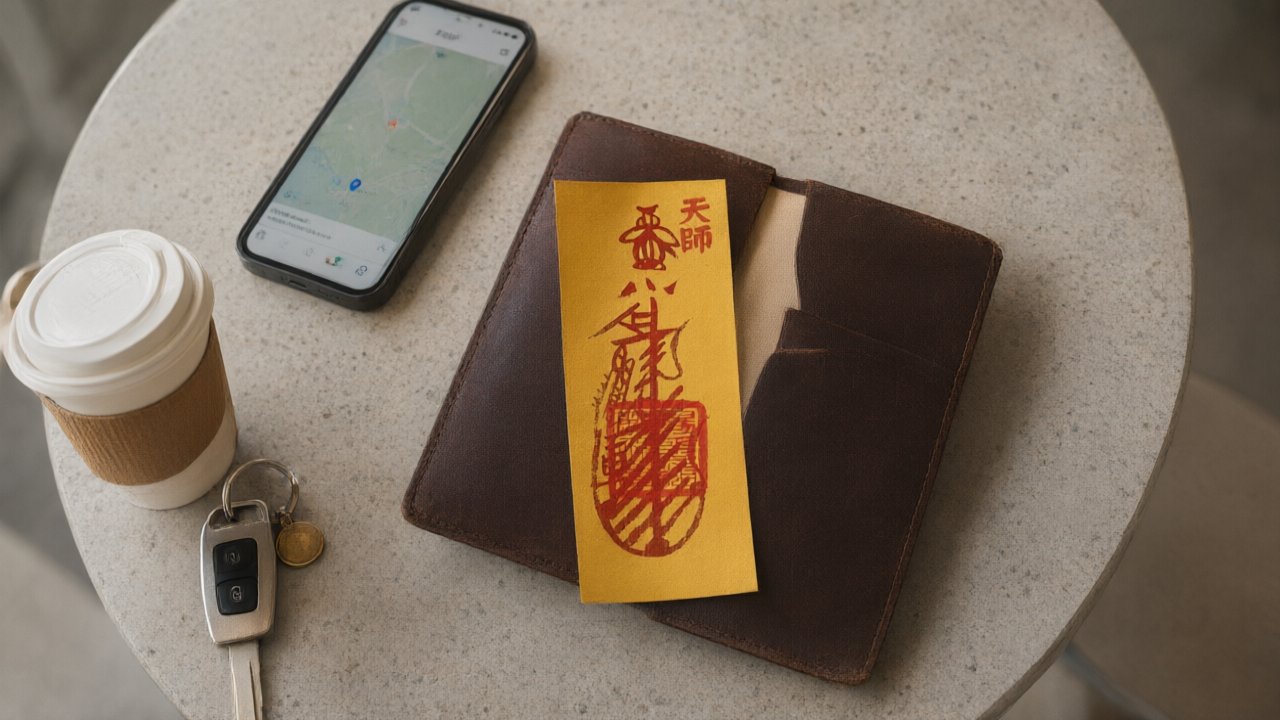
But there, tucked inside the waterproof ziplock bag she’d shoved into the top drawer of her nightstand *the night before*, was something intact: a small, folded square of yellow paper, its vermilion strokes still sharp, its edges only slightly softened by humidity. The Wu Lu Cai Shen Fu—the Five Roads Wealth Talisman—consecrated at Mt. Longhu in spring 2025.
She didn’t cry when she saw it. She laughed. A short, startled, almost disbelieving laugh—like finding your childhood bicycle leaning against a tree after twenty years of forgetting where you’d left it.
That talisman didn’t *stop* the hurricane. It didn’t part the waves or silence the wind. But in the quiet chaos of the aftermath—while insurance adjusters scribbled notes and neighbors shared generators—it became something else entirely: a quiet anchor. Not magic. Not luck. Just *continuity*. A thread pulled taut across 1,800 years of Taoist practice, tied to her grandmother’s hands, then her mother’s purse, then her own wallet—and now, improbably, surviving a Category 3 storm in a Ziploc bag.
That’s the thing no one tells you about talismans: they’re not shields. They’re signatures.
—
## What a Talisman *Actually* Is (Hint: It’s Not a Spell)
Let’s pause for a gentle correction—because this is where modern imagination often stumbles over ancient intention.
Most people picture a talisman as a tiny spell scroll: draw the right symbols, chant the right words, and *poof*—prosperity, protection, love. That’s not wrong… but it’s wildly incomplete. Like describing a violin as “wood + strings + sound.” True—but missing the soul.
In Zhengyi Daoism—the living tradition rooted at Mt. Longhu since 59 AD—a talisman (*fu*) is first and foremost an *act of transmission*. Think of it less like a battery and more like a signed letter from a lineage.
Here’s how it works: every year on the 23rd day of the 12th lunar month—the *Xiao Nian* or “Little New Year”—Mt. Longhu holds the grand *Sending-Off Gods Ceremony* (*Song Shen Da Dian*). Priests gather in the Celestial Masters’ Mansion (first built under Emperor Guangwu of Han, 59 AD) to ritually release the household deities who’ve watched over families for the past year. As part of that ceremony, freshly drawn talismans are consecrated—not with incantations alone, but with fasting, meditation, brushwork calibrated to celestial alignments, and breath synchronized with the *Yin-Yang* pulse of the mountain itself.
That means the Wu Lu Cai Shen Fu Maria carried wasn’t just ink on paper. It was a cultural artifact stamped with three layers of continuity:
1. **Lineage**: Drawn by a priest trained in the 64th generation of the Zhang family—the hereditary Celestial Masters who’ve presided over Mt. Longhu since the Eastern Han Dynasty.
2. **Timing**: Consecrated during the annual ritual cycle that has run uninterrupted for over 1,960 years—longer than any continuous religious institution in the Western world.
3. **Intention**: Not “give me money,” but “align my path with abundance, integrity, and flow”—a subtle but profound distinction between transaction and relationship.
A friend once asked me, “So… does it *work*?” I told her: “Ask Maria. She’ll tell you it didn’t stop the flood—but it helped her rebuild *with purpose*. And in Taoist thought, that *is* the work.”
The talisman isn’t a switch. It’s a tuning fork.
—
## The Real Magic Happens After the Ink Dries
There’s a quiet moment in the documentary *Mountains of the Immortals* (2021, Harvard-Yenching Institute) where Master Liang, a 78-year-old priest from the Qingliu Temple on Mt. Longhu’s western ridge, holds up a blank talisman sheet and says: *“The paper is empty until the hand remembers why it draws. The ink is dry until the heart remembers why it prays.”*
That line stayed with me—especially after visiting the old street near the Celestial Masters’ Mansion last autumn. We watched a master craftsman prepare brushes using *Shanma* goat hair—harvested only once a year, in late spring, from goats grazing on wild *Dong Quai* root. He told us, “A brush that touches paper without reverence leaves only a stain. A talisman drawn without presence is just calligraphy.”
Which brings us back to Maria.
Her talisman survived the hurricane—not because of its vermilion ink, but because of *how she held it*. Not as a charm, but as a covenant. She kept it folded beside her stethoscope. She touched it before difficult shifts. She showed it to her daughter—not as a “lucky charm,” but as a story: *“This is how Grandma kept hope when she arrived in New York with $12 and a suitcase full of recipes.”*
That’s the unspoken power no algorithm can quantify: talismans amplify meaning—not outcomes.
Think of it like carrying a family recipe written in your grandmother’s hand. It won’t cook dinner for you. But it reminds you *how to stand in the kitchen*, how to taste balance, how to trust your hands—even when the stove won’t light.
And that’s why, when Maria posted a photo of her water-warped but legible talisman on her private Facebook group—*“Miami Moms Who Remember Their Grandmothers’ Hands”*—over 142 women replied with their own stories: the Peace Talisman taped inside a law student’s laptop case; the Tai Sui Fu tucked into a pilot’s flight log; the Gui Ren Fu embroidered onto a baby’s onesie. Not as superstition—but as cultural grammar. A way to say, *“I am not starting from zero. I carry something older than this storm.”*
We don’t sell talismans at DeHuiTang—we steward them. Each one arrives from Mt. Longhu sealed in rice paper, wrapped in silk, accompanied by a handwritten note from the priest who drew it. Some bear faint smudges of incense ash. Others hold a single pressed *Bai He* (lily) petal—used in spring purification rites. These aren’t flaws. They’re footnotes.
So yes—Maria’s talisman survived a hurricane. But what really survived was *memory*. The kind that doesn’t drown.
—
## Your Turn: What’s in Your Ziploc Bag?
Let’s get real for a second: we all have our own versions of Maria’s Ziploc bag.
Maybe it’s a faded postcard from your grandfather’s first trip abroad. A worn copy of *Tao Te Ching* with coffee rings on page 42. A jade pendant your aunt gave you “just in case.” Or maybe it’s not an object at all—it’s a phrase your mother repeated every time you left the house: *“Walk with your shoulders down. Breathe first. Then speak.”*
These aren’t relics. They’re lifelines—quiet, unassuming, and stubbornly persistent.
So here’s my question—not about talismans, but about *you*:
**What’s one small, ordinary thing you carry—not because it “works,” but because it helps you remember who you are, even when everything else feels washed away?**
Tell us in the comments. No explanations needed. Just the thing—and if you feel like it, the name of the person who gave it to you.
We’ll read every single one.
And if you’d like to explore authentic talismans drawn and consecrated at Mt. Longhu—like the Wu Lu Cai Shen Fu or the Ping An Fu—DeHuiTang offers them as cultural artifacts, respectfully sourced and carefully documented. Each comes with background on its ritual origin and traditional use.
> These items are sold as cultural artifacts. Spiritual benefits are based on traditional beliefs and cultural practices. DeHuiTang does not guarantee specific outcomes.
—
### FAQ
**Q: Can I keep a talisman in my wallet or phone case?**
A: Yes—many people do, especially the Wu Lu Cai Shen Fu or Ping An Fu. Traditionally, talismans are kept clean, dry, and treated with quiet respect—not as decorative objects, but as intentional companions. Avoid folding them sharply or placing them near electronics that generate strong electromagnetic fields (though no scientific evidence suggests interference, traditional practice favors natural proximity).
**Q: How often should a talisman be renewed?**
A: In Zhengyi Daoist practice, talismans drawn for personal use are traditionally renewed annually—often aligned with the Lunar New Year or the *Tai Sui* cycle. This isn’t because they “expire,” but because renewal reflects life’s natural rhythm: intention deepens with reflection, and commitment renews with time.
—
### Further Reading
– [Harvard-Yenching Institute: *Ritual Continuity on Mt. Longhu*]( — A peer-reviewed ethnographic study documenting the unbroken transmission of Zhengyi rites since the Han Dynasty.
– *The Book of Talismans: History, Craft, and Meaning in Daoist Ritual* (Oxford University Press, 2022) — Chapter 4 details the seasonal consecration calendar used at Mt. Longhu.
– *Living Lineages: Contemporary Daoist Practice in China and the Diaspora* (University of Hawai‘i Press, 2024) — Includes oral histories from priests, artisans, and overseas practitioners like Maria Chen.
Frequently Asked Questions
Do Taoist talismans actually protect people from natural disasters like hurricanes?
Taoist talismans are not understood in traditional practice as physical shields against storms or disasters. As the article explains, Maria’s talisman didn’t stop Hurricane Idalia—but it served as a meaningful anchor amid loss. In Zhengyi Daoism, a fu (talisman) represents lineage, ritual timing, and intentional alignment—not magical immunity. Its value lies in cultural continuity and personal resonance: a reminder of heritage, resilience, and values—especially during upheaval.
What makes a Taoist talisman 'authentic' or traditionally consecrated?
Authenticity in Zhengyi Daoism centers on transmission: proper lineage (e.g., priests trained in the unbroken Zhang family line), precise ritual timing (like the annual Song Shen Da Dian ceremony), and disciplined preparation—including fasting, meditative focus, and brushwork aligned with cosmological principles. It’s not about materials alone, but the embodied intention and continuity of practice spanning nearly 2,000 years at Mt. Longhu—making each talisman a living cultural signature, not mass-produced symbolism.
Can I carry a Taoist talisman even if I’m not religious or don’t fully believe in its power?
Yes—and many do, respectfully. As the article notes, people often hold talismans as cultural grammar: expressions of identity, intergenerational care, or personal values like integrity and resilience. Maria shared hers with her daughter as a story—not a spell. DeHuiTang honors this by offering talismans rooted in authentic practice, while encouraging mindful, non-appropriative engagement: honoring their origin, context, and the quiet discipline behind their creation.
Why do some Taoist talismans use red ink and yellow paper?
In traditional Chinese cosmology, red (vermilion) symbolizes vitality, protection, and the transformative energy of Fire; yellow represents Earth, stability, and the center—key to balance in Taoist thought. Together, they reflect foundational yin-yang and Five Phases principles. These colors aren’t arbitrary—they’re part of a symbolic language refined over centuries, used intentionally in ritual calligraphy to harmonize intention with cosmic resonance, as practiced at Mt. Longhu.
Related Taoist Instruments
About DeHuiTang — This article is part of our Taoist cultural education series. Explore more authentic Taoist knowledge, Feng Shui wisdom, and destiny philosophy at our main site.