# Why a Silicon Valley Engineer Keeps a Taoist Talisman on His Desk
### — Not for magic. Not for luck. But for something quieter, older, and far more human.
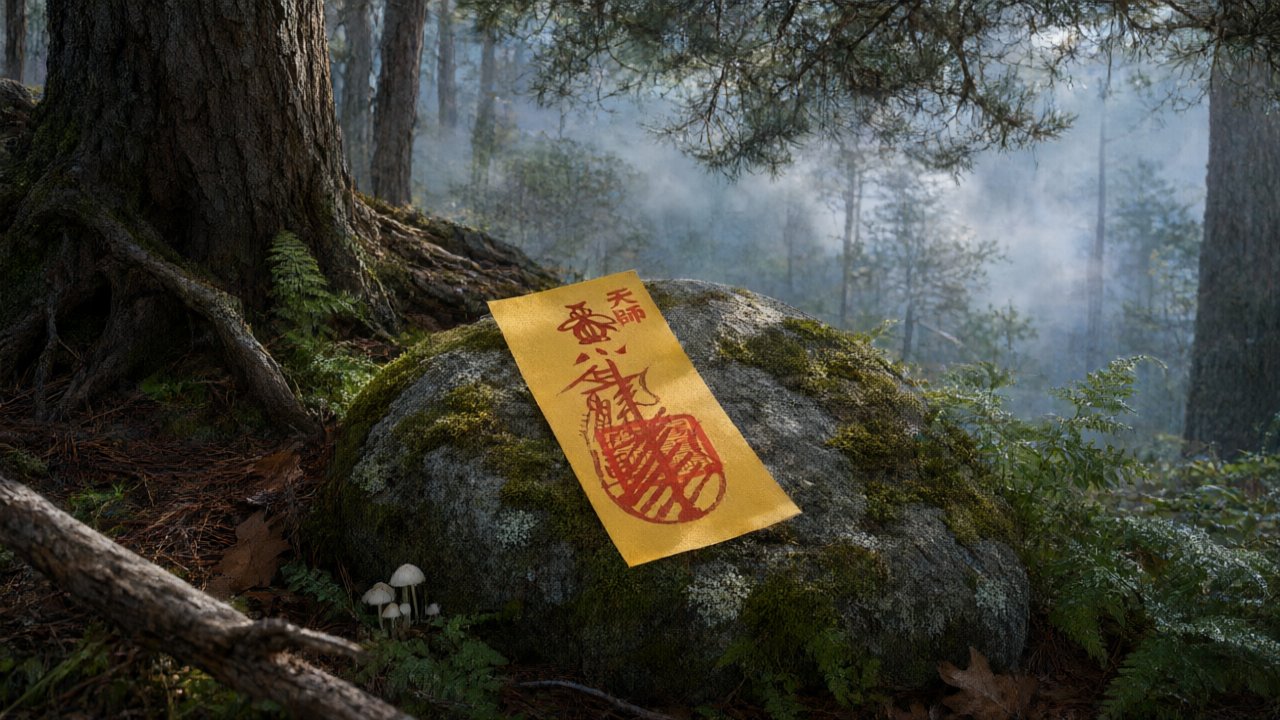
It’s 3:17 a.m. in Palo Alto. The glow of three monitors casts long shadows across a minimalist desk — carbon-fiber keyboard, matte-black thermal camera, a half-empty matcha latte gone cold. And tucked between a mechanical switch tester and a vintage *I Ching* pocket guide? A small, folded square of yellow paper, sealed with a vermilion stamp shaped like a coiled dragon. No QR code. No firmware update. Just ink, intention, and 1,800 years of unbroken transmission.
That talisman — a *Ping An Fu* (Peace Talisman) from Mt. Longhu — belongs to Leo Chen, a principal firmware architect who helped design the low-power chip inside your smartwatch. He doesn’t wear it. Doesn’t chant over it. He just *keeps it there*. “When the sprint deadline hits and my Slack is on fire,” he told us over matcha last spring, “I don’t pray. I *pause*. And I look at that little square. It reminds me: stillness isn’t empty. It’s where clarity begins.”
This isn’t a story about superstition. It’s about resonance — how ancient cultural forms quietly re-anchor modern people when the ground feels algorithmically unstable. And it’s happening everywhere: in Berlin co-working spaces, Tokyo UX studios, Vancouver acupuncture clinics, and yes — right there, next to the logic analyzer on a Silicon Valley engineer’s desk.
—
## The Dragon Stamp Isn’t a Spell — It’s a Signature
Let’s clear something up first: a Taoist talisman (*fu*) is not a magic spell. It’s not a wish-granting incantation or a cosmic coupon. In Zhengyi Daoist tradition — the lineage rooted at Mt. Longhu since the Han Dynasty — a talisman is best understood as a *consecrated contract between intention and tradition*.
Think of it like a handwritten legal document signed by someone you deeply trust — except the signer isn’t a lawyer. It’s a *Celestial Master*, a title formally held by the Zhang family for 63 generations, beginning with Zhang Daoling in 142 CE. The Celestial Masters’ mansion at Mt. Longhu was first built in 59 AD — before the Colosseum, before the Library of Alexandria’s final collapse — and has remained the spiritual and ritual center of Zhengyi Daoism ever since.
Every talisman drawn there follows strict protocols: three days of fasting and meditation, purification rites at the Yushu Temple’s ancient well (still flowing since the Tang Dynasty), and calligraphy performed only during astrologically auspicious *shichen* (two-hour windows). The ink? A blend of cinnabar, pine soot, and sacred spring water. The brush? Made from the tail hair of a white deer — a symbol of purity and longevity in Daoist cosmology.
But here’s the subtle part most miss: the power isn’t *in* the ink. It’s in the *continuity*. When Leo places his *Ping An Fu* beside his oscilloscope, he’s not invoking supernatural forces — he’s tapping into a living cultural rhythm. It’s the same rhythm that guided farmers planting rice by lunar phases in Jiangxi 1,200 years ago, and now guides a software engineer choosing *when* to step away from the screen.
That’s why anthropologists studying diasporic Taoist practice — like Dr. Mei Lin Wong at UC Berkeley — describe these talismans not as charms, but as *cultural compasses*: physical anchors that help people navigate identity, pace, and presence in fragmented, hyper-accelerated worlds.
—
## The Desk Is the New Altar
We visited Mt. Longhu last autumn during the *Qingming* (Tomb-Sweeping) preparation week. In a quiet courtyard behind the Celestial Masters’ mansion, Master Li — 67, with ink-stained fingertips and eyes that hold centuries — showed us how he draws *Gui Ren Fu* (Noble Person Talismans) for students heading abroad. “In old times,” he said, handing us a magnifying glass to see the micro-calligraphy inside a single stroke, “we placed talismans in door lintels, altar shelves, or wrapped them in red silk for travel. Today?” He smiled and tapped his temple. “Today, the altar moves. It lives where attention lives.”
And attention, in 2026, lives on desks.
Not just tech desks — though yes, many do. We’ve seen *Wu Lu Cai Shen Fu* (Five Roads Wealth Talismans) taped discreetly inside the lid of a Parisian pastry chef’s laminator; *Fu Qi He He Fu* (Harmony Between Partners Talismans) tucked into the spine of a Toronto marriage counselor’s notebook; *Tai Sui Fu* (Year-Protecting Talismans) clipped to the lanyard of a nurse in Melbourne working night shifts during the Year of the Dragon.
What unites them isn’t belief in miracles — it’s *ritual literacy*. These are people who understand that placing an intentional object in a habitual space creates what psychologists call a *behavioral cue*: a tiny, tactile nudge toward a different state of being. Like lighting a candle before journaling. Or bowing slightly before opening a laptop.
That’s why, when we asked Leo what changed after he started keeping the talisman on his desk, he didn’t say “my stock options went up.” He said: “I stopped answering Slack messages after 8 p.m. My team noticed. One even asked if I’d joined a new mindfulness app. I just showed them the talisman — and told them it stands for ‘this space is for focus, not firefighting.’”
That’s the quiet revolution: talismans aren’t changing fate. They’re helping people reclaim agency over their attention — one desk, one breath, one deliberate pause at a time.
Which brings us to you.
Because your desk — whether it’s a reclaimed oak table in Lisbon, a fold-out tray on a Tokyo subway, or a sunlit corner in Nairobi — holds more than tools. It holds your rhythm. Your thresholds. Your unspoken contracts with yourself.
So here’s a question — not about belief, but about resonance:
**What kind of talisman would your desk *quietly ask for* — if it could speak?**
Would it need grounding? Clarity? Protection from digital noise? Harmony with collaborators? Gentle boundaries? Or something else entirely?
That’s not a quiz with right answers. It’s an invitation to listen — to the space you inhabit, and the person you’re becoming within it.
At DeHuiTang, every talisman we offer is consecrated on Mt. Longhu following the Zhengyi Daoist tradition — drawn by ordained masters, purified with spring water from the Yushu Temple well, and sealed with the dragon-stamp of continuity. For those seeking authentic cultural artifacts rooted in real lineage and lived practice, our *Ping An Fu*, *Gui Ren Fu*, and *Wu Lu Cai Shen Fu* are available as physical, consecrated objects — not digital downloads, not mass-printed copies, but hand-drawn, ritually anchored pieces of living heritage.
These items are sold as cultural artifacts. Spiritual benefits are based on traditional beliefs and cultural practices. DeHuiTang does not guarantee specific outcomes.
—
### FAQ
**Q: Do I need to be Taoist to use a talisman?**
A: No. Talismans have long been used across cultures as expressions of intention and respect for tradition — much like lighting a candle in a cathedral without being Christian, or wearing a hamsa hand without practicing Judaism. What matters is sincerity, not doctrine.
**Q: How do I care for a physical talisman?**
A: Keep it clean and dry, away from direct sunlight or moisture. Many place it in a frame, tuck it in a book, or keep it in a small pouch. Traditionally, talismans are renewed annually — especially *Tai Sui Fu*, which aligns with the lunar calendar’s shifting celestial energies.
—
### Cultural Disclaimer
> These items are sold as cultural artifacts. Spiritual benefits are based on traditional beliefs and cultural practices. DeHuiTang does not guarantee specific outcomes.
Frequently Asked Questions
What is a Taoist talisman, and how is it different from a 'lucky charm'?
In Zhengyi Daoist tradition, a talisman (fu) is a consecrated paper inscription — not a magical charm or good-luck token. It’s created through disciplined ritual: fasting, purification, precise calligraphy using sacred ink and materials, and astrological timing. Its significance lies in cultural continuity and intentional presence, not supernatural guarantees. At DeHuiTang, each talisman is drawn by ordained masters at Mt. Longhu — a practice unbroken for over 1,800 years — serving as a quiet anchor for focus, reflection, or personal rhythm.
Do I need to believe in Taoism to use a talisman respectfully?
No. Many people — engineers, artists, healthcare workers — keep talismans as cultural compasses, not articles of faith. What matters is respectful intention: treating the talisman as a mindful object tied to tradition, discipline, and personal pause — much like lighting a candle before study or bowing before practice. At DeHuiTang, we honor this diversity: talismans are offered as expressions of heritage and human rhythm, not religious conversion or doctrinal adherence.
Where should I place a talisman, and does it need special care?
Traditionally, talismans are placed where attention naturally rests — on a desk, beside a workstation, or near a bedside — not hidden or discarded. No rituals or upkeep are required, though many choose to replace them annually (e.g., with a new Tai Sui Fu for the lunar year) as a gentle reset. Avoid moisture or direct sunlight. Think of it less like a sacred relic needing worship, and more like a well-crafted tool: its value emerges through consistent, thoughtful presence in your daily space.
Are all talismans the same, or do they serve different purposes?
Talismans vary by traditional function — such as Ping An Fu (Peace), Qu Xie Fu (Protection), or Gui Ren Fu (Noble Person) — each rooted in centuries-old liturgical forms. These distinctions reflect classical Daoist cosmology and ethical orientation, not personalized fortune-telling. At DeHuiTang, we offer only those authenticated by Mt. Longhu’s lineage, drawn with ritual precision. Choosing one is less about ‘what you want’ and more about what resonance supports your current life rhythm — clarity, stability, harmony, or grounded presence.
Related Taoist Instruments
About DeHuiTang — This article is part of our Taoist cultural education series. Explore more authentic Taoist knowledge, Feng Shui wisdom, and destiny philosophy at our main site.