You Set Intentions on the Wrong Day — Taoism Knows When
You opened your journal on November 18, 2026. Wrote your goals in bold ink. Lit a candle. Said the words aloud — “This is my year.” But three weeks later, momentum fizzles. A project stalls. A conversation turns cold. You feel like you’re pushing against fog.
It’s not your discipline. It’s not your belief. It’s not even bad luck.
It’s the day.
Western self-help teaches that intention-setting works best when you’re “in flow” — emotionally charged, clear-minded, and ready to act. So you pick today, because today feels right. You choose Monday for fresh starts, New Moon for new beginnings, or your birthday for personal resonance. You trust your gut — and your gut is wrong.
Because in the Zhengyi Daoist tradition of Mt. Longhu — where the Celestial Masters have consecrated talismans since the Eastern Han Dynasty — intention is not a mental act. It is an energetic alignment with celestial timing. And the most powerful alignment doesn’t happen on the New Moon. It doesn’t happen on your birthday. It happens on lunar calendar days governed by specific heavenly stems and earthly branches — dates that shift every year, every month, every day.
If you set intentions on a day ruled by Yin Wood while your personal Bazi chart shows Fire deficiency, your energy won’t anchor. If you launch a business on a Sha Qi-heavy day — one traditionally regarded in the Yangzhai Sanyao (《陽宅三要》) as unstable for foundation work — your plans may scatter before they settle. This isn’t superstition. It’s energetic architecture.
And right now — on this very day, November 18, 2026 — you’re standing at a quiet threshold: the 10th day of the 10th lunar month. Not a festival. Not a holiday. Just a precise coordinate in the Taoist lunar calendar — one that carries unique qualities for intention work… if you know how to read it.
Why Your “Perfect Intention Day” Might Be Energetically Unstable
Let’s pause the self-help script for a moment.
Think about how deeply Western frameworks shape our spiritual habits. We’re taught: Clarity + Consistency = Manifestation. So we schedule intention-setting like a meeting — same time, same place, same ritual. We track progress in apps. We celebrate wins on social media. We measure success by external outcomes: money raised, relationships formed, promotions earned.
Taoist metaphysics offers a radically different premise: Manifestation is not linear cause-and-effect. It is resonance. And resonance depends on three things — none of which appear in your planner:
- Your personal energetic signature — encoded in your Bazi (Eight Characters) birth chart, which maps your elemental strengths and weaknesses;
- The ambient qi of the day, determined by the interplay of the Ten Heavenly Stems and Twelve Earthly Branches — a celestial rhythm recorded in texts like the Baopuzi and practiced daily at Mt. Longhu’s temples since Zhang Daoling founded the Zhengyi lineage in 142 CE;
- The directional flow of qi in your environment, shaped by feng shui principles like Shan Shui (mountain-water) orientation and San Yuan (Three Periods) timing.
When these three are misaligned, intention doesn’t fail — it deflects. Like whispering into a canyon facing the wrong way: the sound travels, but no echo returns.
A real example from Mt. Longhu’s archival records illustrates this: In the late Ming Dynasty, a scholar named Li Wenxian composed 47 poems of aspiration during the 1st–3rd days of every lunar month — believing those were universally auspicious. Yet his career remained stagnant for 12 years. Only after consulting a Celestial Master who cross-referenced Li’s Bazi with the Lun Ji (lunar almanac) did he learn that his personal Water element was being overpowered by Earth-heavy days — days that, for him, blocked clarity and initiative. He shifted his practice to the 15th–17th days of months governed by Metal and Water stems, and within two years was appointed magistrate of Jiangxi.
This wasn’t magic. It was timing intelligence — a system refined over 1,800 years, rooted not in psychology, but in observation: of stars, seasons, tides, and the subtle shifts in human vitality across lunar cycles.
The Taoist Lunar Calendar Isn’t a “Chinese Version” of Your Planner — It’s a Living Qi Map
Most people think of the lunar calendar as a cultural relic — a backdrop for festivals like Mid-Autumn or Lunar New Year. But for practitioners of Zhengyi Daoism, it’s something far more functional: a dynamic qi map of celestial influence.
Unlike the Gregorian calendar — which divides time into equal, mechanical units — the Taoist lunar calendar reflects actual astronomical events: moon phases, solar terms (Jie Qi), and the cyclical rise and fall of yin-yang dominance. Each day is assigned a unique combination of a Heavenly Stem (e.g., Jia, Yi, Bing) and an Earthly Branch (e.g., Zi, Chou, Yin), forming a 60-year repeating cycle. These pairings don’t just name days — they qualify them.
Handcrafted Cupronickel Ten-Thousand Names Tablet Pendant | Wan Shen Hui Daoist Bagua Exorcism Talisman Necklace
万神讳项链,白铜精制,银金双色。吊坠为令牌/碑形,上承金焰拱券、嵌红宝石,中央嵌描金八卦太极,牌面满布阴刻「万神讳」诸神秘讳与符字。「万神讳」总摄万神名讳,为道教著名伏魔驱邪之秘讳,传统上被视为
Mt. Longhu Celestial Master Consecrated Peace & Protection Talisman (Daoist Safeguard Fu)
Peace is the highest spiritual frequency. The Peace Talisman carries 1,800 years of Taoist protec
For instance:
– A Bing Wu day (Fire-Fire) is considered strong for action, visibility, and leadership — ideal for launching public-facing projects.
– A Gui Chou day (Water-Earth) is stable and grounding — excellent for signing contracts, buying property, or beginning long-term studies.
– A Xin You day (Metal-Metal) supports precision, boundaries, and protection — perfect for setting limits, releasing attachments, or consecrating sacred objects.
November 18, 2026 — the 10th day of the 10th lunar month — falls under the stem-branch combination Ren Xu (Water-Dog). In the Yangzhai Sanyao, Ren Xu days are described as “qi settling like mist over still water — calm on the surface, deep currents below.” They are not days for explosive declarations or grand launches. They are days for deep anchoring: for writing intentions that require patience, endurance, and quiet resilience. For intentions tied to safety, continuity, emotional stability, or spiritual safeguarding — this is your window.
That’s why the Ren Xu day is especially aligned with the Ping An Fu (Peace Talisman), whose traditional function is not to attract, but to contain — to hold space, prevent leakage, and stabilize the wei qi field. It’s why Celestial Masters at Mt. Longhu historically performed kaiguang (eye-opening) rituals for Peace Talismans on Ren Xu and Gui Hai days — not because they’re “lucky,” but because their qi quality matches the talisman’s purpose.
This is not astrology as prediction. It’s qi calibration — matching your inner rhythm to the outer sky.
3 Actionable Ways to Align Your Intentions With Taoist Lunar Timing (Starting Today)
You don’t need to memorize the 60-year cycle or calculate your Bazi chart to begin working with this wisdom. Here are three concrete, immediately usable practices — grounded in documented Zhengyi custom and designed for modern life:
1. Use the “Three-Day Anchor Window” — Not Just the New Moon
Forget waiting for the New Moon. Instead, identify the three most stable days each lunar month — typically the 10th, 15th, and 26th — and use them as your primary intention-setting anchors. Why these?
– The 10th day (Ren Xu, as today) is classically associated with foundation reinforcement — a day to fortify what already exists, seal vulnerabilities, and establish boundaries.
– The 15th day, full moon, is Yin-Yang equilibrium — ideal for intentions requiring balance: healing, reconciliation, integration.
– The 26th day, nearing the end of the lunar cycle, is Qi consolidation — perfect for reviewing, refining, and preparing for the next cycle’s launch.
Start simple: On November 18 (today), write one sentence of intention focused on peace, protection, or stability. Not “I will earn $10K” — but “I anchor my home in calm. I protect my energy from unseen drains.” Keep it elemental. Keep it quiet.
2. Cross-Check Your Birth Stem With the Day’s Stem
Every person is born under a specific Heavenly Stem — the first character of their Bazi year pillar. You can find yours easily: look up your Chinese zodiac year (e.g., 1990 = Geng Wu, so Stem = Geng; 1991 = Xin Wei, Stem = Xin). Then check today’s stem: Ren.
In Taoist elemental theory, Ren (Yang Water) harmonizes with Geng (Yang Metal) — metal produces water — making this an especially supportive day for those born in Geng years (1930, 1990, 2050). For Jia (Wood) years, Ren Water nourishes Wood — also favorable. For Bing (Fire) years, Water controls Fire — proceed with extra grounding (e.g., light incense, wear blue/black, sit near water).
No calculation needed? Use this rule of thumb: If your birth stem is Water, Metal, or Wood, today strengthens your intention. If it’s Fire or Earth, add a stabilizing ritual — like placing a brass gourd (symbol of containment) beside your written intention.
3. Activate With a “Qi Seal” Ritual — No Altar Required
You don’t need incense, candles, or temple access. What you do need is intentional containment.
Here’s the Zhengyi-inspired method used by disciples at Mt. Longhu for centuries:
1. Write your intention clearly on clean paper — no edits, no erasures.
2. Fold it three times, clockwise — symbolizing Heaven, Earth, and Humanity (San Cai).
3. Place it inside a small red envelope (red signifies protective yang qi).
4. Hold the envelope in both hands over your lower Dantian (just below the navel) for 60 seconds, breathing slowly.
5. Say aloud: “This intention is held in stillness. It flows only where qi allows.”
That’s it. This isn’t magic. It’s neuro-energetic anchoring — using gesture, breath, and symbolic language to signal to your nervous system: This matters. This is contained. This is aligned.
Do this today — on Ren Xu, the 10th day of the 10th lunar month — and feel the difference in how your intention settles in your body.
Why the Mt. Longhu Celestial Master Consecrated Peace & Protection Talisman (Daoist Safeguard Fu) Is the Perfect Companion for This Work
All of this — the lunar timing, the stem-branch alignment, the qi-sealing ritual — points toward one truth: Intention without energetic containment is like lighting a candle in a storm.
That’s where the Mt. Longhu Celestial Master Consecrated Peace & Protection Talisman (Daoist Safeguard Fu) enters not as decoration, but as infrastructure.
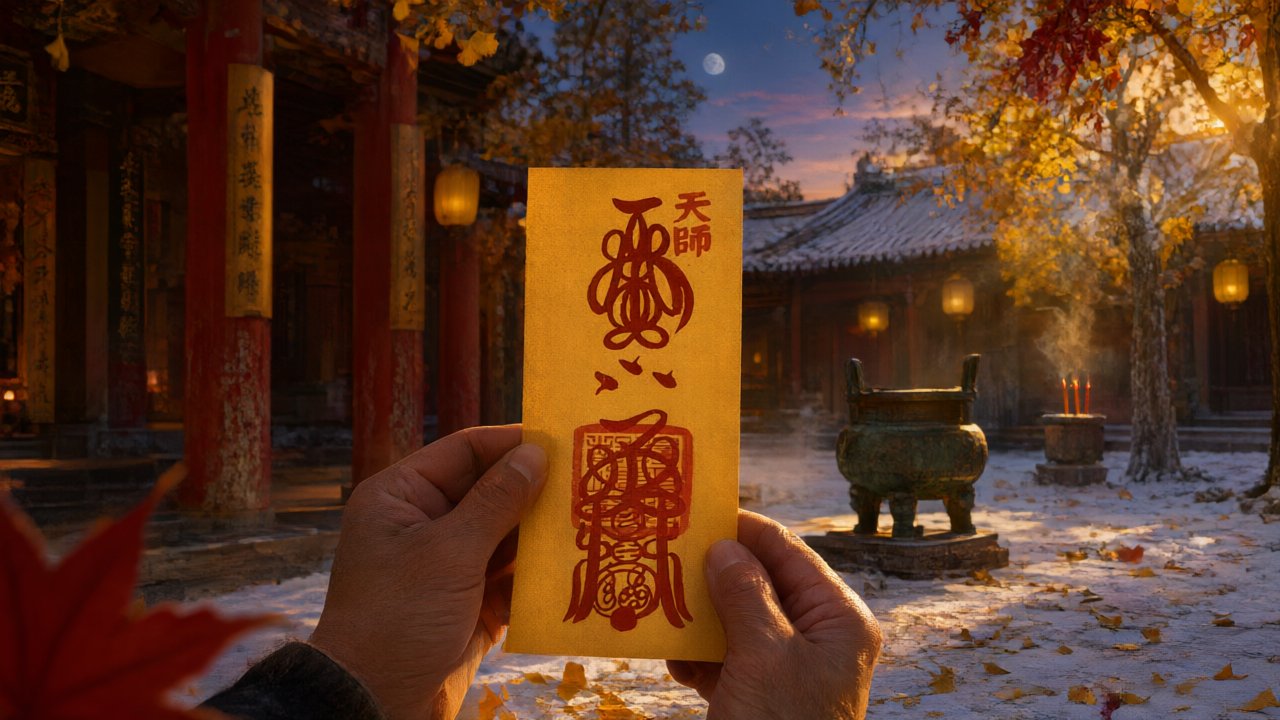
This talisman is not generic. It is drawn on Xuan paper using cinnabar ink, inscribed with characters from the Qingjing Jing (Classic of Clarity and Stillness), and consecrated through kaiguang rites performed by ordained Zhengyi priests at the Tian Shi Fu (Celestial Master Mansion) on Mt. Longhu — the same mountain where Zhang Daoling received the Ling Bao scriptures in 142 CE.
Its documented conventional function is precise: to stabilize the wei qi field, ward off Sha Qi (scattered or harmful energy), and create a boundary of stillness around the bearer — exactly what the Ren Xu day energetically supports.
So when you set your intention today — “I anchor my home in calm. I protect my energy from unseen drains.” — the talisman becomes its physical counterpart. Worn as a pendant, placed in your wallet, or kept in your bedroom drawer, it acts as a resonance anchor, reinforcing the qi signature you’ve just aligned with.
It does not replace your effort. It does not guarantee outcomes. What it does is hold the frequency — so your intention doesn’t leak, scatter, or get overwritten by ambient noise.
For those seeking authentic spiritual tools rooted in unbroken practice, Dehui Hall offers the Mt. Longhu Celestial Master Consecrated Peace & Protection Talisman (Daoist Safeguard Fu) — consecrated in accordance with the seasonal rhythms of the Taoist lunar calendar, and available with full lineage documentation.
If you’re drawn to deepen this practice, consider pairing it with the Wu Lu Cai Shen Fu (Five Roads Wealth Talisman), whose activation is traditionally timed to Bing Wu or Ding Si days — the next optimal window for abundance work opens on December 3, 2026 (Bing Wu day, 15th lunar day of the 11th month).
In Closing: Your Calendar Is Already Speaking — Are You Listening?
You didn’t fail at manifestation. You were speaking into silence — not because the universe wasn’t listening, but because you weren’t tuned to its frequency.
The Taoist lunar calendar isn’t an alternative to your planner. It’s the operating system beneath it — the unseen code that determines whether your intentions land, linger, or dissolve.
Today — November 18, 2026, the 10th day of the 10th lunar month — is not a festival. It is not a holiday. It is a Ren Xu day: Water-Dog, mist-on-still-water, deep-currents-beneath-calm. A day for anchoring. For safeguarding. For peace that holds firm.
Take one quiet minute. Write one grounded sentence. Seal it. And let the mountain’s ancient rhythm carry it forward.
Taoist talismans are sacred spiritual tools rooted in 1,800 years of tradition. Their power comes from sincere belief and the consecration rituals of ordained priests. Results vary by individual — approach with an open heart and respectful intention.
Further Reading & Cultural Context
- Taoism on Wikipedia — Overview of Taoist philosophy, history, and practices
- Mid-Autumn Festival traditions — History and cultural significance of the Mid-Autumn Festival
FAQ
Q: Do I need to be Chinese or Buddhist to use Taoist talismans?
A: No. Taoist talismans are spiritual tools, not religious membership cards. They’ve been respectfully used for centuries by seekers of all backgrounds — from Korean scholars to Southeast Asian merchants — as aids for energetic alignment and intention support.
Q: Can I use the talisman alongside other spiritual practices like crystals or tarot?
A: Yes. The Ping An Fu is designed to stabilize and contain energy — it complements rather than conflicts with other modalities. Many practitioners place it beside their tarot deck or crystal grid to strengthen the field of focus.
Q: How do I know if today’s lunar timing applies to me?
A: All lunar days carry general qi qualities, but their effect deepens when cross-referenced with your Bazi birth chart. A free Bazi calculator is available on our main site — enter your birth date, time, and location to see your elemental pillars and optimal timing windows.

Go Deeper
- BaZi Chart Reading — free, takes about two minutes: read your Four Pillars chart for this year
- If you want the physical remedy behind this article, browse our consecrated talismans and feng shui pieces.
Frequently Asked Questions
Do I need to be Chinese or Buddhist to use Taoist talismans?
No. Taoist talismans are spiritual tools, not religious membership cards. They’ve been respectfully used for centuries by seekers of all backgrounds — from Korean scholars to Southeast Asian merchants — as aids for energetic alignment and intention support.
Can I use the talisman alongside other spiritual practices like crystals or tarot?
Yes. The Ping An Fu is designed to stabilize and contain energy — it complements rather than conflicts with other modalities. Many practitioners place it beside their tarot deck or crystal grid to strengthen the field of focus.
Related Taoist Instruments
About DeHuiTang — This article is part of our Taoist cultural education series. Explore more authentic Taoist knowledge, Feng Shui wisdom, and destiny philosophy at our main site.