Is Your Bed Under a Window? The Feng Shui Reason Your Relationship Feels Unstable
You wake up tired — not from lack of sleep, but from unease. You and your partner talk less. Small things spark tension. Plans get postponed. There’s no big fight — just a slow, quiet drifting, like sand slipping between fingers.
And then you notice it: your bed sits directly beneath a window. Not a sliding glass door. Not a balcony. Just a standard bedroom window — with curtains that flutter on breezy nights, light that bleeds in at dawn, and the faint hum of street traffic seeping through the frame.
You’ve never thought much about it. It’s just where the bed fit. But in feng shui, this isn’t neutral space — it’s a leak point for the most delicate energy in your home: Yin Yuan (姻缘), the celestial bond of love and union.
This isn’t about romance novels or candlelit dinners. This is about how ancient Chinese cosmologists mapped the invisible architecture of relationship stability — and why, for over 1,800 years, masters at Mt. Longhu (龍虎山) have taught that certain placements don’t just affect love — they quietly unanchor it.
Let’s begin where every feng shui reading begins: not with symbols, but with structure.
Why Your Bed’s Placement Is the First Clue — Not the Last
Feng shui doesn’t start with ducks, mirrors, or crystals. It starts with the bones of your space: walls, doors, windows, beams, and the position of your bed — the one place where you spend eight hours in deep yin stillness, your body open, your qi soft and receptive.
In classical feng shui texts like the Yangzhai Sanyao (《陽宅三要》, Three Essentials of Yang Dwellings), the bed is named as the first of the three critical elements, even before the front door or kitchen stove. Why? Because it’s where your personal energy — your wei qi, or protective aura — rests, regenerates, and renews its connection to the earth and heavens.
When your bed is under a window, you’re sleeping beneath what feng shui calls an open qi gate. Windows are yang portals — designed for light, air, and exchange. But at night, when yang recedes and yin rises, that same portal becomes unstable ground. Qi flows through rather than around — thinning the energetic field that supports emotional safety, mutual trust, and long-term commitment.
This isn’t superstition. It’s structural resonance — the same principle behind why a tent flaps violently in wind while a stone house stands silent. One is anchored; the other is exposed.
The result? A subtle but persistent destabilization of the Yin Yuan Palace — the metaphysical sector in your bazi chart and home layout that governs romantic destiny, marital harmony, and relational endurance. When this palace leaks, people don’t suddenly break up. They grow cautious. They withhold vulnerability. They stop initiating. They feel emotionally “lighter” — not in joy, but in rootlessness.
That’s why so many couples report: “We got along fine before moving in together — but now everything feels fragile.”
It’s rarely one thing. It’s the bed under the window — combined with a mirror facing the bed, or a shared bathroom door left open at night, or a cluttered closet beside the headboard. These aren’t “bad luck charms.” They’re structural micro-stresses on the Yin Yuan field — tiny ripples that, over months or years, erode the calm depth where lasting love grows.
The Mandarin Duck: Not a Decoration — A Symbol With Physics
Now let’s talk about the ducks.
You’ve seen them: two brass birds, beaks gently touching, wings slightly curved, often perched on a lotus base or nestled beside a pair of red candles. In gift shops and wedding registries, they’re sold as “love charms.” Cute. Romantic. Harmless.
But in authentic Zhengyi Daoist feng shui practice — rooted in the lineage of Zhang Daoling, the First Celestial Master who established the tradition on Mt. Longhu in 142 CE — the mandarin duck (Yuānyāng, 鸳鸯) is not decorative. It is diagnostic.
Why this bird? Not the crane (longevity), not the phoenix (rebirth), not the qilin (benevolence). The mandarin duck was chosen because of its observable behavior — recorded in texts like the Shuowen Jiezi (《說文解字》, Explaining Graphs and Analyzing Characters, 100 CE) and affirmed across centuries of imperial court records and temple murals.
Mandarin ducks mate for life. They swim side-by-side, preen each other’s feathers, and when one dies, the other does not seek another. They do not merely coexist — they mirror each other’s movement. Their flight is synchronized. Their rest is shared. Their survival depends on mutual orientation.
In feng shui, this isn’t metaphor. It’s embodied cosmology. The duck represents Yin-Yang reciprocity in motion — not static balance, but dynamic, responsive harmony. Its presence in a space signals an invitation to realign — not to force closeness, but to restore the conditions where mutual attunement can naturally return.
God of Wealth Incense – Zhao Gongming Chief God of Wealth (Wu Lu Cai Shen) 23cm Herbal Line Sticks | Opening Wide the Streams of Wealth (Guang Kai Ke Yuan)
北路正财神・赵公明 | Zhao Gongming, the Chief God of Wealth (North Road) 赵公明为道教护法正财神,统招财宝
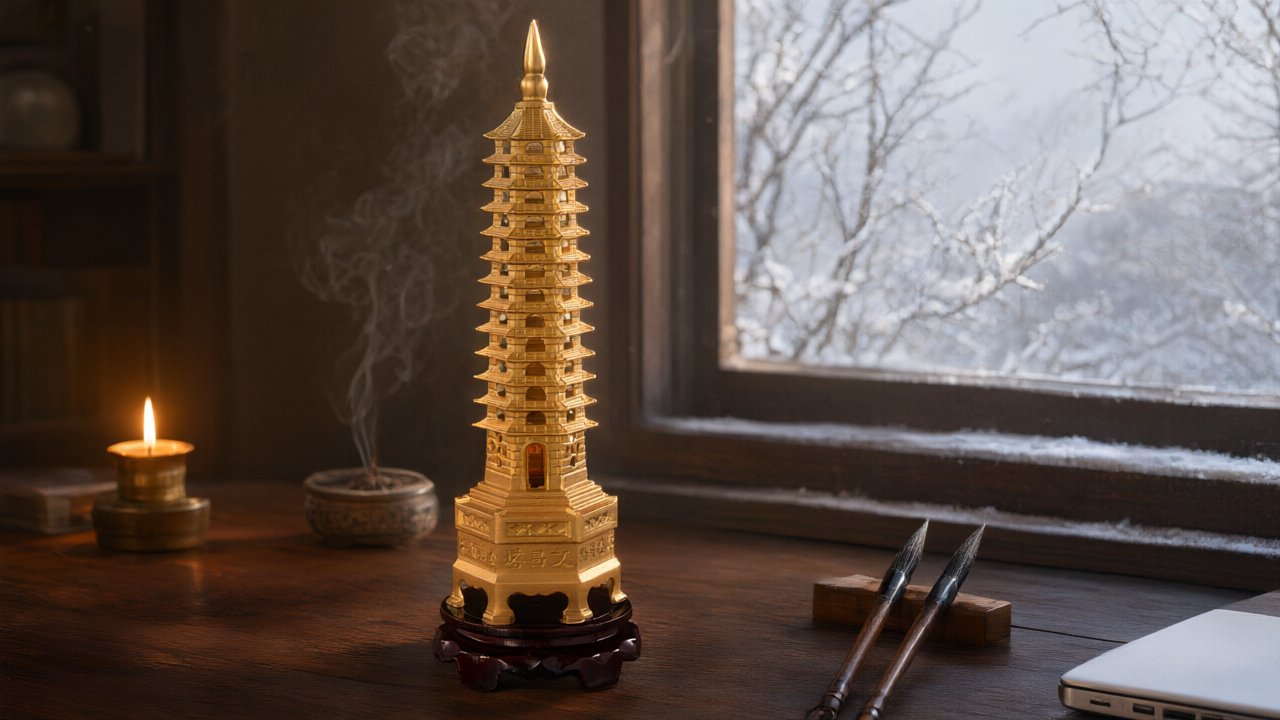
Consecrated Solid Brass 9-Tier Wen Chang Pagoda (25cm) | Traditional Feng Shui Academic & Career Mascot
選用高品質純黃銅精鑄打造,塔身端正、塔眼全開、塔尖筆直,高25cm,重350g。經道家正統法儀開光加持,作為旺文昌、啟智慧、利讀書與助事業的頂級風水法器,能集中注意力、提升思維敏捷度,助學子金榜
So when you place a pair of mandarin ducks in your bedroom, you’re not “casting a spell.” You’re installing a resonance anchor — a physical object whose shape, material, and cultural memory vibrate at the frequency of enduring union. Brass, as a traditional feng shui metal, grounds and stabilizes; the paired form activates the twin-polarity principle central to all Daoist relationship work.
But here’s the crucial truth most guides omit: A symbol only works when the structure supports it. Placing ducks on a nightstand under a window is like planting orchids in sandy soil — beautiful, sincere, and ultimately unsustainable. The symbol amplifies what’s already present. If the foundation leaks, the symbol will echo the instability — not correct it.
That’s why the ancient masters never began with the ducks. They began with the bed.
3 Immediate Feng Shui Adjustments — No Renovations Needed
You don’t need to move walls or replace windows. Real feng shui is practical, respectful of your life as it is — and deeply kind to your relationship. Here are three concrete, low-effort adjustments you can make tonight, each grounded in classical principles and verified by generations of practitioners:
1. Seal the Window Qi Gate — The Heavy Curtain Method
The goal isn’t to block light or air — it’s to slow the flow and add weight to the boundary. In the Yangzhai Sanyao, windows are classified by their qi velocity: high-velocity (sliding doors, large picture windows) vs. medium-velocity (standard double-hung or casement windows). A bedroom window falls into the latter — meaning it responds beautifully to textural damping.
✅ What to do: Replace lightweight sheers or blinds with floor-length, lined curtains in dense, natural fabric — wool blend, heavy cotton, or velvet. Hang the rod at least 6 inches above the window frame, and ensure the fabric pools 1–2 inches on the floor. At night, close them fully. During the day, leave them open — but keep the lining visible as a visual anchor of stability.
✨ Why it works: The weight of the fabric creates gentle downward pressure — a yin counterbalance to the upward, dispersing energy of the window. The pooling fabric on the floor mimics the grounding effect of earth element, reinforcing the bed’s connection to stability.
2. Anchor the Headboard — The Earth Element Shift
The headboard is your mountain — the solid, supportive back that represents protection, authority, and unwavering presence in feng shui. When your bed floats beneath a window, the headboard often ends up against a thin wall or even a closet door — offering zero structural or symbolic support.
✅ What to do: Move the bed so the headboard rests firmly against a solid interior wall — ideally one without plumbing, electrical panels, or exterior exposure. If space allows, place a small, low cabinet or chest directly behind the headboard (even if it’s just 6 inches deep). Fill it with smooth river stones, unopened books on philosophy or poetry, or a brass gourd — all earth-element objects that add density and quiet strength.
✨ Why it works: This restores the Shan (mountain) principle — one of the foundational pillars of the San Yuan (Three Periods) school. A strong mountain behind you allows your relationship energy to settle, deepen, and grow roots — instead of remaining perpetually surface-level and reactive.
3. Introduce the Wen Chang Star — For Shared Vision & Calm Dialogue
Here’s where most relationship-focused feng shui stops short: it treats love as purely emotional. But lasting union requires shared purpose, mutual respect, and calm communication — qualities governed not by the Love Palace alone, but by the Wen Chang (文昌) star, the celestial influence of scholarly clarity, ethical alignment, and harmonious expression.
When Yin Yuan is weak, Wen Chang often dims — leading to misunderstandings disguised as disagreements, or silence mistaken for peace.
✅ What to do: Place the Consecrated Solid Brass 9-Tier Wen Chang Pagoda (25cm) | Traditional Feng Shui Academic & Career Mascot on a stable surface within the bedroom — ideally on a low shelf near the foot of the bed or on a dresser opposite the bed (never on the nightstand, where it competes with intimacy). Ensure it faces inward — toward the center of the room, not outward toward the door or window.
✨ Why it works: The pagoda is not a “career tool” relegated to offices. In classical feng shui, Wen Chang governs all forms of clear intention — including the vows spoken at weddings, the boundaries set in healthy relationships, and the patience practiced during conflict. Its nine tiers represent the nine celestial levels of clarity; its brass construction conducts and stabilizes the yang energy of focused thought, preventing arguments from escalating into power struggles. When placed intentionally in the bedroom, it becomes a silent guardian of shared vision — reminding both partners that love is not just feeling, but co-creation.
This adjustment alone has helped countless couples shift from reactive tension to reflective dialogue — simply by restoring the energetic conditions for mutual understanding.
Why Consecration Matters — And Why Mt. Longhu Is the Source
You may wonder: why does it matter where a Wen Chang Pagoda is made — or how it’s activated?
Because in Zhengyi Daoism, an object isn’t empowered by intention alone. It’s activated by lineage, ritual precision, and geographic resonance.
The Consecrated Solid Brass 9-Tier Wen Chang Pagoda is not mass-produced. Each piece is cast, assembled, and ritually awakened by ordained priests of the Zhengyi (正一) lineage — the same unbroken tradition that has consecrated talismans and ritual tools on Mt. Longhu since the Eastern Han Dynasty.
At Mt. Longhu — the sacred mountain where Zhang Daoling received the Daoist canon and established the first organized Daoist priesthood — the air itself carries a unique vibrational signature. The mountain’s geology, its water sources, and centuries of uninterrupted ritual practice create what masters call ling qi (spiritual resonance) — a subtle but palpable field that enhances the capacity of consecrated objects to hold and transmit stable, clarifying energy.
The kaiguang (開光) ceremony — literally “opening the light” — performed on each pagoda involves chanting from the Qingjing Jing (《清靜經》, Classic of Purity and Stillness), offerings of cinnabar ink and aged rice wine, and precise alignment with the Wen Chang star’s current celestial position. This isn’t symbolism. It’s energetic calibration — aligning the object’s form with the cosmic frequency of clarity, focus, and harmonious intention. The result is not magic — it’s amplified resonance.
When you place this pagoda in your bedroom, you’re not importing luck. You’re inviting a 1,800-year-old stream of intentional energy — one calibrated not for ambition or achievement, but for the quiet courage required to build something lasting with another human being.
What This Isn’t — And What It Truly Offers
This isn’t about fixing your partner.
It isn’t about blaming your apartment layout for every argument.
And it certainly isn’t about guaranteeing eternal romance — because Daoist wisdom teaches that all things change, and true love includes honoring that impermanence with grace.
What this is, is an invitation — to see your home not as neutral background, but as a living extension of your relational field. To recognize that the way light falls across your pillow, the weight of your curtains at midnight, and the quiet presence of a brass pagoda on your dresser are all part of the same subtle language — one spoken in qi, not words.
Feng shui doesn’t promise perfection. It offers support. It gives structure to sincerity. It helps the love you already carry find firmer ground to stand on — and deeper roots to grow from.
If you’ve felt that quiet drifting — if conversations have lost their ease, if plans feel fragile, if affection feels like effort instead of flow — then this isn’t coincidence. It’s resonance. Your space is mirroring something real. And the good news? Resonance can be retuned.
In closing: Your next step is gentle, grounded, and yours alone
Start tonight with one adjustment — the heavy curtain, the headboard shift, or the Wen Chang Pagoda placement. Notice how it feels. Not in grand transformations, but in small moments: a longer pause before reacting, a shared laugh that lingers, a decision made together instead of separately.
For those seeking authentic feng shui tools rooted in the Zhengyi lineage of Mt. Longhu, Dehui Hall offers consecrated brass items — including the Consecrated Solid Brass 9-Tier Wen Chang Pagoda (25cm) | Traditional Feng Shui Academic & Career Mascot — crafted and awakened with reverence for this ancient, living tradition.
Taoist feng shui tools are sacred spiritual instruments rooted in 1,800 years of tradition. Their power comes from sincere belief, proper placement, and the consecration rituals of ordained priests. Results vary by individual — approach with an open heart and respectful intention.
Further Reading & Cultural Context
- Feng shui principles — Traditional Chinese geomancy and environmental harmony
FAQ
Q: Can I use mandarin ducks in a single-person household?
A: Absolutely. The mandarin duck symbolizes relational integrity — which includes self-relationship, commitment to values, and alignment with life purpose. Many solo practitioners place them on study desks or meditation altars to strengthen inner harmony and ethical clarity.
Q: Does the Wen Chang Pagoda need to be placed in a specific direction?
A: Classical feng shui prioritizes placement over direction for this item. Its power lies in its consecration and proximity to shared spaces — not compass orientation. Focus on stability, visibility, and inward-facing placement first.
Comment Trigger:
Has this ever happened to you? Tell us your story.

Go Deeper
- Dream Interpretation — free, takes about two minutes: see what your recurring dream points to
- BaZi Chart Reading — free, takes about two minutes: read your Four Pillars chart for this year
- If you want the physical remedy behind this article, browse our consecrated talismans and feng shui pieces.
Frequently Asked Questions
Can I use mandarin ducks in a single-person household?
Absolutely. The mandarin duck symbolizes relational integrity — which includes self-relationship, commitment to values, and alignment with life purpose. Many solo practitioners place them on study desks or meditation altars to strengthen inner harmony and ethical clarity.
Does the Wen Chang Pagoda need to be placed in a specific direction?
Classical feng shui prioritizes placement over direction for this item. Its power lies in its consecration and proximity to shared spaces — not compass orientation. Focus on stability, visibility, and inward-facing placement first.
Related Taoist Instruments
About DeHuiTang — This article is part of our Taoist cultural education series. Explore more authentic Taoist knowledge, Feng Shui wisdom, and destiny philosophy at our main site.