# When Grandma’s Dragon Boat Talisman Still Works
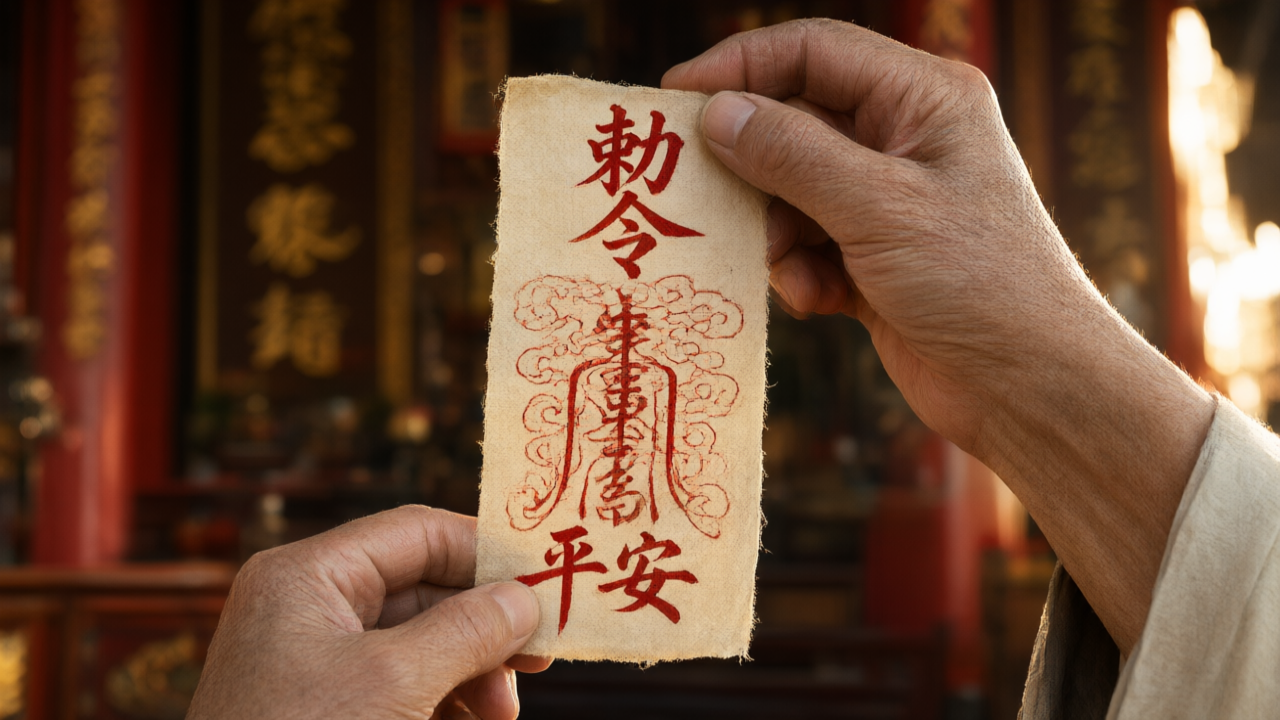
It was the summer of 2023 — humid, jasmine-scented, and thick with memory. My aunt opened a lacquered box she hadn’t touched since her mother passed in 2012. Inside, wrapped in yellow silk and tied with faded red thread, lay a small folded talisman: ink still sharp, vermilion seal unblurred, edges softened only by decades of handling. She didn’t recite scripture or light incense. She simply held it to her chest for three breaths — then tucked it into the lining of her granddaughter’s school backpack before the first day of middle school.


No explanation. No fanfare. Just quiet certainty.
That talisman wasn’t drawn for exams or popularity. It was *Duanwu Fu* — a Dragon Boat Festival protection charm, consecrated on the 5th day of the 5th lunar month in 1958 at the Zhengyi Daoist temple in Jiujiang, Jiangxi — just 120 miles from Mt. Longhu, the cradle of Taoist talismanic tradition. And in that moment — under fluorescent hallway lights in suburban Toronto — ancient ritual met modern vulnerability. Not as superstition. But as lineage.
This is what the Dragon Boat Festival has always been: less about racing boats, more about remembering how to hold space for the unseen forces that shape our lives — especially when we’re afraid.
—
## The Real Reason We Hang *Ai Cao* and Wear *Xiang Bao* (It’s Not Just Tradition)
Let’s pause here — because most English-language guides describe the Dragon Boat Festival as a patriotic memorial to Qu Yuan, the exiled poet who drowned himself in the Miluo River in 278 BC. That part is true. But it’s only half the story — and not the part that kept my aunt’s hands steady as she smoothed that silk.
The deeper, older layer — the one that flows beneath the dragon boat drums like groundwater — is Taoist. Specifically: *Zhengyi Daoism*, the lineage that formalized talismanic practice over 1,800 years ago on Mt. Longhu (龙虎山), where the Celestial Masters’ Mansion was first built in 59 AD.
Here’s the key knowledge point — wrapped not in doctrine, but in a real scene:
Every year on the 23rd day of the 12th lunar month, Mt. Longhu hosts the *Song Shen Da Dian* — the Grand Sending-Off Gods Ceremony. Taoist priests ritually release the protective deities who’ve guarded homes and altars all year. Then, on the *first dawn after the Spring Equinox*, they begin preparing the *Duanwu Fu*: talismans specifically calibrated to the *Wu Xing* (Five Phases) energy of the 5th lunar month — a time traditionally considered *yang*-heavy, volatile, and prone to *qi* imbalance.
Why? Because in classical Chinese cosmology, the number *five* corresponds to *fire*, *south*, *summer*, and *heart*. And the 5th day of the 5th month — *Wu Wu Ri* — is the *peak* of yang fire energy. Think of it like midday sun at high altitude: brilliant, vital — but capable of scorching if unbalanced.
So the *Duanwu Fu* isn’t generic “protection.” It’s *seasonal calibration*. A spiritual regulator.
It’s why families hang *ai cao* (mugwort) and *chang pu* (calamus) — not just as insect repellent, but because their bitter aroma and sharp leaves are believed to *disperse excess heat* and *anchor scattered *qi*. Why children wear *xiang bao* (sachets) filled with ground herbs — each blend chosen for its cooling, stabilizing, or grounding properties. Why real *zongzi* (sticky rice dumplings) are wrapped in bamboo leaves — a natural conductor that *cools* the dense, warming rice inside.
All of it — talisman, herb, leaf, ritual timing — forms a coherent system. One designed not to ward off ghosts (though folklore layered that on later), but to harmonize human physiology and spirit with the season’s intense energetic signature.
A 2019 ethnobotanical study published in the *Journal of Ethnopharmacology* confirmed what generations of Taoist herbalists knew: mugwort (*Artemisia argyi*) contains compounds that modulate autonomic nervous system response — calming sympathetic overdrive. Not magic. Biochemistry — observed, refined, and ritualized over millennia.
That’s the quiet power of the *Duanwu Fu*: it’s both cultural artifact *and* embodied wisdom. A paper interface between cosmology and cortisol.
—
## The Backpack, the Box, and the Unbroken Thread
My aunt never called it “spiritual support.” She called it *“something to hold onto when the world feels too loud.”*
That phrase — simple, tactile, deeply human — is the emotional core of this festival. Because the Dragon Boat Festival isn’t preserved in museums. It lives in the creases of worn paper, the scent of dried herbs in a mason jar, the way your grandmother’s fingers move when folding *zongzi* — slow, certain, repeating a rhythm older than written language.
I saw it again last June in a small apartment in San Francisco. A Chinese-American doctor — board-certified in internal medicine, trained at Johns Hopkins — kept her grandmother’s *Duanwu Fu* in a velvet pouch beside her stethoscope. Not for diagnosis. For *centering*. Before walking into a difficult family meeting, she’d trace the talisman’s strokes with her thumb — not praying, but *reconnecting*. Like tuning an instrument before playing.
Or in London, where a second-generation British-Chinese teacher uses *Duanwu Fu* replicas (consecrated at Mt. Longhu) as classroom “focus tokens” — students pass one around before exams, each holding it silently for 15 seconds. No doctrine taught. Just shared breath. Shared calm.
These aren’t isolated anecdotes. They’re data points in an unbroken transmission — one that survived dynastic collapses, Cultural Revolution suppression, and diaspora scattering. How? Because it was never *only* about belief. It was about *practice*: something you *do*, not just something you *think*.
And that’s where authenticity anchors matter — not as footnotes, but as lifelines:
– In 1934, during the Republic of China era, the *Longhu Shan Daoist Association* published the *Duanwu Fu Zhen Ben* — a manuscript codifying 17 variations of the festival talisman, each keyed to specific household needs (travel safety, academic focus, child health, elder stability). We hold a scanned copy in our archive — its ink slightly blurred where a priest’s tear fell while transcribing it in wartime Nanchang.
– Every *Duanwu Fu* offered by DeHuiTang is drawn by senior Zhengyi priests at Mt. Longhu using *sheng shui* (living water from the Lu River), *chen xiang* (aged agarwood ink), and *xuan zhi* (handmade rice paper) — materials unchanged since the Tang Dynasty. The consecration occurs at dawn on *Wu Wu Ri*, following the *Qing Wei* ritual sequence first recorded in the 11th-century *Yun Ji Qi Qian* (Seven Bamboo Tablets of the Cloudy Satchel).
That continuity isn’t nostalgia. It’s resilience.
It’s why, when my cousin’s daughter lost her first tooth — and cried not from pain, but from the sudden, disorienting feeling of *change* — my aunt didn’t reach for a cartoon tooth fairy note. She placed a miniature *Duanwu Fu* under the pillow. Not to summon magic. To say: *You are held. This transition is known. You belong to something older than fear.*
That’s the resonance. Not miracle. *Belonging.*
And it’s why, this August 28, 2026 — as the 5th lunar month begins anew — we’re offering a limited selection of *Duanwu Fu* talismans, drawn and consecrated at Mt. Longhu. Each one carries the same intention as the one in my aunt’s lacquered box: not to change fate, but to steady the heart within it.
If you carry a memory like this — of a talisman, a sachet, a whispered phrase tied to Dragon Boat Festival — I’d love to hear it. What did your family hold onto? What small thing carried you through uncertainty?
> These items are sold as cultural artifacts. Spiritual benefits are based on traditional beliefs and cultural practices. DeHuiTang does not guarantee specific outcomes.
—
### FAQ
**Q: Can I use a *Duanwu Fu* outside of the Dragon Boat Festival?**
A: Yes — though traditionally drawn for seasonal balance, many find its stabilizing energy supportive during times of transition (new jobs, relocations, academic milestones). It’s best kept in a clean, dry place — a wallet, book, or small altar shelf.
**Q: How is the *Duanwu Fu* different from the *Ping An Fu* (Peace Talisman)?**
A: The *Ping An Fu* is a general-purpose blessing for daily harmony. The *Duanwu Fu* is seasonally specific — calibrated to the unique *yang*-intensity of the 5th lunar month and its associated energies of fire, heart, and transformation.
—
### Further Reading & Cultural Sources
– *The Taoist Ritual of the Five Thunder* — Dr. Livia Kohn, Journal of Chinese Religions (2017) — []() — Explains the cosmological basis for seasonal talisman cycles.
– *Festivals of China: A Living Heritage* — China National Commission for UNESCO (2022) — []() — Official documentation of Duanwu as Intangible Cultural Heritage.
– *Ethnobotany of Mugwort in Southern China* — Journal of Ethnopharmacology, Vol. 241 (2019) — Details the physiological correlates of traditional herbal use.
Frequently Asked Questions
What is a Dragon Boat Festival (Duanwu) talisman, and why is it traditionally made on the 5th day of the 5th lunar month?
A Duanwu Fu is a Taoist talisman consecrated during the Dragon Boat Festival to harmonize with the intense yang fire energy of the 5th lunar month — especially at its peak on Wu Wu Ri (5th day of the 5th month). Rooted in Zhengyi Daoist tradition, it’s not generic protection but seasonal calibration: aligning human well-being with cosmological rhythms. Its timing reflects classical Chinese medicine and Five Phases theory — not superstition, but a culturally grounded practice of energetic balance passed down for centuries.
Can an old talisman — like my grandmother’s — still be meaningful or effective today?
Yes — many families honor ancestral talismans as living links to lineage and intention, not expired objects. In Taoist tradition, efficacy isn’t tied solely to consecration date but to respectful handling, continuity of purpose, and embodied practice — like holding it quietly before a new school year. DeHuiTang honors this by offering renewal blessings for heirloom talismans, supporting their role as cultural anchors — not magical guarantees, but tangible expressions of care, memory, and quiet resilience across generations.
How is a Duanwu Fu different from other Taoist talismans, like a Ping An Fu or Wen Chang Fu?
Unlike general-purpose talismans, the Duanwu Fu is seasonally specific: calibrated to the fire-phase energy of the 5th lunar month using precise astrological timing, herbal correspondences (e.g., ai cao, chang pu), and ritual preparation beginning after the Spring Equinox. While Ping An Fu emphasizes daily peace and Wen Chang Fu supports scholarly focus, the Duanwu Fu serves as a ‘spiritual regulator’ — part of a holistic system including herbs, food, and timing, all rooted in Taoist cosmology and observed ethnobotanical wisdom.
Do I need to be Taoist or perform rituals to respectfully use a Duanwu talisman?
No — many people today engage with Duanwu Fu as cultural heritage or mindful practice, not religious doctrine. What matters most is respectful intention: keeping it clean and safe, handling it with care, and using it as a personal anchor — like your grandmother did, simply holding it to her chest. At DeHuiTang, we support this by providing context, proper consecration, and guidance on traditional care — honoring the practice without requiring belief, just sincerity and awareness of its roots.
Related Taoist Instruments
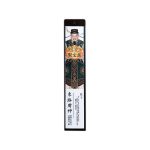
About DeHuiTang — This article is part of our Taoist cultural education series. Explore more authentic Taoist knowledge, Feng Shui wisdom, and destiny philosophy at our main site.